As candy and costumes fly off the shelves of local stores ahead of Halloween, I wanted to take a look back in time to see how Thomasvillians of yore marked the occasion. We’re all familiar with the traditions of today: yard décor that begins popping up in September, pumpkins stacked high in cardboard crates, and neighborhoods girding themselves against the oncoming hoard of small children dressed as the trendiest cartoon characters of the year. But what did we do before animatronic skeletons, bulk candy bags, and polyester princess gowns? Let’s travel back to 1892 to see how one set of enterprising young women set up their Halloween festivities.
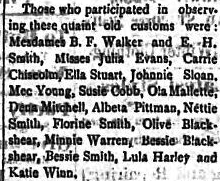
Clipping from the Daily Times-Enterprise, November 2, 1892.
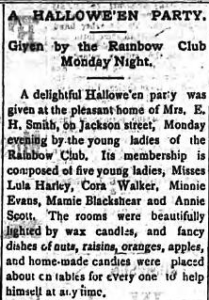
This flashback comes to us from an article published in the Daily Times-Enterprise on November 2, 1892. It describes a party held on Halloween night by the Rainbow Club, a short-lived local, women’s social club from the 1890s. At this time, the club was comprised of Lula Harley, Cora Walker, Minnie Evans, Mamie Blackshear, and Annie Scott. The party was held at the home of Mrs. E. H. Smith on Jackson Street. The article describes the setting as follows:
“The rooms were beautifully lighted by wax candles, and fancy dishes of nuts, raisins, oranges, apples, and home-made candies were placed about on tables for everyone to help himself at any time.”
Mrs. E. H. Smith was born Elizabeth “Bessie” Fondren in 1849, and following the death of her husband, Eugene Hamilton Smith Sr., moved into a house on the 300 block of East Jackson Street, likely in the area that is now home to Smile Doctors. As many of her own children ended up on the invitation list, they were likely friends of the members of the Rainbow Club, making her house and watchful eye the perfect setting for a co-ed Halloween party.
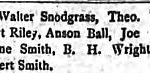
Clipping from the Daily Times-Enterprise, November 2, 1892.
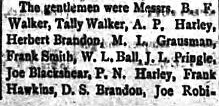
Speaking of guests, the invite list is made up of many eligible bachelors and bachelorettes of 1890s Thomasville. Familiar last names like Titus, Smith, Ball, Brandon, Pringle, Blackshear, Wright, and even Snodgrass show up on the list of fellows while the ladies’ list includes the names Mitchell, Young, Pittman, Blackshear, Smith, Chisolm, Stuart, and Winn. And Mrs. Smith was not the only chaperone to watch over the festivities. She was joined by Mrs. B. F. Walker (Anna E. Nutting, 1848-1934), the mother of two of the party guests who lived nearby on Jackson Street.
The article continues with just what the young guests did for entertainment. Several games were played, many of them featuring some amount of flirting by fortune telling. For example, the young ladies were encouraged to take some of the nuts mentioned above and put them on the grate in front of the fireplace as symbols of themselves and the man (or men) they fancied. Nuts that exploded from the heat or fell off the great signified bad boyfriends – men who would leave or “prove unfaithful” – while those that caught fire were “faithful, loving, and true.”
Clipping from the Daily Times-Enterprise, November 2, 1892.
The gentlemen guests were not left out of the romantic fortune telling games. In their case, each young man was blindfolded in turn and led to three bowls of water. If he dipped his hand in a bowl of clear water, he would marry a maid (perhaps one of the young ladies present), if he landed in the bowl of black-tinted water, he would marry a widow (perhaps Mrs. Smith was available). And if his hand slipped into a dry bowl with no water at all, he would spend his life as a confirmed bachelor. Sadly, the article did not report the results of these scientific tests.
But fortune telling wasn’t the only fun being had at the party. One of the games included an old-fashioned (or at the time, not-so-old-fashioned) apple-bobbing contest. Here called “ducking for apples,” the rules were the same then as today (pre-Covid at least), with contestants attempting to catch apples floating in a tub of water using only their teeth. Another variation involved tying the apple stem to a string and hanging it from trees while participants again tried to eat the apple without the assistance of their hands.
If the guests weren’t sick of apples by the end of the night, there was one more game they could indulge themselves in. Fortune-seekers were sent into a dark room to sit in front of a mirror and eat an apple. As guests ate their individual apple and stared into the mirror, they were supposed to see the face of their future spouse staring back at them. The article goes on to mention that this game and many like it were tried during the party.
The party drew to a close around mid-night, “the witching time,” where guests were supposed to see strange sights on their way home. Perhaps they did see strange and spooky things – or maybe it was all an illusion caused by eating too many apples.
Every so often, the museum receives a donation that includes a cookbook or recipe card. Sometimes the recipes are familiar comfort foods still served on many Thomas County tables. Others… well, let’s just say some recipes are best left in the past. This series highlights some of those recipes: from the classics to the experimental. If you try any of these recipes, successfully or not, let us know what you think!
Today’s recipe comes from Mrs. Pauline McKenzie in the book Our Favorite Recipes, a cookbook compiled as a fundraiser for the Thomasville Firemen’s Fund in 1969. The Fund set aside money for emergencies the firemen might face such as hospital bills incurred in the line of duty.
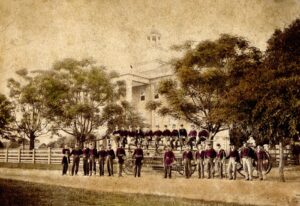
The cookbook includes a brief history of fire fighting in Thomasville starting with the first department organized in 1866.
Thomasville History Center Collections: Neptune Fire Company in Front of Thomas County Courthouse, 1868.
“The first Fire Protection Company of any type was organized in 1866 by the Mayor of Thomasville at that time, Col. Peter McGloshon [sic]. They were called the ‘Neptunes.’ For the next 30 years there were a number of men elected Chief of the organization although none of them were paid. Neither was there a Fire Station. After a particularly disastrous fire on Broad St. in 1873, there was quite a bit of dissension and misunderstanding in the organization. For the next few years four or five different men headed the Organization. Then in 1896 the ‘Neptunes’ asked the city to take over their equipment and disbanded the organization. In 1897 the first Engine House was constructed.”
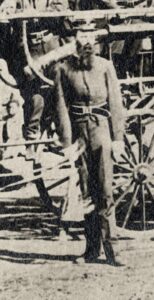
Thomasville History Center Collections: Close up of Peter Alexander Selkirk McGlashan from Neptune Fire Company Photograph, 1870.
That engine house was located on the corner of East Jackson Street and Crawford Street, just a few feet away from the current location. The two story, brick building was divided into three sections: one room for storage, one room for the fire engine, and one room for the supply wagon. A small wooden structure on the side held the extra hoses.
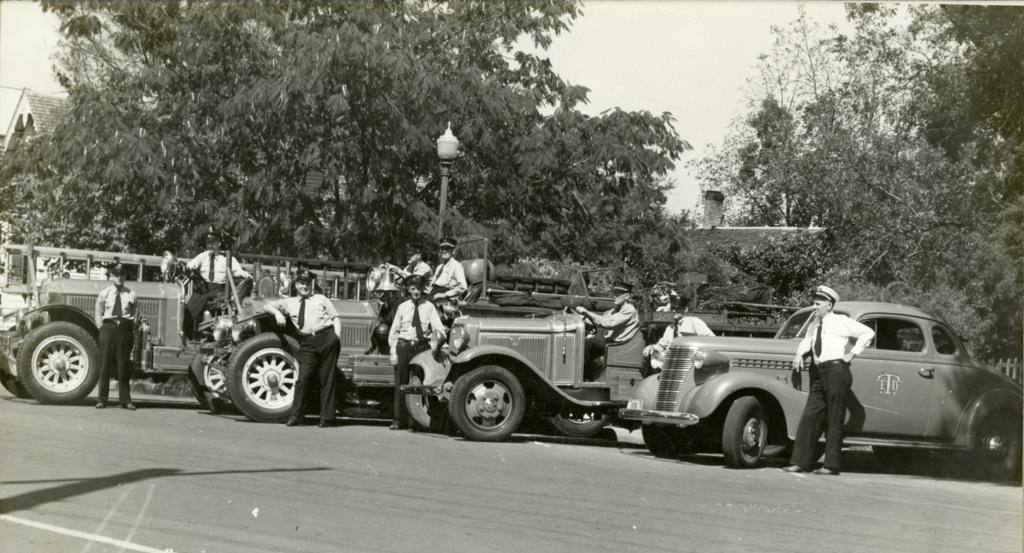
Speaking of the engine, the cookbook goes on to describe the department’s vehicles over the years.
“In February 1913, the Department got its first motor driven fire apparatus. A Type 10 American LaFrance Pumper. In 1916 – a Type 12 Pumper. In December 1916, the Department suffered its first casualty. Chief Dawkins was killed in a wreck enroute to a fire. The accident occurred under the ‘Big Oak’ of Thomasville. He collided with an auto driven by Mrs. Frank Woodward. Oscar Davis, Sr. who was later made Chief, was injured in the same wreck. Chief Porter was elected Chief to succeed Dawkins. This was in 1918. During the next 30 years there were many improvements. An alarm system was installed, two new pumpers purchased, additional men were hired, until at present we have five pumpers and one 65 foot aerial truck. In 1954 another Fire Station was completed on Bartow St. The Department now operates with the Chief I. D. Golden, an assistant Chief, and 28 men. These men work 24 hours on duty and then are off 24 hours.”
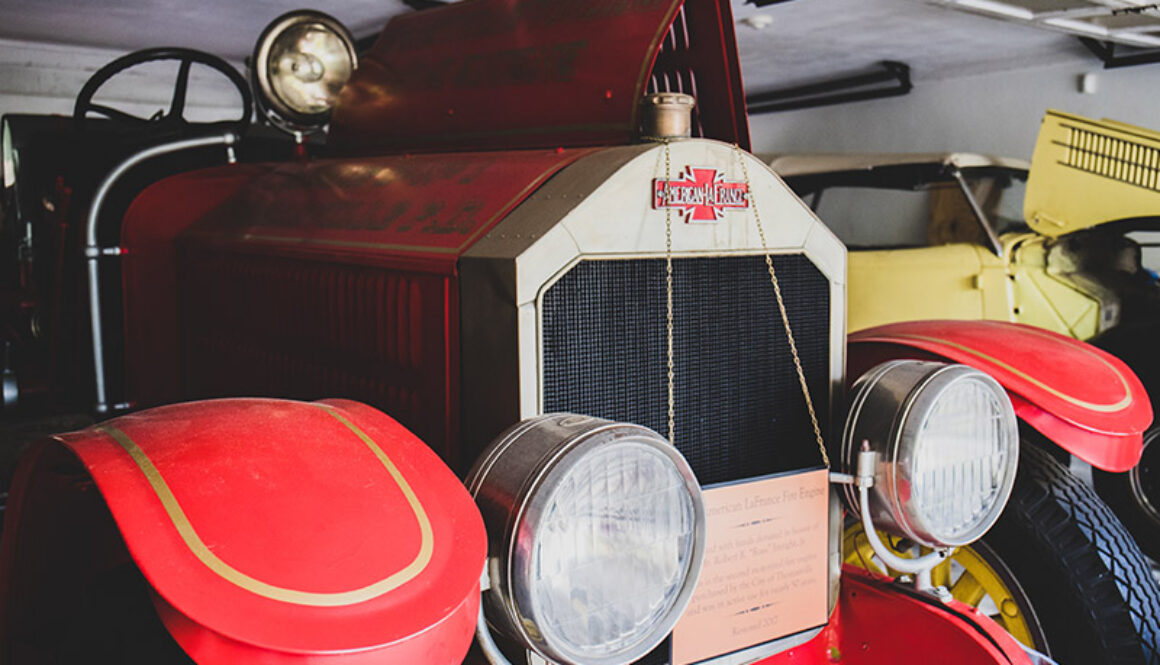
The second vehicle mentioned above, the Type 12 American LeFrance Pumper, was donated to the Thomasville History Center in 1972. In 2016, a century after it first arrived in Thomasville, the engine was restored to its original appearance and remains on display at the History Center in the Flowers Garage.
Thomasville History Center Collections: Thomasville Fire Department Engines, 1936.
If you’re interested in learning more about Thomasville’s fire department history, drop by the museum to check out our exhibit on the department and see the LeFrance in all her shining glory. For now, let’s get back to the cookbook portion of our story – a little recipe for something called “Blueberry Yum Yum”!
Blueberry Yum Yum
3 cups graham cracker crumbs
1 8-oz. package of cream cheese
½ pint whipping cream (if desired)
1 cup sugar
1 stick margarine or butter
2 No.2 cans blueberry pie filling (a 21-oz. can in 2026)
2 packages of Dream Whip
Mix cracker crumbs with butter. Butter bottom of dish well. Pat half cracker crumbs into bottom dish. Mix Dream Whip and whipping cream (if desired), according to directions on package. Set aside. Mix cream cheese with sugar and add this to Dream Whip and mix well. Put half of this on crumbs in dish. Top with blueberry pie filling. Add other half of whip and cheese. Put rest of cracker crumbs on top. Chill and serve.
Mrs. Pauline McKenzie
Our Favorite Recipes: Presented by the Thomasville Firemen’s Fund of Thomasville, Georgia 1969
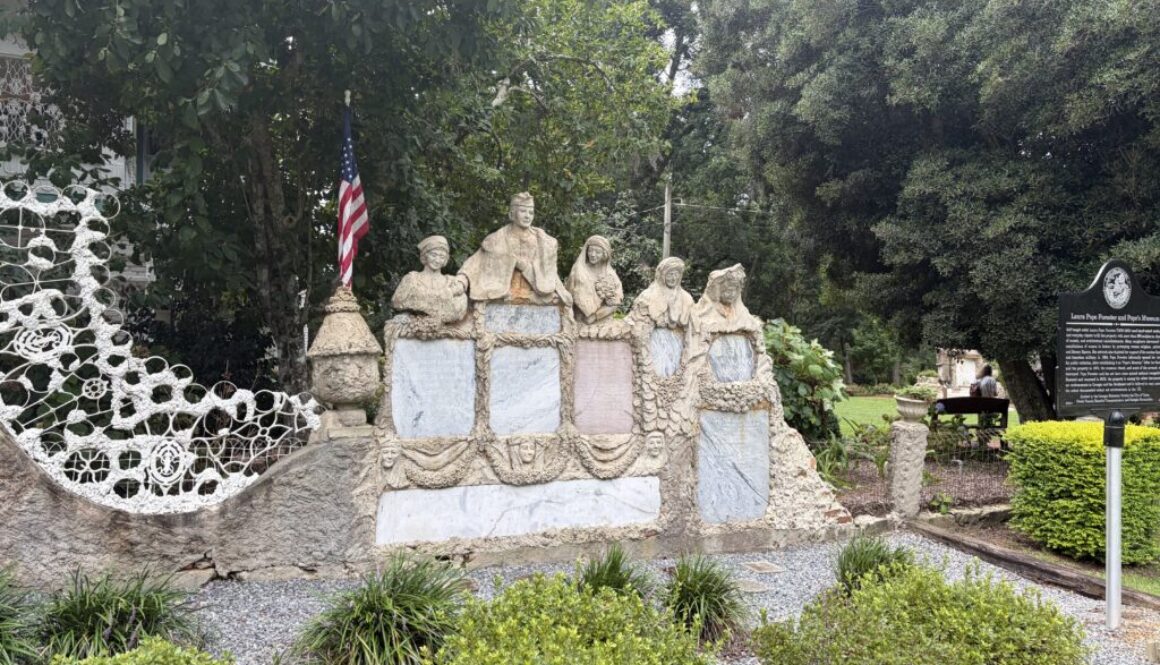
If you’ve been following along on our social media in the last few days, you may have noticed our Road Trip! series took us to Ochlocknee. Our final stop for the day was at Pope’s Museum, a site dedicated to telling the story of Laura Pope Forrester and displaying over 200 pieces of sculpture and paintings she created to honor the men and women she admired. So who was Laura Pope Forrester, and just what was so special about her as to create a museum of work?
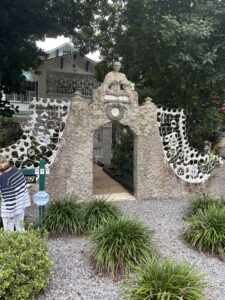
The Martha Berry Entrance Gate at Pope’s Museum – July 15, 2026
Laura Cordelia Atkinson was born on January 31, 1873 around the burgeoning town of Ochlocknee. When she was a child, her mother taught her to model clay and use berries to make paints and dyes. She attended a nearby school for her formal education which was conducted by Benjamin Hill Pope (1856-1911), a man almost twenty years her senior and her future husband whom she married in 1894. They moved into the one-story house that is now Pope’s Museum in the community of Spence (once part of Thomas County before being assigned to Grady in 1905). Ben opened a store across the street from their home while Laura took care of the house and their growing family of four.
Having a live-in maid to help with domestic tasks allowed Laura enough free time to work on her creative endeavors. Using what art skills she learned from her mother and her appreciation for history and literature, Laura’s creativity inspired her to honor the people and characters who shaped our nation; especially the women and veterans of wars.
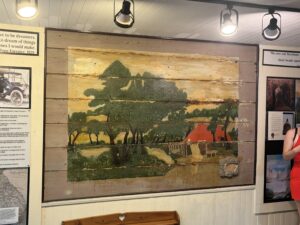
Ben died in 1911 leaving Laura with two teenage sons to raise. In 1914, she married Julian Franklin Forester (1870-1949) who took over the family store allowing Laura to return to her artistic passions. These ideas manifested into paintings that covered every wall of her home, plaster statues that dotted her interior design, architectural embellishments on her house, and over 200 statues across the family’s property.
A Mural within Pope’s Museum – July 15, 2026
By the 1920s, her two sons were grown and ready to start lives of their own, and Laura was left in the same situation of many empty nesters who find themselves in need of something to keep them busy. With her extensive art collection at hand, she opened her doors to the public, creating Pope’s Museum, one of the earliest art environments in America. Her home was photographed by several local and national magazines further promoting her business and encouraging tourists and artists to visit. Even the Library of Congress sent a photographer down to record the interior of her home for posterity.
Laura continued operating the museum until her death in 1953 at the age of 80. One of her sons took over the stewardship of the museum with community help and kept the operation going until 1975. It was sold into private ownership, and the house was rented out as apartments, complete with the landlord special – a thick layer of paint hiding away the murals that covered the walls of Laura’s home. After decades of neglect and abandonment, the current owners have revitalized the property and are working to restore as much of Laura’s art as possible.
That was where we found ourselves in the timeline of this museum’s history last Saturday. Michelle Dean, executive director, guided our group through the house while telling us about Laura’s story, the history of the home, and her efforts to restore this local treasure. Her work to recover Laura’s art and story has led her through multiple archives and even the estate sale of a major movie executive who had collected one of Laura’s paintings. What Michelle has not been able to retrieve (yet!) she has displayed in interpretive panels throughout the house.
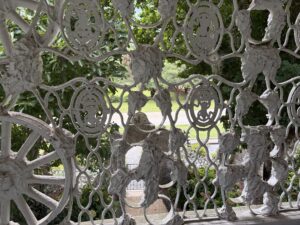
Detail of Pope’s Museum Balcony (constructed from iron sewing machine legs, wagon wheels, and concrete to symbolize the plight of women working in Georgia’s cotton mills) – July 15, 2026
Speaking of retrieving, we arrived under very special circumstances, as just the night before our trip, Michelle received four “lost” statues from Laura’s collection. The pieces had made their way out west under mysterious circumstances, but despite their unplanned journey, they have arrived home where Michelle hopes to have them restored. The works include Laura’s bust of Queen Marie of Romania, “Death With A Smile at Ninety” (part of her Footprints of Time series), part of a vase, and the form of a baby resting on its mother’s shoulder taken from her larger piece “Cupid’s Pond.” Michelle also informed us there were thirteen of Laura’s paintings arriving at the museum in the near future.
If you’re interested in learning more about this fascinating artist, her works, and her impact on her community and the world, why not take a trip to see Pope’s Museum? Can’t get out there? Michelle has worked with Bloomberg Philanthropies and their new Bloomberg Connects App to provide a free, digital tour of the museum and grounds. No matter how you get there, this place is worth the trip!
Last time, we left you on a cliff hanger: Who is “W” who wrote the original history of Boston, Georgia? And who were the “Watson and Graves” that featured so prominently in this origin story?
While unconfirmed, the most likely candidate for “W” is Shelby Walker Davis, or S.W. Davis, conveying stories from his father, John Davis. The elder Davis was a longtime Lowndes County resident who worked his way west through the years. It should be noted that at the same time “W” was writing for the Times-Enterprise in 1890, he was also writing histories for the Valdosta Times. Shelby Davis, was a lifetime “newspaper man” who later owned the Quitman Free Press and then founded the Thomasville Press. He was known professionally as S.W. later in life but also went by Walker or sometimes just “W.” Shelby’s father, who died in 1900, was a pioneer of Southwest Georgia, who even if he didn’t experience all of the stories told directly (which between the two newspaper story features almost no one could) would have heard many of them as a contemporary.
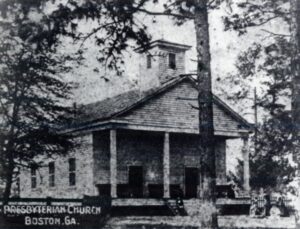
Thomasville History Center Collection: Presbyterian Church of Boston, c.1900.
Who Watson and Graves were may be more relevant, or at least Graves. Thomas Watson, the only Watson in Thomas County’s early years, moved from North Carolina in the 1830s. He did own property in the general vicinity of our Boston, but has no apparent ties to Boston, Massachusetts. Eli Graves (1803-1868), a Presbyterian minister, moved to Thomas County from Vermont when he was hired as the first pastor of First Presbyterian Church of Thomas County, located in land lot 271, the site of “Old Boston,” owned by Roderick McIntosh. He was in Thomas County no later than 1842. Most of the Graves family lived in and around Boston, Massachusetts.
The First Presbyterian Church of Thomas County, as it is named in deeds, later became known as the First Presbyterian Church of Boston. It is possible this early church, and settlement along with it, became known as “Boston” because Eli Graves named it. It is also possible that Graves and the devout Presbyterians in the area named it for another Thomas Boston – the one from Scotland, who 100 years earlier became well known as a Presbyterian theologian with a coarse demeanor, who was having a bit of a revival “moment” as a philosopher in the 1840s and 1850s.
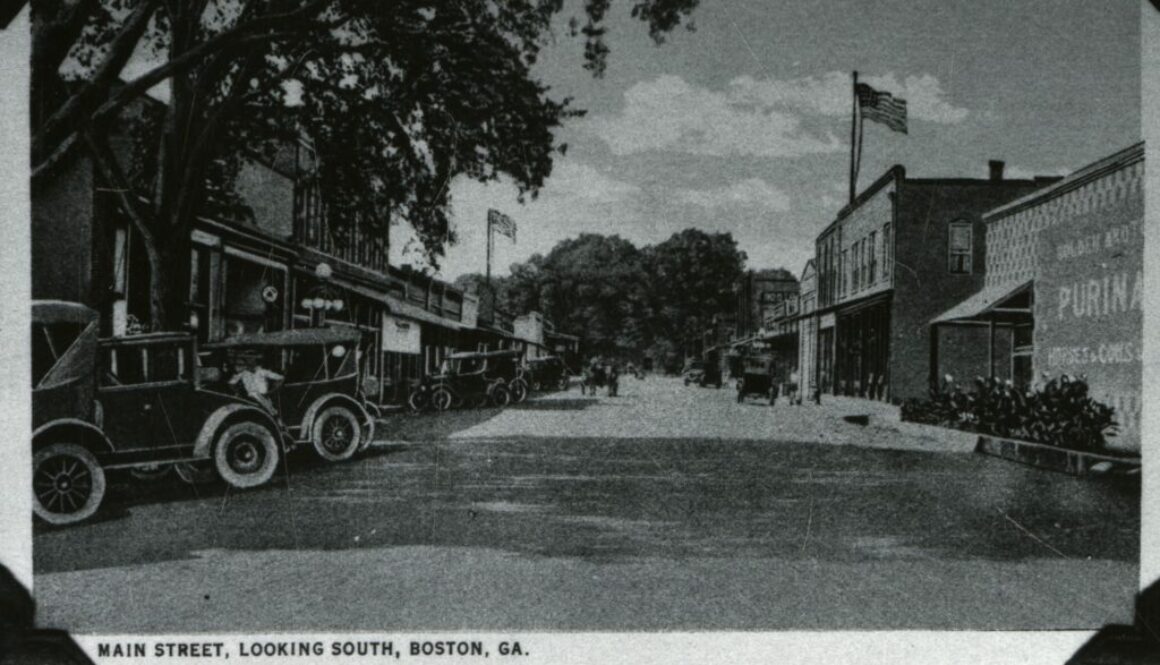
So why, by 1923, did Irwin MacIntyre think Boston was named for Thomas Mickleberry Boston? Because there was a third Boston. Not Old Boston in land lot 271 nor “New” Boston but a third Boston, 20 miles west of the location of modern-day Boston on the Brooks County bank of the Withlacoochee River just off of U.S. 84. It was founded by Thomas Mickleberry Boston around 1848 or 1849 when it was still Lowndes County. He purchased some land around a sulfur spring he found there adjacent to the Withlacoochee and built a hotel, establishing what became known as Boston’s Spring. Soon a village emerged around it, which became known as Boston.
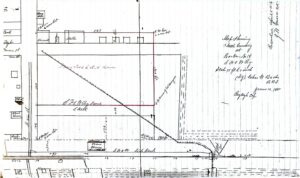
Thomasville History Center Collection: Irwin County District 13 – Land Lot 326 – Dec. 20, 1869 – Atlantic & Gulf to Daniel Horn
Moving forward to 1860, the Atlantic & Gulf Railroad was being built from Savannah to Bainbridge. Seeing the route through Quitman and Grooverville, the people of “Old Boston,” or so goes the story, believed the railroad would build through their settlement. Instead, the Atlantic and Gulf purchased right-of-way land about a mile east and half-a-mile south of where “Old” Boston was located on the far north-center of land lot 326 but enlarged to include part of land lots 327 and 365. This land was (conveniently) owned by former United States Representative James Seward. Stop Number 17 was first called “Seward’s Station” and then became known as Boston.
Soon after, Seward sold an acre to the trustees of the First Presbyterian Church of Thomas County. The story is smooth and easy and clean – they built the railroad southeast of Boston, so the whole town packed up and rolled over to new Boston! Except absolutely nothing works like that.
Deed records show that nothing really happened immediately. The land all around the depot was still owned by the Atlantic and Gulf Company – travel just a little beyond that and you’re including land that “Old Boston” people already owned. So by 1861, when they were calling the new depot stop Boston, there were three settlements named Boston along what is U.S. 84 today, all within 25 miles. “New” Boston didn’t really start to develop until 1869, when the Atlantic & Gulf Road sold all that land around the depot to Daniel Horn, who laid out and sold individual lots, and that’s really when Main Street and Jefferson Street started to become the heart of Boston. Things developed quickly and Boston, as we know it, was incorporated by Georgia in 1870.
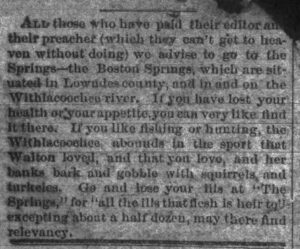
Thomasville History Center Collection: Article on Boston Springs, July 15, 1868.
The third Boston, in Brooks County on the Withlacoochee, stopped being known as Boston, or Boston Springs, or Boston’s Spring through the 1860s, and by 1870 was known as Blue Springs, and was a fairly popular summer resort and recreation area for 30-40 years.
While it’s a bit more involved, the most likely explanation for Irwin MacIntyre attributing the founding of Thomas County’s Boston to Thomas M. Boston was a good ol’ fashioned mix up over time. He typically did not cite sources but was likely told all of this by an older member of the Boston community, or one of their children. I think it may be fair speculation that it was another well-known Thomasville citizen from a Boston family – Dr. Thomas Murdoch McIntosh – that likely shared this version of the story when he was older in 1923. The story also includes a side note about how the First Presbyterian Church of Thomas County became known as “McIntosh Presbyterian Church” in honor of Roderick McIntosh. There is no known contemporary evidence that the church was known by that name, only this claim from 1923.
Finally, there is one more “missing” bit of information: Why are there no contemporary accounts of Old Boston and New Boston? The first mention of there being an “Old Boston” is the 1890 history, which used it in the context of the church being moved. But it was really around 1892, 30+ years after the fact, that the term “Old Boston” as a place came into common use. We believe it is most likely that the original Boston – which was unincorporated and did not have formalized borders until 1870 – was a farm region or district of Thomas County. Most of the known landowners owned hundreds of acres of land, that easily traversed the areas that later became known as “Old” and “New” Boston.
Only over time did memories of the location of the first church and still existing graveyard in the McIntosh lands lead to the idea of there being an Old Boston. Add in a third Boston down the road, a reverend with family from the Massachusetts Boston, and a guy named Tom Boston, and you have a recipe for confusion. An absolute, ironclad answer to how the Thomas County city got its name may not be knowable; but at least we know what it is not.
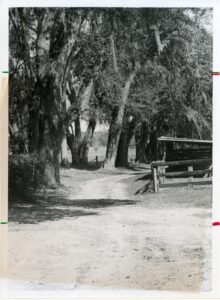
Thomasville History Center Collections: Russell Road in Boston, Georgia, 1976. 1977.34.033.
By Ephraim Rotter
The origin story of the Thomas County city of Boston, the second oldest city in the county, has been well honed since America’s Bicentennial in 1976. The telling goes something like this: A man named Thomas Boston was a frequent visitor to early Thomas County, by way of stagecoach. He (in some tellings) purchased significant land holding in the vicinity of what has been known as “Old Boston” since the late 1800s or became friends with a man who did own significant land in the vicinity of “Old Boston,” John Parramore. As settlers arrived through the 1820s and 1830s, possibly as early as 1831 or maybe as late as 1839,the settlement located off of Sally Road today at the Russell Farm was named Boston, either in honor of Thomas Boston as a local landowner, or in celebration of his frequent visits to his good friend John Parramore, who the story tells us had a stagecoach stop in the vicinity of Old Boston. But is this version of events accurate?
Several months ago, the History Center received a request from researchers in that other Boston – the Massachusetts one. A recently retired couple, determined to find the origin story of each place named “Boston” in America, called to ask about Thomas County’s iteration. The History Center benefits from and appreciates the research that came before it, but from time-to-time we will revisit the stories and then the source documents to try to find out more, especially as new research tools have made materials both more available and more searchable.
The first step was to gather all the origin stories for Boston we could: the earliest is from 1890 and the most recent from 1989. The most influential was Irwin MacIntyre’s History of Thomas County written in 1923. It is cited by Dr. William Warren Rogers in his books about Thomas County history and numerous other places. This is where we first find the claim that Boston was founded by a man named “Major Thomas M. Boston” around 1831, and that he purchased significant land holdings there, presumably including the site of Old Boston. All other origin stories, including the stagecoach stop theory, are variations of this, excepting the first history of Boston, written in the April 14, 1890 edition of the Times-Enterprise.
That history was part of a series titled “Highways and By-Ways of Thomas County” written by an anonymous County elder identifying himself as “W.” According to him, Boston was founded in the mid-1830s by two men with the last names of Graves and Watson who came to Thomas County from Boston, Massachusetts. With these stories to work with, identifying exactly who is this “Major Thomas M. Boston” was my first priority. At times referenced as “Captain” Thomas M. Boston, he was quickly profiled to be Thomas Mickleberry Boston, born 1815 in Screven County, Georgia. On the 1830 census, he is listed as living with his parents in Screven County. Even with shorter lifespans, the thought of a sixteen-year-old dependent getting a town named in honor of him in 1831 seems unlikely.
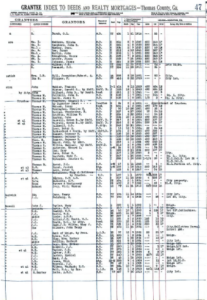
Thomas County Grantee Index 1825-1910, Boston-Boswell.
A visit to the Thomas County Deed Room confirmed this. He did not show up on any Georgia property tax rolls until the late 1830s. He did eventually buy property in Thomas County and was a hotelier in Thomasville. The very first land Tom Boston purchased in Thomas County was in Thomasville in 1851. While his Uncle John purchased lots in the 8th district (Colquitt County today) and a lot in today’s Brooks County between 1839-1841, none of the family’s properties were in the vicinity of “Old” or “New” Boston. Tom Boston himself never owned any property near Boston.
The variation of this theory, that he was friends with John Parramore and visited by way of stagecoach at a stagecoach stop Parramore hosted on his property, is also without evidence. The stagecoach routes of Georgia – particularly the one Thomas Boston would have had to take to get to south Thomas County – were extremely well documented. These were commercial operations that required reliable stops every 40-50 miles where horses could be changed and people get something to eat or even a place to stay overnight.
While John Parramore was a large landowner in the vicinity of “Old” Boston, and certainly popular and well known in the area, his property is simply not listed as a stagecoach stop nor changing station in any newspaper or gazetteer, particularly the Gazetteer of the State of Georgia for 1837. Thomasville is listed, as is Troupeville, Albany, and other places on either the route through Albany or the route from the east. The primary logic problem being that for a state-wide stage operator, the Parramore property was too close to Thomasville for there to be an additional stop.
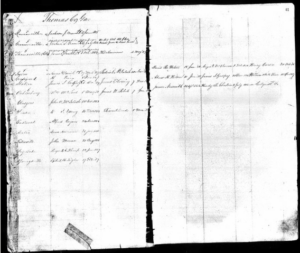
Thomas County Post Office Book, 1844-1857.
The next key data point for us to discover was to find the very earliest use of the name “Boston” for a place in Thomas County. The United States Postmaster Book lists Aaron Daniel as the postmaster of a Boston in Thomas County in 1847. This is the first verifiable use of the name we can find thus far. By 1850, it appears with some frequency. Which brings us back to the original history written by “W” in 1890 who claimed, “Watson and Graves” moved from the “Old Bay State.”
So who is W? And who are Watson and Graves? Those are questions we’ll have to save for next time!
Spring is in the air and so is the pollen! As we shake off the last frosty days of winter, many plants are blooming and turning Thomasville into a beautiful sight to behold. And many people are getting out and returning to their gardens. With several historic garden clubs in our area and a rose show that has been around for over a century, it’s no wonder that the flora of Thomasville is uniquely lush and beautiful.
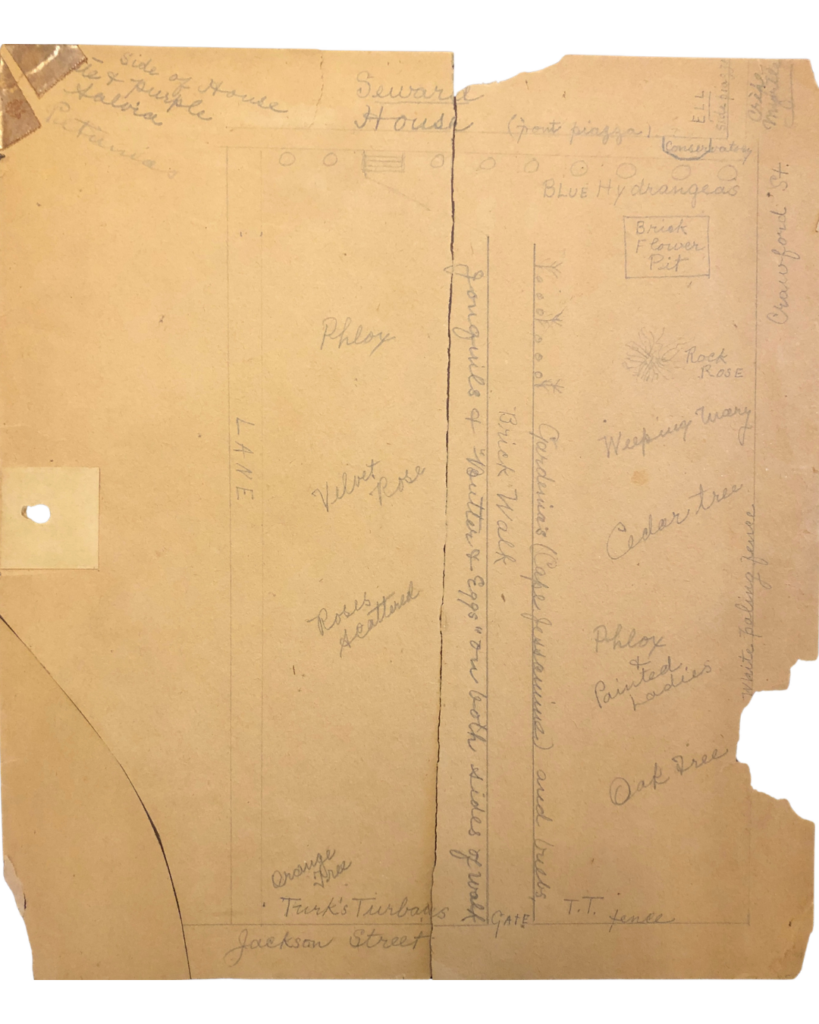
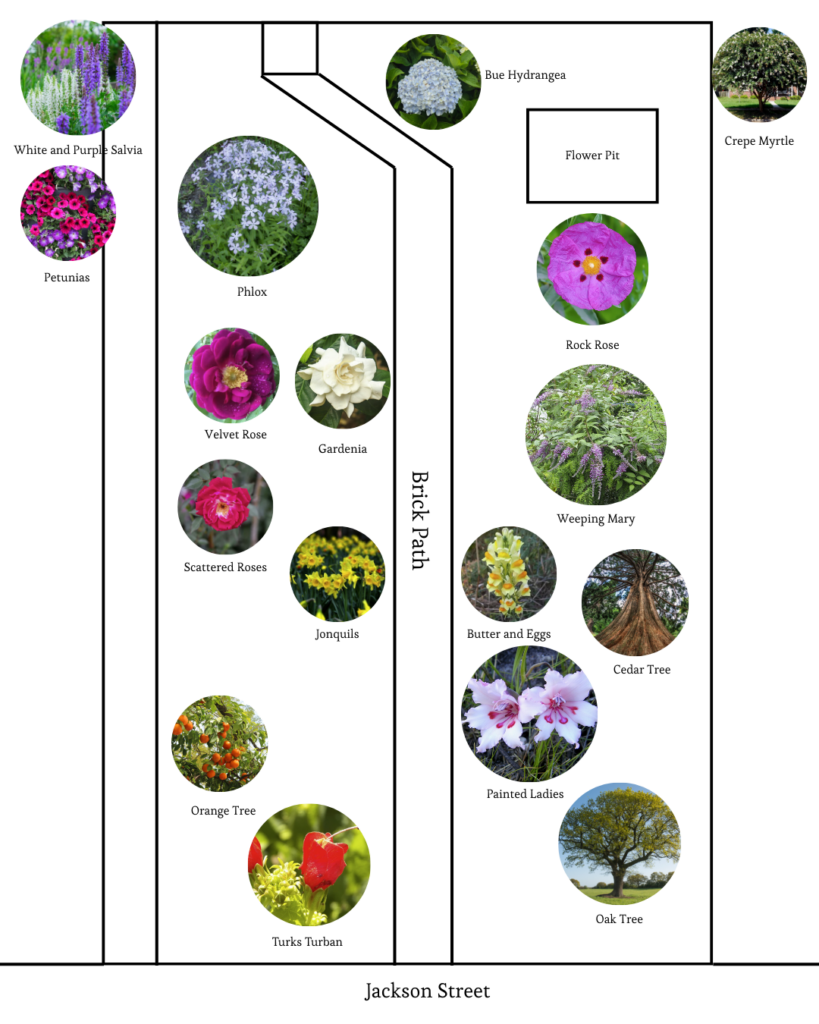
Plan of the Seward House Garden as it appeared in the 19th century, c.1925
If you’re looking for ideas for transforming your garden, why not take a historic approach? The History Center’s collections offer us many pictures of past gardens, but a deeper look through the files shows us a map of a very special garden – the original 19th century garden that once decorated the front yard of the Seward House. This layout can be easily recreated or worked on to create a classic Southern garden for any level of gardener (including those of us with sickly green and brown thumbs).
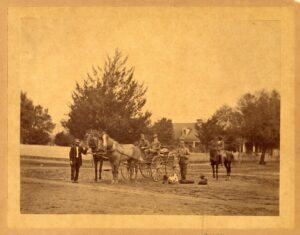
A hunting party in front of the Seward House, c. 1885. The buggy occupants are H. W. Hopkins on the left and Dr. Thomas Metcalfe.
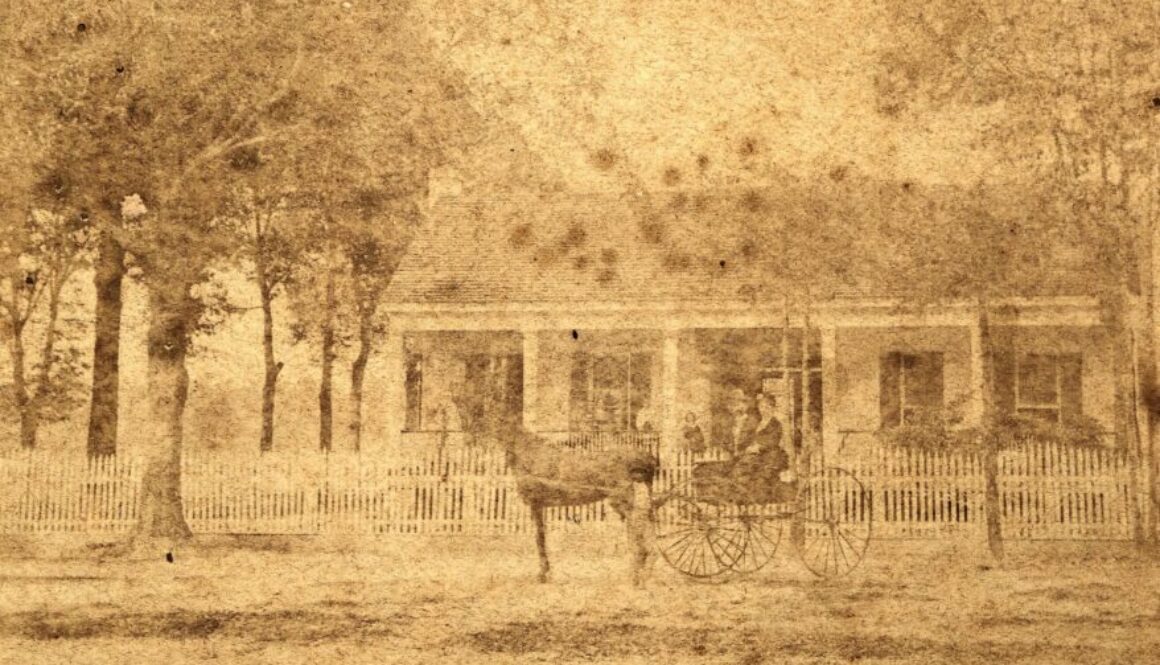
Before diving into the gardens, let’s get a little background on this house and why we have the garden plans in our collections. The Sewards in question for this property were Senator James Lindsey Seward (1813-1886) and his wife Frances Amanda Tooke Seward (1822-1897). Formerly located along the middle of Crawford Street facing Jackson Street, the site is now the location of several businesses including Hong Yip, the headquarters of the Republican Party in Thomasville, and AJ Moonspin. The house was likely built prior to 1865 and added onto with the gardens developing over that time.
Most of the plantings in this garden are familiar names to us: cedar, oak, hydrangeas, etc. But a few of them require a little deep dive to find the intended plant. For example, take the Weeping Mary (be sure to add “plant” after the name in your google search or else you’ll be flooded with religious iconography). The scientific name for this plant is Buddleja lindleyana. It is native to China but was introduced to the United States in the 1800s. The plant is reminiscent of wisteria in its growth habit (though a little less likely to take over your yard).
If you’re looking to add Phlox to your garden, there are several native varieties to pick from that are likely what the Sewards planted. Phlox subulata or Moss Pink and Phlox nivalis or Trailing Phlox are good for sunny areas. Have a shady spot? Try Phlox divaricate or Woodland Phlox or Phlox Pilosa (Downy Phlox) for those areas.
In the great Thomasville debate between camellias and roses, the Sewards seem to have been rose fans. One of the notes mentions “roses scattered” through the garden. These would have been what we now call antique varieties that existed before the first hybrids came about in the mid-late 1800s. Some cultivars include “Blush Noisette” which arrived in America in 1817, “Madame Plantier” in 1835, “Souvenir de la Malmaison” in 1843, and a Thomasville favorite, “Louis Phillippe” in 1834. The “Velvet Rose” mentioned likely refers to Rosa gallica or “Tuscany.” Thomas Jefferson received one of these in 1808.
But some of their roses aren’t roses. Rock rose or Pavonia lasiopetala is a Mediterranean plant that appears rose-like. Though not native to this country, this plant does well in rougher terrains. They’re even known to be fire-resistant!
Mixed between the jonquils and gardenias (or Cape jessamine as it is referred to here) is another flowering plant called “Butter and Eggs” or Linaria vulgaris. Like it’s name suggests, it is a light yellow and white colored flower that would have mixed in well with the yellow jonquils and cream gardenias.
Our Painted Ladies are Gladiolus carneus. This plant does not flower in the summer but in the winter, adding some beauty while the other plants lie dormant. It is native to South Africa and holds up well when cut for arrangements.
Along the fence line, the Sewards planted Turks Turbans. This could refer to several types of plants including a type of squash that produces brilliant red flowers and the cutest hat-shaped gourds. But in this case, the name likely refers to Mavaviscus arboreus from the hibiscus family.
Finally, if you want to recreate the garden faithfully, the map makes note of a “brick flower pit” close to the front of the house. This is your chance to be creative with your flower choice! This space would be great for wildflowers, experimental plants, or even an ornamental vegetable.
While this garden is long gone, there are many throughout Thomasville that still harken back to these historic plans. You may have some of these growing in your own yard or have seen them in your neighborhood as they start to bloom. But what do you think? How would your garden grow?
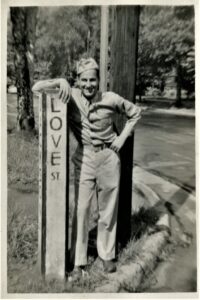
Thomasville History Center Collection: Unidentified Soldier standing by sign on corner of Love and Jackson Streets, 1944.
Love is in the air and on the shelves this time of year, making it a good time to talk about love in Thomasville. Not the gushy community love or loving our neighbors, but love with a capital L. The Love that can be found on Love Street in the Tockwotten Neighborhood. How did this street get its name? Was it Victorian sentimentality? Or is there more to the story? Let’s find out!
Look at a map of Thomasville and you will see that Love Street runs for about four blocks in town, from Washington Street to Remington Avenue. It’s a residential street lined with dozens of vernacular Victorian houses of all different shapes, colors, and sizes. But what’s Love got to do with it? To answer that question, we have to get to know the neighborhood.
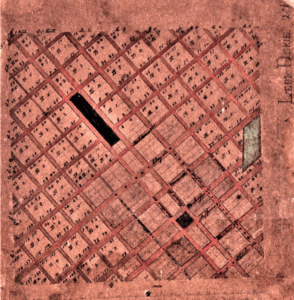
In the History Center’s map collection, we have a series of maps put together by the late Judge Roy M. Lilly Jr. who researched the various city limits of Thomasville over the last 200 years. In 1857, the city limits expanded to cover the area we now know as Love Street. This was huge growth for Thomasville as the former city limits had not included this area nor a nearby town known as Fletcherville. So why were they adding this land to the city limits? The area only covers a neighborhood today, so why was it not part of the original limits? We have a clue to this question hiding in our maps.
Thomasville History Center Collections: Map of Thomasville by Lebb Dekle, 1857.
Lebb Dekle, a well-to-do merchant, politician, and overall man-about-town, made his own map of Thomasville in this time period. It barely covers the area that would become Love Street. In fact, that space on his map is demarcated with a giant blue trapezoid. But if you look very closely you can see that the space reads “Tan Yard.” Tanning yards were work spaces for tanners or people who turn animal hides into leather. It’s a smelly business as you might imagine so tanning yards were often on the outskirts of town – just close enough for the workers to walk there from home and into town but not close enough to make people complain about the smell. From this we can gather that the tanning yard was on the move around 1857, opening up the land for citizens to build a residential community.
But where does the name “Love” come into this tanning yard-turned neighborhood? For that answer, we need to look into the homes dotting the street. Take a walk down Love Street and you’ll notice those Victorian houses mentioned previously. One of those houses bears a wooden plaque marking it as the P. E. Love House. But who was P. E. Love, and what did he do to have a street named after him?
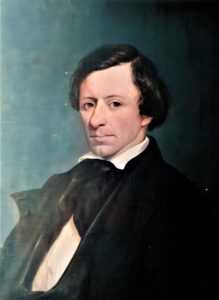
Thomasville History Center Collection: Colorized copy of Portrait of Peter Early Love, 1850.
Peter Early Love was born in 1818 in the town of Dublin, Georgia, about three hours northeast of Thomasville. His parents died when he was still a young boy so his older sister and her husband raised him. When Peter was old enough, he attended Franklin College, now known as the University of Georgia. After graduating, he traveled north to study medicine at the University of Pennsylvania, which was the place for Southern students to learn medicine at the time. He quickly realized his heart was not in medicine and decided to take up law instead.
In 1839, Peter returned to middle Georgia and began his study of law alongside several future Thomasville lawyers. Peter and the young lawyers descended upon the still fairly new town of Thomasville and set up shop. As Peter rose through the ranks, he became a delegate in the electoral college during the presidential election of 1840. His vote helped elect William Henry Harrison as the nation’s 9th president (before he died of pneumonia one month into his term). A few years later, Peter was made Solicitor General of the Southern Circuit, meaning he rode all over Southwest Georgia trying cases for the State. This also meant he spent a lot of time away from home – but that didn’t stop him from putting down roots in Thomasville.
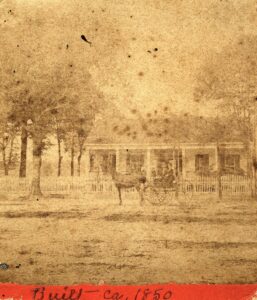
Thomasville History Center Collection: Love House on South 141 Love Street, 1875.
Back on the farm, Peter was setting up a home with his wife and four children. He bought a large tract of land in what is now known as the Love-Tockwotten neighborhood. Peter began dividing up the land soon after and selling it to his many friends including the Hansell family and the Remington family. He kept just enough land for himself and built a simple wood-frame dwelling around the year 1850. He called his house “Love Mansion.” Work on the house finished just in time for Peter to leave Thomasville to act as a Georgia Senator in Milledgeville.
After his term as a senator, Peter was made Judge of the Southern Circuit, replacing his friend Augustin H. Hansell. On top of that, Peter started his own local newspaper: The Wiregrass Reporter ran for several years before the start of the Civil War. He was also made captain of the Thomasville Guards, a local militia group, and helped lead the formation of Young’s Female College in town. When he grew restless for the next big adventure, Peter became a member of the United States House of Representatives.
This was a short-lived trip. Peter was elected just as the Civil War was breaking out. He was pro-secession, so when Georgia and many other states left the Union, Peter and his fellow Southern congressmen packed up their bags as well. He returned home to Thomasville, but not quietly.
Peter returned to his post as captain of the Thomasville Guards. In the years before the War, the Guards mainly spent time doing drills and participating in parades and social events. Despite being a militia, the Guards were more of a social club for the young men of Thomasville. Even Peter admitted the “Light Infantry is a company of boys, as brave, as enthusiastic as any, but still most of them are boys… They would ostracize me if they only knew that I had doubted for a moment their perfect equality with all other companies…” Despite his feelings, the Guards were sent to fight in the Civil War – this time, without Peter as their captain.
Peter stayed behind to serve in the Georgia State Legislature, now one of eleven states making up the Confederate States of America. Not long after, he was made mayor of Thomasville.
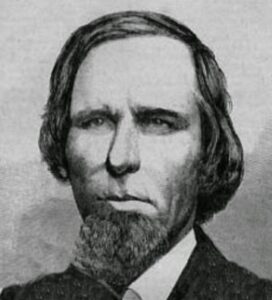
The end of the Civil War brought Union troops to Thomasville as part of President Andrew Johnson’s plans for Reconstruction. Ever true to his personal beliefs and staunch support of secession, Peter resigned from his post as mayor. Having burned the candle at both ends all his life, Peter died on November 8, 1866 at the age of 48. He was buried in his family’s plot at the City Cemetery, only a few blocks away from the courthouse he spent so much time in.
Public Domain: Peter Early Love, 1860.
As for the street, it earned its official name around the 1870s. The earliest mention of the street by that name shows up in a newspaper article from 1875. That was one of the first years the town of Thomasville held Independence Day celebrations following the Civil War. The Thomasville Guards marched from Broad Street down to the Love Mansion on Love Street where attendees gave speeches and read the Declaration of Independence, a fitting tribute to the man who gave his name for this street.
What must it have been like to live in Thomasville at the brink of the Civil War? Here at the History Center we have the transcript of a diary written by a young, seventeen-year-old woman over the year of 1861. This diary not only gives us insight into this question but also paints a vivid picture of life in South Georgia and how it was about to drastically change. Follow along as we explore the world from Henrietta Armstrong’s point of view in this blog series!
Our last visit with Henrietta concluded with the last entry in her diary. After some excitement in the autumn, her schedule quickly became too encumbered for her to keep up with her daily writing. We do not have any other journals or writings from her in our collection. So, what happened next? We do know a few things about her life after 1861 and the fate of her loved ones as they made their way through the American Civil War thanks to some hints from Henrietta.
While her entries stopped in December of 1861, Henrietta did come back after the end of the War to write an epilogue, located in the back of her diary, indicating that she likely did not keep another journal throughout the War but felt the need to record this important message for future readers. Her words are straightforward but give us a glimpse into her personal feelings:
“Lieut. Aeneas Armstrong was drowned in the James River, below Richmond, January 26, 1865. He was kind, gentle, amiable, and brave; Noble in his deeds; just to all.”
A shocking end to our heroine’s husband! And how did this happen? The Richmond Examiner, a newspaper in Virginia, wrote a version of the story shortly after the incident that gives us the details.
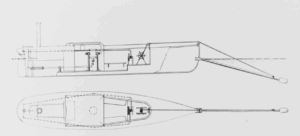
Design plans of the torpedo boat CSS Squib. This boat was similar to the CSS Hornet, the torpedo boat Aeneas was on when he drowned.
“The flag of truce steamer William Allison, on her return trip up the river on Thursday evening encountered the “Torpedo,” a small steamer commanded by Lieutenant Armstrong, of the navy, carrying a crew of seven men, and employed in the torpedo work of the river. The “Torpedo” attempted, in the darkness, to cross the bow of the Allison, and was cut in twain, the Torpedo sinking immediately, and leaving the commander and crew struggling in the chilly waves. The Allison was at once put about, and succeeded in picking up all of the crew, but Lieutenant Armstrong was drowned. His body was not recovered,” (The Richmond Examiner, January 28, 1865).
It gets worse:
“The Torpedo is a total loss. We learn through an officer who was on board the Allison, that the collision occurred at a point between Drewry’s Bluff and Chaffin’s Farm, in the dusk of the evening. When the engineer of the “Torpedo” observed the approach of the other steamer, he reversed his engine, which made three reverse revolutions, when the Allison struck her, and being a light, frail vessel, with one gun, she broke in two, and as the parts went down all on board sprang into the water.
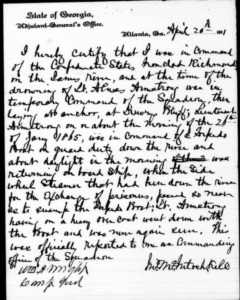
Letter of Support from John McIntosh, April 20, 1907. The letter recalls Aeneas’s drowning and mentions the “heavy overcoat” he was wearing that led to his death.
Lieutenant Armstrong grasped one of the crew and was supporting himself, when the seaman exclaimed, “Lieutenant let go; you’ll drown us both.” The self-sacrificing lieutenant replied, “Man, I’ll not drown you,” and let go his hold. The seaman was rescued and Lieutenant Armstrong floated off a short distance. They shouted to him from the Allison to hold on, and the reply faintly came, “Make haste; I’m benumbed.” The boat was within fifteen feet of him when he went down the first time, but coming up again, he said, “It is no use; I’m gone,” and disappeared.”
Remember from our earlier entries, Aeneas was not a well man. He began the War still suffering from the effects of what was likely Malaria. And being January in Virginia, it was likely a rather cold day leading to an even colder night and frigid waters. According to a witness, Aeneas was in “a heavy overcoat,” part of his full wool uniform which would have absorbed water like a sponge and weighed him down. With these factors in mind, it’s little wonder he didn’t survive the incident. As the newspaper reveals, his remains were never recovered from the site of the accident.
Henrietta never remarried after the loss of her husband. Looking at her note at the end of her diary, she may not have found anyone she thought was good enough. Like many Southerners following the War, the details surrounding Henrietta’s life get a little murky at this point. What became of the plantation and the people who lived there requires further research. However, by 1870, she had moved to Thomasville to live with her mother and half-brother, Albert. Their home was a one-story, wooden house located at 344 East Jackson Street – today the location of Bennett Real Estate.
Before we get too far into Henrietta’s life after the War, let’s see what happened to her brother, Buddie. When we left off in 1861, Buddie volunteered to join the Confederate Army. This was a short stint for Buddie. By 1864 he was back home working on his plantation and had paid a substitute to take his place in the fighting.
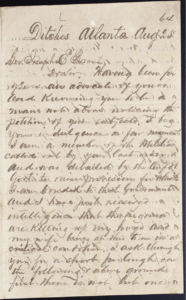
P. N. Vickers to Governor Brown, Sept. 1, 1864. U.S. Civil War Correspondence.
But his break did not last long! By August of that year, Buddie found himself in Atlanta, having been called up to join the State Militia by Governor Joseph Brown to defend the state against the Union Army. As part of Company C of the 12th Georgia Militia, Buddie served as a Corporal under the leadership of Thomasville resident, J.J. Ivey. Around this time, Buddie wrote to the Governor to ask for a short furlough that would allow him to return home to help out his wife who was in a “critical condition” (Annie may have been pregnant at this time, but if she was, the child did not survive – this may be the person named Matthew Vickers who is buried in the Ponder family plot at Laurel Hill Cemetery). Whether or not Buddie’s request was granted requires further research.
Despite his brief stints in the fighting and defense of the state during the War, Buddie came out mostly unscathed. He and his wife, Annie, went on to have another child, Charles Walter Vickers, and the family lived at their plantation until Buddie’s death in 1873 at the young age of 34. The cause of his death is currently unknown, but there was an outbreak of Yellow Fever in the area during this time. Annie brought her children to live with family in Thomasville after Buddie’s passing where she became a teacher.
This brings us back to Henrietta, who was also settling into life in Thomasville. Like Annie, and many other Southern women who found themselves displaced after the War, Henrietta needed a job to support herself and her family. Henrietta became a music teacher and took in young girls and women who were attending school in town. Young’s Female College was just a few blocks from the Vickers-Foster home on Jackson Street, placing them in prime territory for taking in student boarders. In 1907, Henrietta applied for a Widows Pension from the State of Georgia in payment for Aeneas’s services during the War. She received $1 a year.
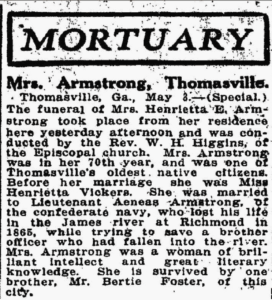
Henrietta’s obituary as it appeared in the Atlanta Constitution on May 4, 1912.
Henrietta spent the rest of her life in this way until her death on May 1, 1912 at the age of 68. She was buried in Laurel Hill Cemetery. She left any money and property she had left to her brother, Albert.
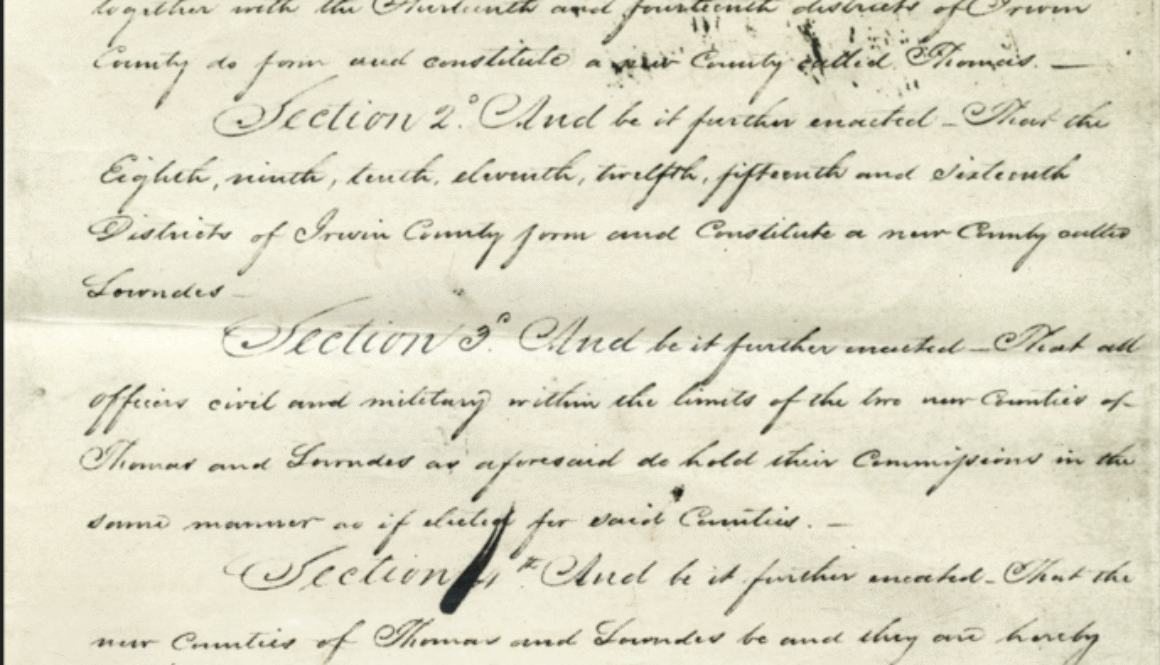
You might have heard that Thomas County turns 200 years old this year. This specifically happens on December 23, 2025, the day when, 200 years ago, the Georgia House of Representatives passed an act which created two new counties: Lowndes County to our right and Thomas County, a much bigger county than what we know it as today. So, what was going on as this momentous occasion occurred? Who was there, and what were they up to? And what does it say about us 200 years later (and going)? Let’s take a look.
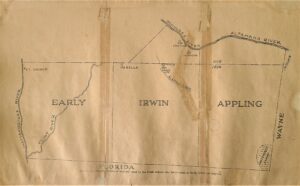
Southwest Georgia-Early, Irwin, and Appling County in 1818
The area that was soon to become Thomas County was carved out of Irwin County, founded in 1818 as part of the land ceded by the Muskogee people, and Decatur County which had only recently been carved out of Early County. Today, the Thomas and Irwin County are over eighty miles apart from one another, but in 1825 Irwin County stretched from its current location down to the state line and over to the west, encompassing a large swath of South Georgia. The county was divided into sixteen districts which were twenty-mile plots of land further divided in to 490-acre square lots. Districts 13 and 14 went into Thomas County. Decatur County reached from the Alabama-Georgia border in the west over to Irwin County and from the Florida-Georgia Border in the south up to its current northern border. Parts of districts 23 and 19 went into Thomas County.
Within these original counties, there were pockets of settlement, mostly in the northern part of Irwin County, with little developments trickling southward. Looking backwards in 1875, the newspapers in Thomasville suggested Thomas Hill Bryan was the first United States citizen to settle in what would become Thomas County back in 1819. We can’t be totally sure of that information, but he was definitely among the earliest of the new settlers. In the 1820 census, there were nearly 400 White citizens in Irwin County with 39 enslaved workers. The settlement of Glasgow first popped up around this time close to the Florida border near present-day Metcalfe. As you might guess from the name, the settlers were mostly of a Scottish background.
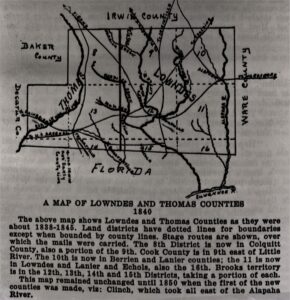
A Map of Lowndes and Thomas Counties in 1840
One of the early settlers we know of was Thomas Jefferson Johnson. His property in the southern part of Irwin County became the plantation we know today as Pebble Hill. Johnson was responsible for introducing the bill to create Thomas and Lowndes Counties. He was also responsible for naming the county, choosing to name it after his distant relative General Jett Thomas, a veteran of the War of 1812 and the architect behind the oldest buildings at the University of Georgia. Whether or not he chose this relative because they shared a name is up for debate.
Once Thomas County was officially recognized as its own county, the people of the area put forth a list of men to serve as commissioners: Duncan Ray, William J. Forson, Simon Hadley Sr., Michael Horn, and Thomas Hill Bryan. They decided to hold court in the middle of the new county at the home of Charles Kingsley. The Kingsley property covered Land Lot 54, or what would become part of the boundaries of Thomasville by the end of the 19th century. It was conveniently located next door to Land Lot 39, later owned by Thomas Jefferson Johnson who sold it to the County Commissioners in 1826 to form the new town of Thomasville.
With this event and two hundred years change, we end up in modern Thomas County. And you can help us mark such a momentous occasion by joining us on Victorian Christmas at the Historic Courthouse for a reading of our founding document. Alongside our hosts, the Thomas County Board of Commissioners, we’ll be bringing out artifacts from the past two hundred years of Thomas County’s history and making new memories as a community. We hope to see you there!
What must it have been like to live in Thomasville at the brink of the Civil War? Here at the History Center we have the transcript of a diary written by a young, seventeen-year-old woman over the year of 1861. This diary not only gives us insight into this question but also paints a vivid picture of life in South Georgia and how it was about to drastically change. Follow along as we explore the world from Henrietta Armstrong’s point of view in this blog series!
It’s been a while since we last checked in on Henrietta. When we last left off, she was suffering from the summer doldrums, but what will the next few months hold in store? A lot is happening around the world, and Henrietta may soon find herself appreciating those down times she once took for granted.
The first two weeks of August passed much like the previous weeks: everyone is still stuck at home, everyone is still sick, and the weather is awful in some form or another (this time it’s constant rain!). But thankfully for the family (and the reader), Aeneas proposed a trip to Thomasville! After riding in their own carriage from Smithville to Albany, the couple took “a miserable hack” or stagecoach on the final leg of the trip to Thomasville (Thursday, August 15, 1861). After arriving in town, they rented a carriage from Jim McLendon and rode to Buddie’s house just past the Florida border.
At this same time, things are heating up on the battlefields of the Civil War: Henrietta reports on a battle that has taken place in Leesburg, Virginia where the Federalists went into a retreat and lost three to four hundred men with fourteen hundred taken prisoner (Saturday, August 17, 1861). Keep in mind, Henrietta’s information is a little inflated. The fighting she refers to is the Battle of Ball’s Bluff where a little over two hundred Union troops were killed and over five hundred were captured – a still impressive figure considering the wild discrepancy in size between the Union and Confederate Armies at this time.
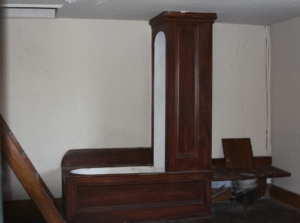
An original 1850s “shower bath” from Dunleith Historic Inn in Natchez, Mississippi – likely similar to what Buddie and Annie Vickers owned. Image curtesy of Natchez National Historical Park.
Over the next few days, Henrietta starts to have some fun again. Having been reunited with her sister-in-law, Annie, the two go out on the town (with Annie’s baby and an enslaved maid named Eliza in tow). Their activities include all the things gentlewomen could be expected to do: calling on friends, reading new books, strolling in the moonlight, and taking showers (Tuesday, August 20, 1861). Yes, the modern shower as we know it today is not quite so new in time as we tend to think. At this point in time, showers were not hooked up to plumbing, and instead used a reservoir of water that was recycled through the drain-to-shower head system. While they may seem primitive by our modern standards, they were high tech and novel for people in Henrietta’s time. As Henrietta did not have a shower at home (she likely used a tub as most people did) she wrote about her novel experiences taking showers several times (thrice in one week!) during her trip to Thomasville.
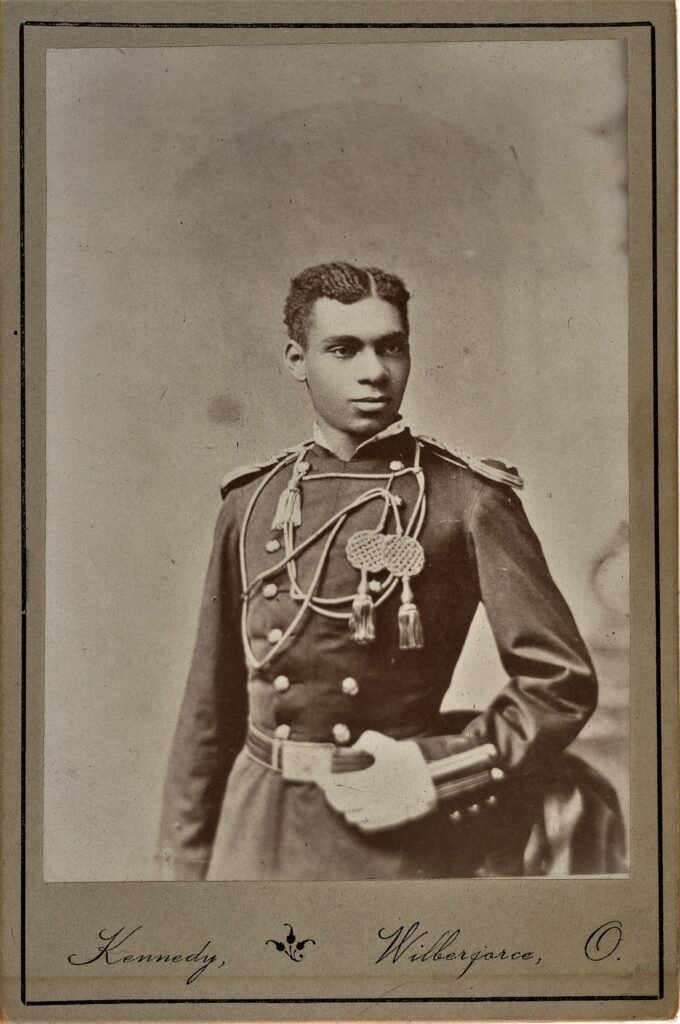
Backing up a bit, who were some of these friends that the ladies called on? Several families are mentioned like the Barkers and Aldermans. One individual included on their calls was Annie’s cousin, Ephraim Ponder. Henrietta gives us a few words on him, stating, “Mr. Ephraim Ponder is here and looks very badly,” (Wednesday, August 21, 1861). He had every reason to look badly. Ephraim Ponder may sound familiar as he is known today in Thomasville for being the enslaver of the Flipper family of Lieutenant Henry O. Flipper fame. While the Flipper family has gone down in the history books for Henry’s historic role as the first Black graduate of West Point, Ephraim’s reputation has not held up as well. Back in 1853, Ephraim married Ellen Gibson Gregory, a woman nearly twenty years his junior who was known for her beauty, spunk, and popularity. Unfortunately, she was a little too popular with other men for Ephraim’s taste and in a few months from Henrietta’s diary entry, he divorced her. Henry Flipper’s autobiography mentions her behavior:
Lt. Henry O. Flipper, 1880.
“The mistress of this fortunate household, far from discharging the duties and functions of her station, left them unnoticed and devoted her whole attention to illegitimate pleasures. The outraged husband appointed a guardian and returned broken hearted to the bosom of his own family,” (Henry Flipper, Black Frontiersman, 1963).
And this is where Henrietta finds him in August, having left his wife at their Atlanta plantation in hopes of finding comfort with his Thomasville family.
Other fun activities for the family included shopping, running a store for a friend who volunteered for the Confederate Army, more showers, and some hijinks:
“Buddie dressed up this afternoon in women’s clothes, put on a mask and frightened us a good deal.” (Friday, August 30, 1861).
But the fun and games were slowly winding down in the month of September. The first bit of panic arrived early in the month when Mrs. Barker came with news:
“I passed a very wretched night, I did not sleep any at all. Mrs. Barker came up about ten o’clock [the night before] and told us that Lincoln’s forces had landed at Fernandina and that they were fighting there and that every man that could shoulder a musket meet in Tallahassee at eight o’clock this morning. Aeneas and Buddie went down to T[allahassee] this morning and left by sunrise. They returned at nine tonight and informed that it was altogether a false alarm. I have been very unwell today.” (Friday, September 6, 1861).
Henrietta’s concerns for her husband and brother were allayed but not before setting the family off on a spell. Other rumors would circulate through town including accounts of the Confederates capturing Washington DC (not true) to British steamers breaking the blockade at Savannah (partly true).
To make matters worse, after several weeks of constant rain, a true storm came through the area. Most likely what we would consider a hurricane today, Henrietta described the aftermath in her diary:
“The wind commenced rising about eleven o’clock and about two it was a perfect gale. I could feel this house shake from its foundations. This morning was a perfect picture of desolation. The pailings were all blown down and the trees all over town. The wind has been blowing all day and I think it will be clear tomorrow,” (Friday, September 27, 1861).
Henrietta and her family were visiting friends in Thomasville when this storm came through. For those of us who have experienced the days after a hurricane, we can imagine what this scene might have looked like. And in a time before government sponsored clean-up crews, the work to restore the town following such a storm must have been massive, with most of it left to private citizens to organize and enslaved workers to perform.
By early October, Henrietta and Aeneas were staying with their Thomasville relatives, the Sewards. James Lindsey Seward (1813-1886), the head of the household, had an illustrious career in government, serving in the Georgia House of Representatives, the United States House of Representatives, and, at the time of Henrietta’s diary, the Georgia Senate. When the family was home in Thomasville, each member was highly involved in local events. Henrietta’s visit coincided with the family taking part in a tableau, a popular Victorian activity where participants dressed up in costumes and posed around scenery to create a living picture of famous stories.
“I have been busy all day helping Mattie [the Seward’s daughter] to get ready for the Tableaux tonight. She is to represent Florida in the ‘Secession of the States.’ I made her flag and trimmed it with a garland of flowers and also a wreath to go over her shoulder,” (Wednesday, October 2, 1861).
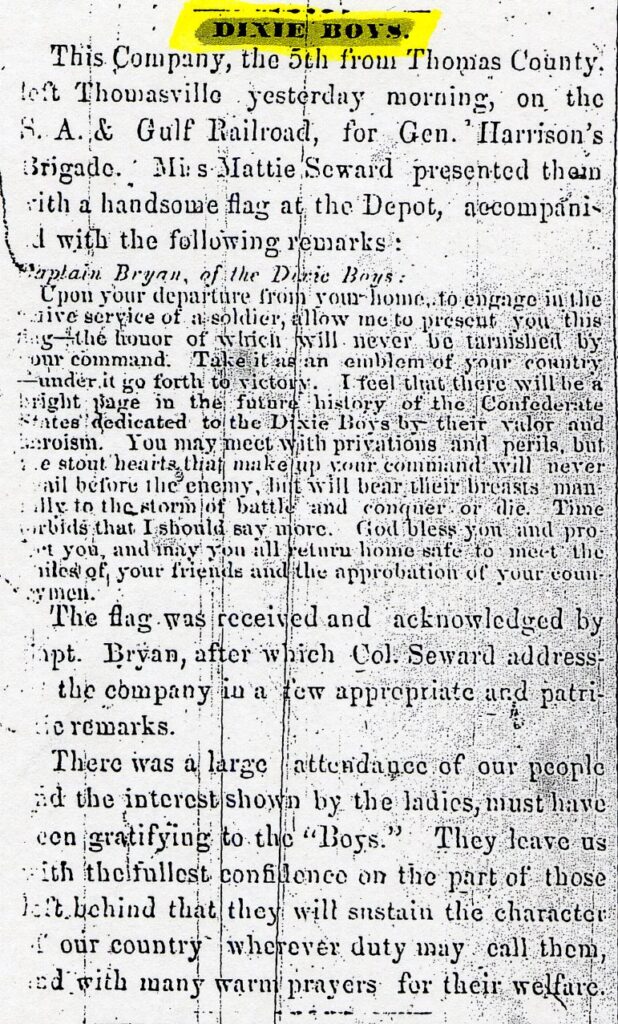
As public support for the War grew, Henrietta and her crew became even more involved. Mrs. Seward and Henrietta’s mother worked diligently to make pants and coats for the local volunteers. In the meantime, Henrietta helped Mrs. Seward sew and decorate a flag for Lucious Bryan’s unit, known as “The Dixie Boys.”
“I have painted the stars on the Blue Field of the flag this morning. Mrs. Seward sent the white stripes to Mr. Walcott to have an inscription on it. The company leaves Thursday morning and Mattie will present the flag to them at the depot,” (Friday, October 4, 1861).
“Dixie Boys,” Thomasville Times, October 9, 1861.
Mr. Walcott’s inscription read, “D.B. Victory or Death, August 10, 1861,” (Thomasville Times, February 26, 1893). Henrietta attended the flag presentation where Mattie made a “very neat little speech.” The Dixie Boys carried the flag throughout the war until 1864 when it was captured by Union forces at Vicksburg. Though later returned, it was in too fragile a state to be used and a replacement was made and used during the rest of the War. Currently, the original Dixie Boys flag is believed to be in private ownership. A similar flag belonging to the 29th Georgia Infantry is on display at the Thomasville History Center.
By mid-month, the Armstrong family returned home to Albany to find trouble at home. Once again their overseer was causing trouble and economic and trade challenges were making it difficult to supply their enslaved workforce with proper clothing.
“Everybody is looking gloomy, distressed, owing to the depresure [sic] in money matters. None can get credit; the cash must be paid,” (Friday, October 16, 1861).
With more work on her hands and the harvest season upon them, Henrietta soon had little time for keeping her journal. The entire months of November and December only received a few days coverage with Henrietta admitting, “My Journal is stopped for this year,” (Monday, November 25, 1861). Her last entry came on Monday, December 30, 1861 where she recorded the names of Confederate Generals as well as the President and Vice President.
While this may seem a rather disappointing end to Henrietta’s diary, worry not – there’s still a little more to come. Tune in next time for an epilogue where we answer several lingering questions: will Buddie and Aeneas survive the War unscathed? What will Henrietta’s life look like after the fall of the Confederacy? How did Thomasville change with the loss of so many young men on the battlefields? Find out next time!


 The gentlemen guests were not left out of the romantic fortune telling games. In their case, each young man was blindfolded in turn and led to three bowls of water. If he dipped his hand in a bowl of clear water, he would marry a maid (perhaps one of the young ladies present), if he landed in the bowl of black-tinted water, he would marry a widow (perhaps Mrs. Smith was available). And if his hand slipped into a dry bowl with no water at all, he would spend his life as a confirmed bachelor. Sadly, the article did not report the results of these scientific tests.