Hallowe’en in 1892
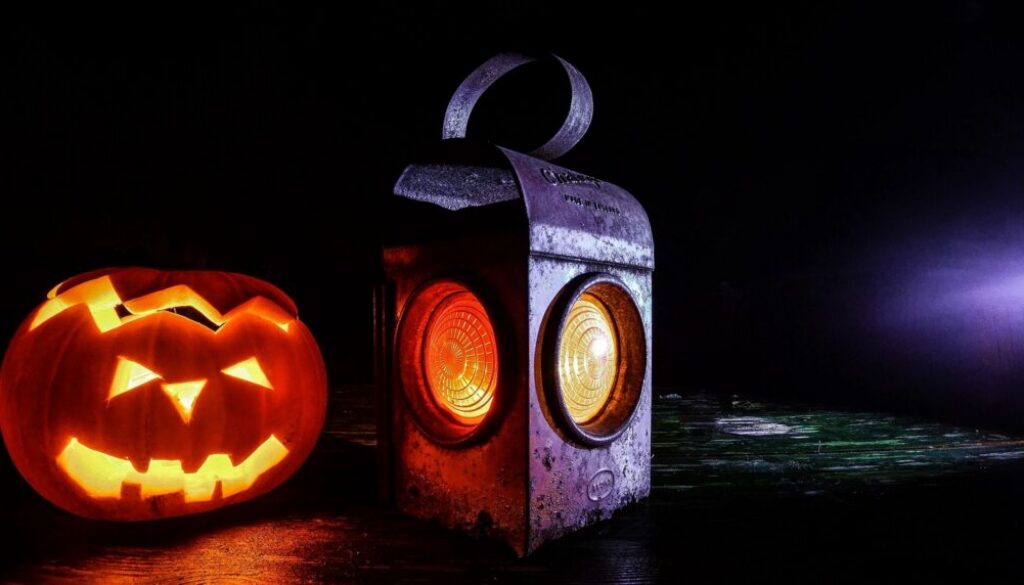
As candy and costumes fly off the shelves of local stores ahead of Halloween, I wanted to take a look back in time to see how Thomasvillians of yore marked the occasion. We’re all familiar with the traditions of today: yard décor that begins popping up in September, pumpkins stacked high in cardboard crates, and neighborhoods girding themselves against the oncoming hoard of small children dressed as the trendiest cartoon characters of the year. But what did we do before animatronic skeletons, bulk candy bags, and polyester princess gowns? Let’s travel back to 1892 to see how one set of enterprising young women set up their Halloween festivities.
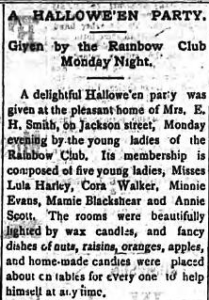
This flashback comes to us from an article published in the Daily Times-Enterprise on November 2, 1892. It describes a party held on Halloween night by the Rainbow Club, a short-lived local, women’s social club from the 1890s. At this time, the club was comprised of Lula Harley, Cora Walker, Minnie Evans, Mamie Blackshear, and Annie Scott. The party was held at the home of Mrs. E. H. Smith on Jackson Street. The article describes the setting as follows:
“The rooms were beautifully lighted by wax candles, and fancy dishes of nuts, raisins, oranges, apples, and home-made candies were placed about on tables for everyone to help himself at any time.”
Mrs. E. H. Smith was born Elizabeth “Bessie” Fondren in 1849, and following the death of her husband, Eugene Hamilton Smith Sr., moved into a house on the 300 block of East Jackson Street, likely in the area that is now home to Smile Doctors. As many of her own children ended up on the invitation list, they were likely friends of the members of the Rainbow Club, making her house and watchful eye the perfect setting for a co-ed Halloween party.
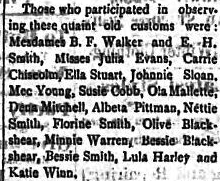
Speaking of guests, the invite list is made up of many eligible bachelors and bachelorettes of 1890s Thomasville. Familiar last names like Titus, Smith, Ball, Brandon, Pringle, Blackshear, Wright, and even Snodgrass show up on the list of fellows while the ladies’ list includes the names Mitchell, Young, Pittman, Blackshear, Smith, Chisolm, Stuart, and Winn. And Mrs. Smith was not the only chaperone to watch over the festivities. She was joined by Mrs. B. F. Walker (Anna E. Nutting, 1848-1934), the mother of two of the party guests who lived nearby on Jackson Street.
The article continues with just what the young guests did for entertainment. Several games were played, many of them featuring some amount of flirting by fortune telling. For example, the young ladies were encouraged to take some of the nuts mentioned above and put them on the grate in front of the fireplace as symbols of themselves and the man (or men) they fancied. Nuts that exploded from the heat or fell off the great signified bad boyfriends – men who would leave or “prove unfaithful” – while those that caught fire were “faithful, loving, and true.”
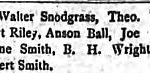
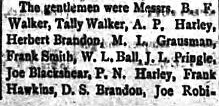 The gentlemen guests were not left out of the romantic fortune telling games. In their case, each young man was blindfolded in turn and led to three bowls of water. If he dipped his hand in a bowl of clear water, he would marry a maid (perhaps one of the young ladies present), if he landed in the bowl of black-tinted water, he would marry a widow (perhaps Mrs. Smith was available). And if his hand slipped into a dry bowl with no water at all, he would spend his life as a confirmed bachelor. Sadly, the article did not report the results of these scientific tests.
But fortune telling wasn’t the only fun being had at the party. One of the games included an old-fashioned (or at the time, not-so-old-fashioned) apple-bobbing contest. Here called “ducking for apples,” the rules were the same then as today (pre-Covid at least), with contestants attempting to catch apples floating in a tub of water using only their teeth. Another variation involved tying the apple stem to a string and hanging it from trees while participants again tried to eat the apple without the assistance of their hands.
If the guests weren’t sick of apples by the end of the night, there was one more game they could indulge themselves in. Fortune-seekers were sent into a dark room to sit in front of a mirror and eat an apple. As guests ate their individual apple and stared into the mirror, they were supposed to see the face of their future spouse staring back at them. The article goes on to mention that this game and many like it were tried during the party.
The party drew to a close around mid-night, “the witching time,” where guests were supposed to see strange sights on their way home. Perhaps they did see strange and spooky things – or maybe it was all an illusion caused by eating too many apples.