A Tale of Three Bostons (Part 2)
Last time, we left you on a cliff hanger: Who is “W” who wrote the original history of Boston, Georgia? And who were the “Watson and Graves” that featured so prominently in this origin story?
While unconfirmed, the most likely candidate for “W” is Shelby Walker Davis, or S.W. Davis, conveying stories from his father, John Davis. The elder Davis was a longtime Lowndes County resident who worked his way west through the years. It should be noted that at the same time “W” was writing for the Times-Enterprise in 1890, he was also writing histories for the Valdosta Times. Shelby Davis, was a lifetime “newspaper man” who later owned the Quitman Free Press and then founded the Thomasville Press. He was known professionally as S.W. later in life but also went by Walker or sometimes just “W.” Shelby’s father, who died in 1900, was a pioneer of Southwest Georgia, who even if he didn’t experience all of the stories told directly (which between the two newspaper story features almost no one could) would have heard many of them as a contemporary.
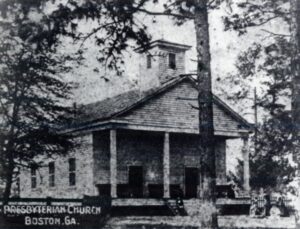
Who Watson and Graves were may be more relevant, or at least Graves. Thomas Watson, the only Watson in Thomas County’s early years, moved from North Carolina in the 1830s. He did own property in the general vicinity of our Boston, but has no apparent ties to Boston, Massachusetts. Eli Graves (1803-1868), a Presbyterian minister, moved to Thomas County from Vermont when he was hired as the first pastor of First Presbyterian Church of Thomas County, located in land lot 271, the site of “Old Boston,” owned by Roderick McIntosh. He was in Thomas County no later than 1842. Most of the Graves family lived in and around Boston, Massachusetts.
The First Presbyterian Church of Thomas County, as it is named in deeds, later became known as the First Presbyterian Church of Boston. It is possible this early church, and settlement along with it, became known as “Boston” because Eli Graves named it. It is also possible that Graves and the devout Presbyterians in the area named it for another Thomas Boston – the one from Scotland, who 100 years earlier became well known as a Presbyterian theologian with a coarse demeanor, who was having a bit of a revival “moment” as a philosopher in the 1840s and 1850s.
So why, by 1923, did Irwin MacIntyre think Boston was named for Thomas Mickleberry Boston? Because there was a third Boston. Not Old Boston in land lot 271 nor “New” Boston but a third Boston, 20 miles west of the location of modern-day Boston on the Brooks County bank of the Withlacoochee River just off of U.S. 84. It was founded by Thomas Mickleberry Boston around 1848 or 1849 when it was still Lowndes County. He purchased some land around a sulfur spring he found there adjacent to the Withlacoochee and built a hotel, establishing what became known as Boston’s Spring. Soon a village emerged around it, which became known as Boston.
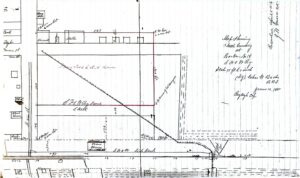
Moving forward to 1860, the Atlantic & Gulf Railroad was being built from Savannah to Bainbridge. Seeing the route through Quitman and Grooverville, the people of “Old Boston,” or so goes the story, believed the railroad would build through their settlement. Instead, the Atlantic and Gulf purchased right-of-way land about a mile east and half-a-mile south of where “Old” Boston was located on the far north-center of land lot 326 but enlarged to include part of land lots 327 and 365. This land was (conveniently) owned by former United States Representative James Seward. Stop Number 17 was first called “Seward’s Station” and then became known as Boston.
Soon after, Seward sold an acre to the trustees of the First Presbyterian Church of Thomas County. The story is smooth and easy and clean – they built the railroad southeast of Boston, so the whole town packed up and rolled over to new Boston! Except absolutely nothing works like that.
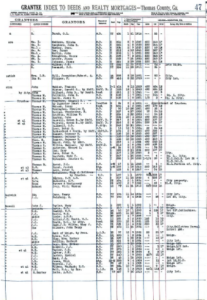
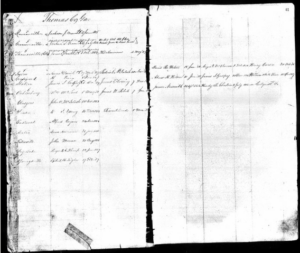
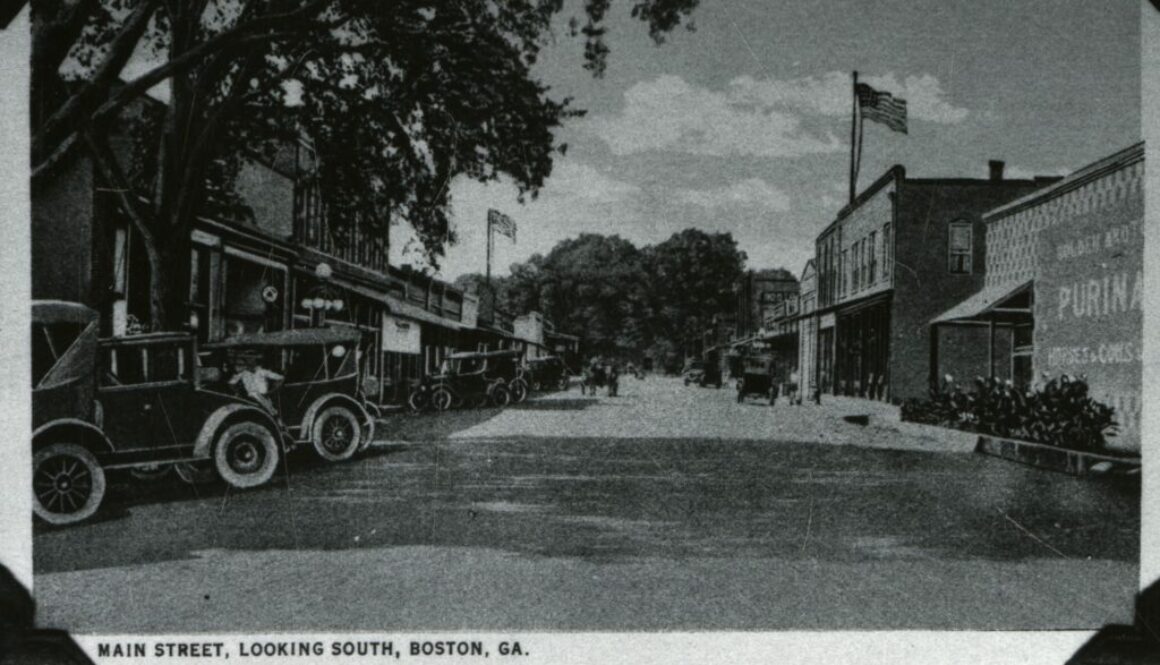
Deed records show that nothing really happened immediately. The land all around the depot was still owned by the Atlantic and Gulf Company – travel just a little beyond that and you’re including land that “Old Boston” people already owned. So by 1861, when they were calling the new depot stop Boston, there were three settlements named Boston along what is U.S. 84 today, all within 25 miles. “New” Boston didn’t really start to develop until 1869, when the Atlantic & Gulf Road sold all that land around the depot to Daniel Horn, who laid out and sold individual lots, and that’s really when Main Street and Jefferson Street started to become the heart of Boston. Things developed quickly and Boston, as we know it, was incorporated by Georgia in 1870.
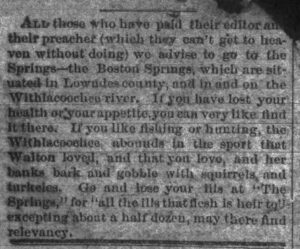
The third Boston, in Brooks County on the Withlacoochee, stopped being known as Boston, or Boston Springs, or Boston’s Spring through the 1860s, and by 1870 was known as Blue Springs, and was a fairly popular summer resort and recreation area for 30-40 years.
While it’s a bit more involved, the most likely explanation for Irwin MacIntyre attributing the founding of Thomas County’s Boston to Thomas M. Boston was a good ol’ fashioned mix up over time. He typically did not cite sources but was likely told all of this by an older member of the Boston community, or one of their children. I think it may be fair speculation that it was another well-known Thomasville citizen from a Boston family – Dr. Thomas Murdoch McIntosh – that likely shared this version of the story when he was older in 1923. The story also includes a side note about how the First Presbyterian Church of Thomas County became known as “McIntosh Presbyterian Church” in honor of Roderick McIntosh. There is no known contemporary evidence that the church was known by that name, only this claim from 1923.
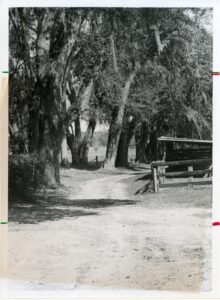
Finally, there is one more “missing” bit of information: Why are there no contemporary accounts of Old Boston and New Boston? The first mention of there being an “Old Boston” is the 1890 history, which used it in the context of the church being moved. But it was really around 1892, 30+ years after the fact, that the term “Old Boston” as a place came into common use. We believe it is most likely that the original Boston – which was unincorporated and did not have formalized borders until 1870 – was a farm region or district of Thomas County. Most of the known landowners owned hundreds of acres of land, that easily traversed the areas that later became known as “Old” and “New” Boston.
Only over time did memories of the location of the first church and still existing graveyard in the McIntosh lands lead to the idea of there being an Old Boston. Add in a third Boston down the road, a reverend with family from the Massachusetts Boston, and a guy named Tom Boston, and you have a recipe for confusion. An absolute, ironclad answer to how the Thomas County city got its name may not be knowable; but at least we know what it is not.