
We’re kicking it old-school this week with some Halloween activities you can do at home! We’ve pulled some pages from a book in our collections entitled, My Activity Book: The How and Why Program Activity Unit for Mother, Teacher, Child, a workbook of games, activities, crafts, and lessons put together by educators from around the United States in 1945. Many parents and teachers used books like this one to entertain their children while also encouraging them to think creatively and practice rudimentary skills like handwriting and basic math. Did you grow up with workbooks like this one? Try out these activities at home with your youngin’s or the young-at-heart!
Our first lesson is in drawing. Using simple shapes like circles, you can add in detail to create something new from a spooky Jack-O-Lantern to a flying witch. What creepy Halloween critters can you come up with?
Ready for more of a challenge? Follow along for the misadventures of Tommy and Susie.
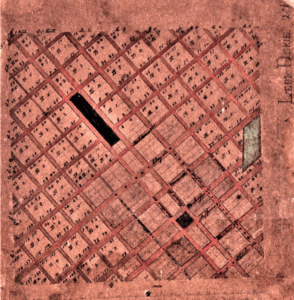
As we continue our spooky tales during the month of October, let’s travel to the Old City Cemetery to meet one of its unfortunate residents. This cemetery was the first public cemetery installed in Thomasville in 1858, almost 30 years after the establishment of the town. Prior to the establishment of the public burial grounds, most people were buried on their own or family property or they were buried in the graveyard of the church to which they belonged. As you might imagine, this practice became a problem as people moved around frequently, the town began to outgrow its original limits, and ideas about sanitation evolved.
Dekle, Ansel, “Plat Map of Thomasville, Georgia,” 1857. Thomasville History Center Collections, 1978.010.1595 (Note that the black rectangle denotes the original boundaries of the City Cemetery).
The original cemetery grounds covered from one end of the current lot down to what is now known as the Flipper Cemetery. Early burials here include Revolutionary War Veterans, town founders, and even enslaved workers found among the families they served. After the Civil War, the long lot of land was split by the newly laid out Jerger Street. The second half of the land formed Old Magnolia Cemetery, now Flipper Cemetery, a public burial ground specifically for the Black citizens of Thomasville. Years later, a portion of the original City Cemetery was given to the American Legion on which their facilities were built. As with many cemeteries of this age, many graves are unmarked or “lost” though some records remain of who was buried here.
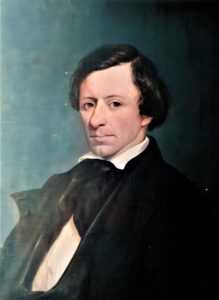
Edward Seixas Sr., 1860. Thomasville History Center Collections, 1978.010.1450.
But the grave I want to discuss today is still standing in the Seixas family plot. Edward Seixas was born in New York as the son of a Jewish immigrant who reportedly escaped from Haiti carrying only the family silver in a tablecloth. Edward converted to Christianity, married Huldah Smith — the daughter of a prominent Rhode Island merchant and sister to Simeon A. Smith who gave us Paradise Park — and moved to Thomasville. Edward started a pharmacy in town and became highly successful. Together, he and Huldah had three children and settled in what is now one of the oldest houses in Thomasville, the Seixas House located on Dawson Street.
While Edward is interesting in his own right, today I’d like to focus his only son, Edward Remington Seixas. Little Ed was born in Thomasville in 1839, the middle child between his two sisters. In the 1860 census, Ed was listed as working as a clerk, probably under his father at the family pharmacy. His family and community may have expected big things from Ed but any dreams for his future were tragically cut short in 1860.
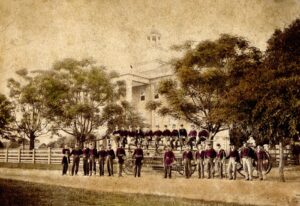
Ed was a member of the Thomasville Guards, a local home guard organized to protect the town. One of his superiors was a man named Columbus Sidney Davis Johnson, a farmer and the town Marshall. Around the middle of September 1860, the two men got into an argument and challenged each other to a duel. If you’ve seen the highly acclaimed Broadway musical Hamilton, you might already know that dueling is illegal in the United State, even back then. But if your opponent is the Marshall then who is going to stop you?
The Southern Enterprise, Oct. 3, 1860.
The men met at an undisclosed location with their pistols and their seconds. In a matter of minutes the duel began and promptly ended. Ed’s shot hit Johnson in the thigh, wounding him slightly while Johnson’s shot hit Ed along the head. An article in the newspaper, The Southern Enterprise, from October 3, 1860 tells the story of what happened next.
“It is with the deepest regret that we have to chronicle the death, on Sunday night last, of Edward R. Seixas, only son of Dr. Edward Seixas, of Thomasville, a young man of much promise, at the age of twenty-one. He died from the effects of a wound upon the head, received about two weeks previous, in a difficulty with Columbus S.D. Johnson, who was also wounded in the thigh, though slightly, by the contents of a pistol. Johnson was arrested on Sunday evening, brought before Judge Hansell on Monday, and the prosecutors not being able to make out a worse case than voluntary manslaughter, he was bailed in the sum of $2500. The untimely fate of young Edward, who, it was thought, had nearly recovered from his wound, has stricken with deep grief his family and numerous friends and relations, while the entire community is saddened by the lamentable occurrence. We tender the bereaved the assurance of our most heartfelt sympathy, in this their sad hour of affliction.”
Many people in town sided with the Seixas family, including a few of his fellow Guards who memorialized Ed in the newspaper. Johnson was allowed to leave town and moved to Liberty County in Florida, bringing his family out with him in the following years. The Seixas family quietly buried their only son at the City Cemetery before joining him there many years later.
Spooky season is soon approaching and the aisles of Walmart are lined with candy, costumes, and decorations for Halloween. Likewise, we’ll soon be gearing up for our Halloween offerings here at the History Center: from our cemetery tours to our trick-or-treat night in the historic backyard. If you can’t wait for tour season to start, why not use our handy guide for understanding the artwork carved into these mournful monuments while strolling through one of Thomas County’s many historic cemeteries? Take a look at these common images found on gravestones – we even made a bingo card for you and your spooky friends to play!
For the people of the 19th century, cemeteries were not just a burial ground. In densely packed cities and factory towns, they became an opportunity for green space where people could get out into fresh air. Re-envisioned as park spaces, people with the financial resources began decorating the graves of their loved ones with richly carved stones. Symbolic images told stories about the family’s feelings toward their departed loved one that words could not convey.
For our cemetery tours, we’ve compiled a list of common symbols or imagery found on stone grave markers and the meaning behind the carvings. How many of these have you seen while in a cemetery or graveyard?
Obelisk = faith, hope, and the strength to overcome adversity; immortality, eternal
Shells = religious pilgrimage and protection, and representing journeys to the afterlife or spiritual journeys through life; historically, shells were used practically in the American South to protect grave mounds from erosion, mimicking roofing shingles
Anchor = hope, steadfastness, and security; the anchoring influence of Christ
Florals arrangements = to add beauty, uniqueness, and a sense of individuality to the memorial, making it feel less standard; some flowers, like lilies, have their own symbolic meaning
Cross = faith in Jesus Christ, hope for eternal life, and the resurrection of the dead
Weeping Willow = profound grief and sorrow; rebirth, resurrection, immortality, and the enduring cycle of life
Square and compass = the Freemason’s symbol for the balance between moral uprightness and spiritual boundaries; denotes membership in the organization
Vines = eternity, growth, and the cyclical nature of life; ivy for eternal life; grapes for being a follower of Jesus; rose for love
Urn = the body as a vessel that once held the soul; mourning or a transition to the afterlife
Shroud or scarf = a veil separating the earthly realm from the spiritual
Broken column = a life cut short, representing that the person died young or in their prime, before reaching old age; the loss of the head of the family or a pillar of the community
Lamb = innocence, purity, and youth; frequently found on the graves of children and infants; Lamb of God referring to Jesus Christ and His sacrifice to take away the world’s sins
Tree stump or stack of logs = Jagged, rough breaks signify a sudden or unexpected end to a life; also used by members of the Woodmen of the World, an insurance organization
Clasped Hands = love, farewell, and the hope of rejoining in the afterlife; often representing a couple’s bond, a final goodbye, or a divine welcome into heaven
Hand pointing up = represents the deceased’s soul going to heaven, signifying the hope of an afterlife for the righteous and confirmation of a life after death
In honor of the upcoming War of the Roses, our curator, Ephraim, is bringing you some Thomas County football history for this blog. If you want the definitive list of football games played by Thomasville High School and Thomas County High School, from the good ol’ days to the infamous game of ’93, he’s got ’em!
The Complete Appendix for Bulldogs vs. Yellow Jackets
The first football game between the Thomasville High School Bulldogs and the (then) Central High School Yellow Jackets took place on Friday, September 14, 1962. It was the Bulldog’s 49th year of playing football, and the Yellow Jacket’s 4th, so it was no surprise that Coach Joe Sumrall’s squad beat Moe McClung’s 34-0. Below is the complete list of matchups between the two teams, by coach and year; the home team is listed first.
Total Combined Score: Central 981 – Thomasville 1105
Central High School Head Football Coach Moe McClung Huddles with Football Players, September 1, 1966. Ed Kelly Collection.
Moe McClung (Yellow Jackets) vs. Joe Summerall (Bulldogs)
1962 09-14: Central 0 – Thomasville 35
1963 09-20: Thomasville 34 – Central 0
1964 09-04: Thomasville 13 – Central 6
1965 09-03: Central 2 – Thomasville 25
Moe McClung (Yellow Jackets) vs. Lee Forehand (Bulldogs)
1966 09-02: Central 6 – Thomasville 27
1967 09-01: Thomasville 21 – Central 7
Lee Forehand (Bulldogs) vs. Bruce Long (Central)
1968 09-20: Central 8 – Thomasville 40
1969 09-19: Thomasville 56 – Central 7
Tom Fiveash (Central) vs. Jim Hughes (Thomasville)
1970 11-13: Central 0 – Thomasville 34
Thomasville High School Football Coaches Joe Sumerall, Guy Sullivan, Hurley Manning, and Will Roy Cooley -1963. Ed Kelly Collection.
Jim Hughes (Thomasville) vs. Will Roy Cooley (Central)
1971 11-12: Thomasville 27 – Central 0
1972-1975: No games were played between Central and Thomasville
1976 10-15: Thomasville 3 – Central 7
1977 10-14: Central 14 – Thomasville 15
Jim Hughes (Thomasville) vs. Don Garland (Central)
1978 10-06: Thomasville 26 – Central 6
1979 10-05: Central 23 – Thomasville 21
1980 10-10: Thomasville 6 – Central 7
Jim Hughes (Thomasville) vs. Larry Green (Central)
1981 10-09: Central 0 – Thomasville 28
1982 10-08: Thomasville 28 – Central 0
Larry Green (Central) vs. Terry Powell (Thomasville)
1983 10-07: Central 0 – Thomasville 10
Mike Hodges (Thomasville) vs. Charlie Greene (Central)
1984 09-07: Thomasville 0 – Central 10
1985 09-06: Central 27 – Thomasville 6
1986 10-17: Thomasville 28 – Central 35
1986 11-28: Central 13 – Thomasville 7 Regional Playoff Game
1987 10-16: Central 6 – Thomasville 15
1987 11-27: Thomasville 21 – Central 35 Regional Playoff Game
1988 10-07: Thomasville 27 – Central 0
1988 11-18: Thomasville 21 – Central 3 Regional Playoff Game
1989 10-06: Central 20 – Thomasville 17
Charlie Greene (Central) vs. George Bobo (Thomasville)
1990 09-14: Thomasville 46 – Central 7
Thomas County Central High School Coach Ed Pilcher during the State Championship Game against Thomasville High School, December 12, 1993.. Thomasville Times-Enterprise Collection.
George Bobo (Thomasville) vs. Ed Pilcher (Central)
1991 09-13: Central 9 – Thomasville 23
1991 11-15: Thomasville 42 – Central 21 Regional Playoff Game
1992 09-11: Thomasville 21 – Central 20
1993 09-10: Central 28 – Thomasville 7
1993 12-18: Central 14 – Thomasville 12 State Championship Game
Ed Pilcher (Central) vs. Neal Rumble (Thomasville)
1994 10-14: Thomasville 0 – Central 28
Ed Pilcher (Central) vs. Jack Johnson (Thomasville)
1995 10-13: Central 45 – Thomasville 7
1996-1999: No games were played between Thomasville and Central
Thomas County Central High School Fans during the Game against Thomasville High School, September 22, 2000. Thomasville Times-Enterprise Collection.
Ed Pilcher (Central) vs. Tommy Welch (Thomasville)
2000 09-22: Thomasville 16 – Central 7
2001 09-21: Central 19 – Thomasville 0
2002 09-13: Thomasville 28 – Central 29
2003 09-12: Central 56 – Thomasville 26
2004 08-20: Game cancelled because of lightening two consecutive days
Ed Pilcher (Central) vs. Richie Marsh (Thomasville)
2005 08-19: Central 45 – Thomasville 24
2006 09-01: Thomasville 7 – Central 21
2007 09-01: Central 28 – Thomasville 7
Richie Marsh (Thomasville) vs. Bill Shaver (Central)
2008 08-29: Thomasville 7 – Central 13
2009 08-28: Central 9 – Thomasville 13
2010 08-27: Thomasville 17 – Central 20
2011 08-26: Central 35 – Thomasville 20
2012 08-25: Central 41 – Thomasville 7
Bill Shaver (Central) vs. Leroy Ryals (Thomasville)
2013 08-23: Central 38 – Thomasville 0
2014-2015: No games were played between Thomasville and Central
Bill Shaver (Central) vs. Zach Grage (Thomasville)
2016 08-26: Thomasville 14 – Central 16
2017 08-25: Central 7 – Thomasville 41
Zach Grage (Thomasville) vs. Ashley Henderson (Central)
2018 08-24: Thomasville 39 – Central 7
2019 08-30: Central 31 – Thomasville 17
2020 09-11: Thomasville 34 Central 7
2021 08-27: Central 14 – Thomasville 23
Justin Rogers (Central) vs. Jonathan DeLay (Thomasville)
Let’s venture outside of Thomasville into the county to Ochlocknee. If you’re not from this area that name may sound rather odd – and depending on who you talk to, it may be pronounced and spelled in different ways. So why is that? And where did this name come from? And what could it mean? We looked into some research to find out the answers to these questions. The obvious answer to the question of how the town of Ochlocknee got its name is from the Ochlocknee River, but that makes for a very short and very dull blog. So instead, we’ll go back – way back – to see how the river got its name too.
Map of Ochlocknee, Georgia, 1969. Thomasville History Center Collection.
The river which we now know as the Ochlocknee River (or the Ochlockonee River if you live in Florida) starts in Worth County. From there it flows southward into Colquitt County before hanging left and cutting westward through several counties before looping back east and emptying into a bay in Apalachicola, Florida. The northwest corner of Thomas County is home to part of this river and the town is located not far from it. Like most rivers, it provides a habitat for various types of marine life as well as a food and water source for terrestrial wildlife. In other words, everyone wants to hang out by a river if they want to survive. Humans are no different.
The first people to arrive in this area thousands of years ago, were hunter-gatherers whose needs were met along the river. Eventually other groups moved into the area bringing new ideas and ways of life. One big name includes the Mississippi Mound Builders, a culture that originated around the modern southern states of America and spread throughout the eastern half of the country, including much of Georgia and Florida. Just like people today, these groups were slightly different based on where they lived. In our area, a group known as the Fort Walton Culture developed. They weren’t too different from their neighbors except that they made their pottery using slightly different materials based on what they had. As clusters of little family groups developed into larger villages, they expanded their trading along rivers like the Ochlocknee up north into middle Georgia. They became more heavily influenced by their new trade partners, and the cultural practices of the people of this area changed into what archaeologists call the Leon-Jefferson Culture, named after the counties in which archaeological evidence was found.
These were the ancestors of the people living in our area when the first Spanish explorers arrived here in the 1500s. The Apalachee People’s territory covered the Florida Panhandle up to South Georgia and west from the Aucilla River to the Ochlocknee River. They built villages, set up trade networks, and influenced their environment with controlled burns in the long leaf pine forests. Their capital city was located around modern-day Tallahassee, a site they called Anhaica, and many of their cultural centers or mounds can still be seen around the area – the Lake Jackson Mound Sites being part of that area.
When Spanish explorers and conquistadors arrived in Florida, they learned of a land north of the Big Bend called Apalachen by neighboring Indigenous people. This is where we get the modern name of Apalachee for the people who lived in our area as well as the name Appalachian used to name the mountain range that extends north of us. Like most encounters with the Spanish, this meeting did not go well for the Apalachee people. In 1528, they managed to fight off a group of invading Spanish explorers, leaving only four conquistadors to tell the tale. But in 1539 they had a much more formidable foe: Hernando de Soto. De Soto and his men quickly captured Anhaica thanks to their horses, but not long after, the Apalachee learned they could easily defeat these invaders by attacking their horses. Sorry horses.
Eventually disease and the constant invading by the Spanish wore down the Apalachee forces. Spanish missionaries moved in and converted the remaining Apalachee people to Catholicism before sending them to work at missions, like Mission San Luis, and ranches across Florida. But the Spanish couldn’t defeat them all! The Apalachee territory extended farther north than the Spanish were willing to settle in. The Apalachee people who lived in these areas managed to continue living there for several centuries more, even as European settlers began infiltrating more and more of their lands. Many Apalachee married into the white families around here but a few went on to form the Seminole Nation by joining with other indigenous groups throughout Florida.
But what about Ochlocknee? When those early Spanish explorers and missionaries first entered the area, they made maps of the land and its features. The Apalachee did not have a written language, but the Spanish took the Apalachee names and wrote their own version of what they heard.
The Searles Children Swimming on the Ochlocknee River, c.1915. Watt Collection.
The name Ochlocknee comes from two different words in the Apalachee language. While this language is no longer used today, it was part of the Muskogee language family and was very similar to the Hitchiti and Miccosukee branches of the language. The first word in Ochlocknee is “Oki” meaning water. The Okefenokee swamp also starts with “Oki” as does the Okapilco Creek – all water ways. The second word is “Lagana” or “Lugni” meaning yellow. So to the Apalachee people, this was the “yellow water.” And if you visit the Ochlocknee River, you might notice that it doesn’t have the cleanest looking water running through it. That’s because the northern parts of the river (including our area) run through clay-rich soil which gets carried away by the current, mixing that red and sandy colored clay in with the water and giving it its distinctive color. For many generations, it was believed the name meant “Crooked Water,” but nothing has been found to support this claim.
Over time translation issues thanks to the Spanish combined with non-Apalachee speakers moving into the area, changed the name of the Oki Lugni or Oki Lagana to the modern name Ochlocknee or Ochlockonee. Local poet Lola Stubbs got the point when she wrote
“When indigenous man trod the river’s banks,
Swam root-dyed currents, swift and free,
Breathed “Oki-lag-ni, Yellow Waters,”
the white man echoed “Oaky-locknee.”
As for the town in Thomas County, the name comes from its proximity to the river. American settlers spread out into the area as early as the 1810s. But it wasn’t until the 1860s that the town was formally settled, and it didn’t have a charter until 1877. This was around the time the rail road was laid through the town, connecting Thomasville to Albany with Ochlocknee in the middle. Today Ochlocknee is a small town of around 700 people. People from all over still go to swim and fish in the river and events still celebrate the town and the people who live there.
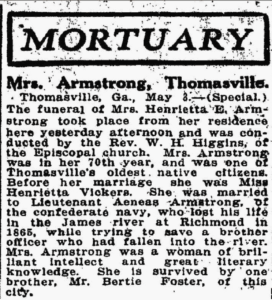
What must it have been like to live in Thomasville at the brink of the Civil War? Here at the History Center we have the transcript of a diary written by a young, seventeen-year-old woman over the year of 1861. This diary not only gives us insight into this question but also paints a vivid picture of life in South Georgia and how it was about to drastically change. Follow along as we explore the world from Henrietta Armstrong’s point of view in this blog series!
When we last checked in on Henrietta, she had just learned that her brother was joining the Confederate Army. At the same time, she was home in Smithville nursing her sick husband and wondering what would come next. Her diary is heading into the summer of 1861 at this point. The weather is heating up, the crops are drying out, and tensions are rising alongside the thermometer. Let’s see what happens with Henrietta next.
Within the first few days of June, Henrietta is already having a very relatable Southern summer. Just as we are accustomed to here, the weather was hot and they were in desperate need of rain. As Henrietta most appropriately put it, “My garden is literally burning up” (June 11, 1861), showing that even over a hundred fifty years ago, teenagers were throwing the word “literally” into any sentence.
In the meantime, Aeneas continued to struggle with his health. Despite beginning the month on a good note, within two days he was back to ailing, this time with “weakness of the stomach.” Coincidentally, he had just started taking a new medicine prescribed by a Dr. Mettaver a few days before. But the pendulum would soon swing back in Aeneas’s favor as Henrietta reported,
“Aeneas is a great deal better today. He applied, last night, a mustard plaster to his stomach and it has relieved him almost entirely of the soreness in his stomach.” (Tuesday June 3, 1861).
Paper packet containing Mustard Plaster, by Seabury and Johnson, 1880-1900. Science Museum Group Collection
Mustard plasters were a popular remedy for aches and pains and were made by grinding up mustard seeds, mixing the powder with flour, and applying the mix under a bandage to the affected area much like the 1800s equivalent of an Icy-Hot Patch. The powdered mustard warms the skin and muscles – although leaving it on for too long could lead to burns. Whatever was ailing Aeneas this time, the patch seemed to help with the pain. But as seems typical for the Armstrong family, Aeneas’s good health only lasted a month until he spread a cold throughout the entire plantation.
Henrietta’s journaling from this time reveals her feelings about Smithville and life in the country in general during this time: it was dull. She states,
“We are lonesome. We see nobody at all and hear nothing.” (Friday, June 7, 1861).
The closest the Armstrong’s came to social interaction was through letters back home (including one that contained a picture of Buddie’s daughter, soon to be named Henrietta after her aunt) and conversing with the hired and enslaved workers on the plantation. The hired workers were Mr. Price, the plantation overseer, and his wife, both of whom seemed to be frequently in trouble for borrowing or taking more than they should of the Armstrong family’s food and resources.
With none of their family or friends around for dozens of miles and very little in town to do, their entertainment came from reading books (most of which they’d already read), playing the piano (which Henrietta forgot how to do), and trying out foods from the newfangled technology of cans and tins. From this we get thrilling updates like:
“Aeneas opened a can of fresh salmon this evening. He enjoyed it very much.” (Thursday, June 6, 1861).
The next day they tried canned corn and tomatoes which were “very nice indeed.” Complaining about their situation, Henrietta admits,
“This life is getting to be very wearisome and monotonous. Aeneas is improving though everyday and I hope that he will continue to exercise prudence and take good care of himself. He is still reading “The Last of the Barons.” I have nothing to read myself. I have read every thing in the house and I am, to use a French word ‘ennuyed’ almost to death. I wish I could get my [sewing] machine, I could then do some work. As it is I have nothing to do. Aeneas and I played cards awhile this evening and then he opened another can of salmon.” (Wednesday, June 12, 1861.)
But things were about to get going. Within a few days the couple ventured out to town to retrieve Henrietta’s sewing machine that was brought by train from Macon. After learning about the intensifying fighting in Virginia between the Union and Confederate troops, Henrietta felt invigorated to help the Confederate troops.
“We were victorious in every encounter. It looks as if Providence is on our side. Mrs. McAfee gave me some drawers to make for the soldiers, I have my machine now and can get along very well.” (Saturday, June 15, 1861).
On top of her work for the soldiers, she made several new clothes for the enslaved workers on the plantation including “three shirts for Edmond, Evans, and Wilson and two dresses for Adeline and Chloe” followed by “three pairs of britches, and one dress for Malinda,” and slip dresses for the children. To make matters more exciting, Henrietta spotted a comet passing by for several days in July, remarking,
“I was very much astonished tonight by seeing a large comet in the West.” (Tuesday, July 2, 1861)
“Great Comet of 1861, also known as C/1861 J1 or comet Tebbutt” by E. Weiss.
She went on to mention the comet over several days, with it only seeming to disappear from view by the middle of the month. This turns out to be “The Great Comet of 1861” which was first seen in Australia over a month before Henrietta could see it. Several notable people across North America also wrote about seeing the comet. And if you can wait around until 2267, you could see it too!
By the end of July, Henrietta remains fairly bored with the occasional bit of news keeping her spirits from sinking too low.
“Next Wednesday is my birthday, I will be eighteen years old. I feel ten years older at least… I wish some of our relatives would visit us.” (Friday, July 26, 2861).
Unfortunately, Henrietta would have to wait another few weeks to see her family and friends. In the meantime, she lost some friends following the death of two Macon men during a battle in Virginia and the elopement of a young woman from a neighboring home who ran away with the Armstrong’s previous overseer.
Despite her ongoing boredom in Smithville, things were heating up across the country and the consequences of the Civil War were soon to come home to the Armstrong family. Will Buddie and Aeneas be called up? Will Henrietta get to leave Smithville? Will canned salmon be on the menu again? Join us next time to hear how life is about to get more interesting for Henrietta and Aeneas.
Every so often, the museum receives a donation that includes a cookbook or recipe card. Sometimes the recipes are familiar comfort foods still served on many Thomas County tables. Others… well, let’s just say some recipes are best left in the past. This series highlights some of those recipes: from the classics to the experimental. If you try any of these recipes, successfully or not, let us know what you think in the comments!
Today’s recipe comes from Mrs. Ralph Durham with the First Baptist Church in Thomasville. Clara Elizabeth Swift (1911 Gardner, FL – 2002 Boone, NC) married William Ralph Durham sometime before 1935 in Perry, Florida. In 1938, their only child, Harvey Ralph Durham, was born. The family moved to Thomasville by 1941 and quickly became involved with the First Baptist Church on Broad Street. William became a deacon and superintendent over the Sunday school while Clara taught the Philathea Class, a bible study group for women.
Their son Ralph attended Thomasville High School where he was involved in many extra curriculars. After graduating, he attended Wake Forrest and the University of Georgia, before eventually getting his PhD in Mathematics. By 1967, Ralph was made a professor of mathematics at Appalachian State University in Boone, North Carolina. A few years later, Clara and William moved to North Carolina to be closer to their son and his family.
Big brains for mathematics need a lot of protein. Clara cooked this recipe for steak at her home and shared it with her fellow congregants at First Baptist Church of Thomasville in 1962. As you light up the grill this summer, why not try out her recipe, and let us know how you liked it?
Chuck Wagon Pepper Steak
Ingredients:
1 boneless chuck steak 2’ thick
1 tsp. unflavored tenderizer
2 tbs. minced onion
The church as Clara would have known it. Thomasville History Center Collection: First Baptist Church – 3rd Building – 1968.
2tsp. thyme
1 tbs. butter
1 bay leaf
1 cup wine Vinegar
½ cup Olive Oil
3 tbs. lemon juice
2 tbs. cracked pepper
Directions:
Put tenderizer on steak, let stand for 30 minutes. Mix other ingredients and pour over steak turning often from one to two hours.
Remove meat.
Grill to a rich brown about 15 minutes on each side.
Mrs. Ralph Durham
First Baptist News – “Seekers Specialties” for Your Kitchen 6/10/62 Vol. 8 No. 60
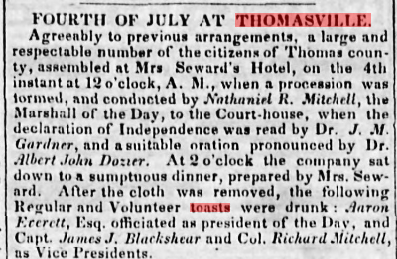
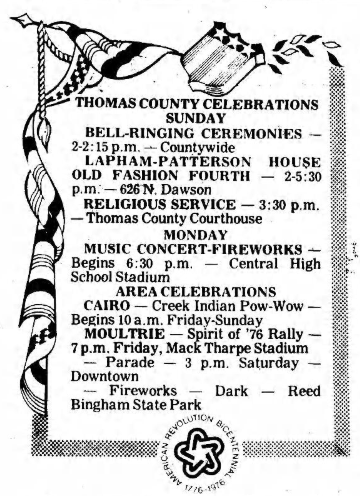
The Fourth of July is here, and while you’re enjoying those hamburgers and hotdogs under a sky lit up by fireworks, why not take a moment to think about some of the people who fought to establish the United States almost 250 years ago? We know of at least five veterans of the Revolutionary War who lived in Thomas County. They were some of the first settlers of this county following its establishment in December of 1825. Join us as we take a brief look into these men, their service to a future country, and the lives they led afterward.
Let’s start with a strong name: Ignatious Hall. Ignatious was born in 1755 in Maryland but his family moved to a small plantation in North Carolina some time in his youth. Around the late 1770s he married his first wife. In 1781 when he was 25, he was made Deputy Quartermaster General and worked as an express rider delivering messages back and forth between military leaders, a bit like Paul Revere. Ignatious held this position for a year before being discharged around the end of the War.
After the War, Ignatious and his first wife had five children: three girls and two boys. Sometime after 1803, his first wife died and the family moved to Tattnall, Georgia. There he met Elizabeth Lewis and married for a second time. In the 1820s, Ignatious was a fortunate drawer in the Georgia Land Lottery and continued moving around the state to claim his land, including some in what was then part of Thomas County (now Colquitt). He stayed here for the remainder of his life until his death in 1843.
Our second veteran is Joseph Anderson. Joseph was born in 1757 in New Bern, North Carolina. We weren’t able to find out much about his early life, but in 1781 when he was about 23 years old, Joseph became a private in the brigade of Colonel Francis Marion, also known as “The Swamp Fox.” During his service he saw action at the Ambush along Benbow’s Ferry on the Black River, the Battle of Camden, the Battle and Siege of Fort Watson, and the Battle of Eutaw Springs. His service ended in 1781 after the British pulled out of the Southern Colonies.
After the War, Joseph moved to South Carolina where he married Shepahoomia Pushmataha, or Sarah Running Deer (1770-1855). Together they had ten children: eight daughters and two sons. Around 1810, the family moved into Bulloch County, Georgia to farm. In 1827, after most of the children were grown with homes of their own, Joseph and Sarah moved to Thomas County alongside a son, Moses, and his wife, Rachel McClelland. They lived in Thomas County the remainder of their lives, even after Joseph’s death in 1848. In fact, you may be or know one of their descendants: many members of the Roddenberry family can trace their line back to Joseph.
Our third man is Ralph Bozeman who was born in Bladen County, North Carolina in 1760. He was living in Williamsburg County, South Carolina when he enlisted with General Francis Marion’s Brigade in 1777. During the War he served in the Battles of Dorchester, Monck’s Corner, Black Mingo, Pinkney’s Lane, Mars Bluff, Camden, and Eutaw Springs – perhaps he met Joseph Anderson there!
Ralph’s life after the War remains shrouded in mystery. According to his testimony given when applying for a pension, he was discharged from military service in 1781 when his unit was in Charleston, South Carolina. After that, he spent thirty-two years “following the seas” as he put it before settling down to live in Georgia moving from Bulloch County to Brian County to Effingham County then to Liberty County then Twiggs County then Houston County and finally to Thomas County sometime after 1830. But he wasn’t done: in 1836 he moved to Gadsden County in Florida where he spent the rest of his very long life, dying in sometime after 1850 when he was in his 90s.
Our fourth soldier was Shadrach Hinton, born in 1759 in Bertie County, North Carolina (are you noticing a pattern of North Carolinians here?). According to Shad’s family he entered service on May 1, 1780 in Captain Johnson’s cavalry, serving three months before being honorably discharged. On year later toward the end of the War as it took place in the South, he entered as a substitute under the command of Captain Walton and Major Hogg (hold your giggles there) and served for three months before being honorably discharged.
Things got a little messy with Shad from here: after the War he married and had fourteen (14!!) children. In 1806 he legally changed his last name, and that of all thirteen of his living children, to Pugh. When land opened up in South Georgia, he moved the whole family to Thomas County where he lived until his death in August of 1842 while he was visiting family in Alabama. Before his death, he attempted to ask for his pension but was denied due to not having the necessary documentation (a problem faced by the other veterans aforementioned). His children reapplied after his death with their success or failure remaining undetermined at this time. However, many of his children remained in Thomas County leaving descendants who remain here today.
Finally we have a name you may already be familiar with: Simon Hadley Sr. He was born in 1760 in (you guessed it) Cumberland County, North Carolina. Despite being from a Quaker family, Simon enlisted with the Continental Army four times throughout the War, fighting alongside his father and brother (the Quakers disowned them for this). Not only did he serve as a soldier but he also worked to supply and deliver beef cattle to the troops.
After the War, Simon married Jane Wilkinson (1767-1829) and the couple had seven children including a daughter Jane who lived at what we now call Pebble Hill Plantation and Simon Jr. whose legacy includes many Hadley descendants still in Thomas County today. The Hadley family moved to Georgia in the 1810s where Simon Sr. served in the House of Representatives. In the 1820 land lottery, he won land in what was then Early County but later became Thomas County where he brought his family to live on their own plantation. Simon was very civically involved in Thomas County and ranked as the second largest slaveowner in Thomas County with 48 people working for him. He died in 1835 at the age of 75.
At the time of Thomas County’s formation in 1825, the War had been over for forty-two years, a time gap not too far off from our connection to veterans of the Vietnam War today. Imagine what their stories would have been about and what sights they saw at the forming of our country. Their experiences in the War made their journeys to Thomas County possible and developed the area we experience today.
In a world where dating takes place virtually more often than it does in person, you might wonder what the people of yester-year had to go through to mingle as singles. You’ve probably heard stories about watchful chaperones and strict curfews: one wrong move could sour your reputation and ruin your chances of finding a partner. Knowing these difficulties but still wanting to meet people, a group of Thomas County boys met in 1914 and made a plan. They found older chaperones, procured a camping site along the Ochlocknee River, and sent out invitations to other young men and women throughout the Southeast to come to their riverside camping club for a week in the summer. From this plan, the Ochlocknee Riverside Camp was born.
Ochlocknee River Camp – Mitch Davenport and friends eating ice cream, 1916. THC 1967.01.349.
We have a book in our collection that documents this camp during its three-year operation. Each day the camp was open, the guests signed in, leaving us long lists of attendees. Over the past year, we have been working to research these attendees to see where they came from, who they knew, what happened to them after the camp, and – most importantly – how successful they were in their search for love!
With 78 campers attending over three years, only ten of those campers married one another. That’s a very rough 12.5% success rate for this camp as far as setting couples up goes. You drop a few points when you consider that the first chaperone was divorced shortly after the first camp year took place. But maybe marriage wasn’t the only goal. Afterall, many of the attendees were young teenagers – this camp was not only a good way to meet people but also a safe environment to practice socializing with people outside of their inner family.
Illustration from the Ochlocknee Riverside Camp Club Book, 1916.
At least, it was mostly safe. As happens with most groups of young people, there were times where campers didn’t get along – even if their camp rhyme stated that “Q is for quarrels, of which we have none.” Evidence of these heightened emotions pop up in a set of poems written in the 1916 section of the book. Judging from the way the poems are compiled, the book must have been passed around a lot, giving the campers the opportunity to profess their feelings about one another, show off their sense of humor, or make snide remarks back and forth (sometimes anonymously and other times more openly). You can read these poems through the above spreadsheet linked to the appropriate camper’s name.
At the end of the day, any event’s success is better measured not by a product (like marriages) or the length of time in which it ran, but by the feelings of the attendees. In this case, the Ochlocknee Riverside Camp could be considered a success. Many of the camper poetry calls out the success of the camp, complimenting the chaperones, the food, and the fun they had along the beaches of the Ochlocknee.
Men of the Ochlocknee River Camp, 1916. THC 1967.01.337.
In fact, it’s possible this camp would have continued for many years following had it not been for the United States’ involvement in World War I. We know at least seventeen of the thirty-eight men who attended the camp served in World War I in some capacity, two of whom died as a result of the war. And while they weren’t in the military, we know at least a few of the women served in auxiliary groups and with the Red Cross. If anything, the Ochlocknee Riverside Camp was the last hurrah for many of these young people before a harsh reality forced many of them to grow up quickly.
This little time capsule of a book captures a certain youthful innocence of the 1910s in Thomas County. A time when all that mattered to the campers was how good of a swimmer you were and whether or not the right person liked you back. So while they may not have had the longest running camp nor been able to point out several happy couples resulting from those summers along the Ochlocknee, the camp was able to bring together a score of young people from across the Southeast for some G-rated fun. It probably beat staying at home!
If you’ve been following along with our adventures over the years, you’ve probably heard about our Apprentice Program. Open to teens throughout Southwest Georgia and North Florida, we’ve invited them into the museum world for a few years now. They learn about the ins and outs of non-profits, from fundraising to education and curation and all the bits in between. Somewhere along the way, they even get to pick up soft skills like how to present yourself, working with others, and transforming their ideas from a spark of inspiration to something to be shared with the public.
Over the last year, we had six Apprentices across three cohorts. Our newest members, Bria and Wren, had a lot to digest as we took them through Museums 101. With the second cohort joining us, we took a trip to the Georgia Museum of Agriculture in Tifton to see how other museums operate. The Apprentices got to speak with the museum’s programs director – in action as she assisted a cane syrup bottling demonstration – explored various historic buildings, and participated in several activities from grinding corn meal to making rag dolls.
Speaking of the second cohort, we were glad to have Bella, Alanis, and Wesley join us for a second year in their apprenticeship. We took them deeper into the innerworkings of non-profits where they learned about budgets, living collections (that’s animals and plants), and the real-world applications of public history.
Jack shows off World War I artifacts from the Thomasville History Center’s collections.
Our longest serving Apprentice, Jack, has been with us for three years. As the sole member of his cohort (the others having graduated or moved on), we stepped up the game on his apprenticeship. Over several months, Jack visited the local courthouse record rooms where he studied a set of books listing every man (and woman!) from Thomas County who served in World War I. These books are over one hundred years old, with frayed pages full of detailed information on these officers, soldiers, seamen, and nurses, many of whom saw action in Europe. Their stories are told within these pages. With the data Jack collected, we will now be able to tell a more complete story about Thomas County’s involvement with the “War to end all Wars.”
At the end of each year, the Apprentices complete a capstone project, a culmination and application of what they’ve learned over the year combined with a subject that interests them. We challenge them to dream big and then transfer those ideas into a presentation that can be delivered to the public (usually an adoring audience of family and friends).
The Capstone Showcase was held April 26 in the History Center’s Davis Wing.
This year, they mustered up their courage and displayed several beautiful and well-thought out projects. Bria envisioned an off-site exhibition detailing her family’s history within Thomas County while Wren created a walking tour of a historic district near downtown Thomasville. Our second cohort featured fundraisers with Wesley’s idea for an event on the grounds of Pebble Hill, Alanis’s plans for a drive-in movie event, and Bella’s dreams for Folk Music festival that would educate attendees on the connections between folk music and native flora in the South. We rounded the capstones off with a presentation from Jack featuring the information he collected over the year accompanied by several artifacts from the History Center’s collections that will be used in future exhibit material here at the museum. Dozens of family members and friends turned out to view our Apprentices’ work and a good time was had by all.
We’ve been grateful to have the opportunity to work with the Apprentices over the years. Each one brings something new and unique to the table and inspires the staff at the History Center to dive deeper into the world of history and museums.