The Thomasville History Center, in collaboration with the Georgia Historical Society, is pleased to announce the reinstallation of the Georgia Historical Marker for Finney General Hospital, preserving an important public-history landmark connected to Thomasville’s World War II history.
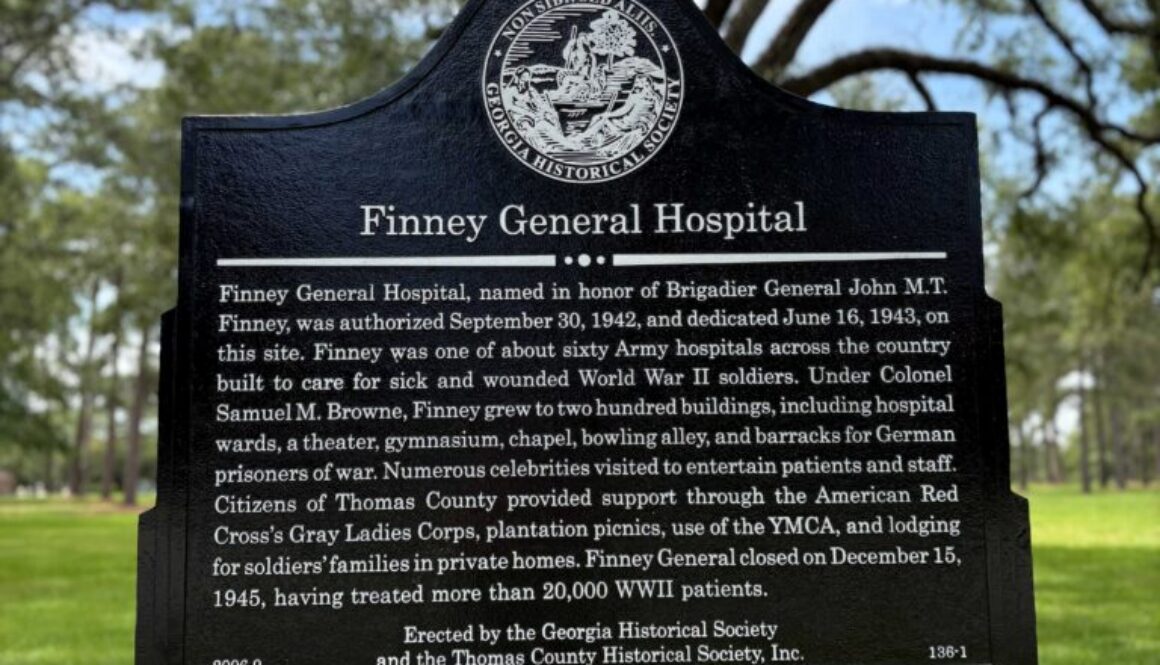
Originally erected in 2006 by the Georgia Historical Society and the Thomas County Historical Society, Inc., now the Thomasville History Center, the marker commemorates Finney General Hospital, a World War II Army hospital once located in Thomasville. The hospital, named in honor of Brigadier General John M.T. Finney, was authorized on September 30, 1942, and dedicated on June 16, 1943. It was one of sixty Army hospitals built across the country to care for sick and wounded World War II soldiers. Before closing on December 15, 1945, Finney General Hospital treated 23,055 World War II veterans.
The marker, which had sustained damage, was recast and reinstalled through a partnership between the Georgia Historical Society and the Thomasville History Center, the marker’s local sponsor. Installation was completed by Pride & Sons Services, LLC, a family-owned Thomasville business whose roots in the community go back generations. The project reflects the shared commitment of all involved to preserving Georgia’s historical markers and ensuring that significant local stories remain accessible to residents and visitors.
“Historical markers are one of the most visible ways communities encounter their past,” said Austin Bell, Executive Director of the Thomasville History Center. “We are grateful to the Georgia Historical Society for its leadership in preserving this marker and proud to continue our role as sponsor. Finney General Hospital is an important part of Thomasville’s story, and this project helps ensure that history remains present in the landscape.”
During its operation, Finney General Hospital grew to include approximately 200 buildings, including hospital wards, a theater, gymnasium, chapel, bowling alley, and barracks for German prisoners of war. Citizens of Thomas County also supported the hospital and its patients through the Grey Ladies Corps, plantation picnics, use of the YMCA, and lodging for soldiers’ families in private homes.
Finney General Hospital was part of Thomasville’s 20th-century history and represents the community’s connection to broader national events. By restoring the marker, the project helps preserve public access to that history and supports continued awareness of Thomasville and Thomas County’s role in Georgia’s past.
“Georgia’s historical markers help tell the stories of communities across the state,” said Breana James, Program Manager, Georgia Historical Society. “We appreciate the Thomasville History Center’s continued stewardship of the Finney General Hospital marker and its partnership in helping preserve this piece of Georgia history.”
The marker is located near the intersection of South Pinetree Boulevard and South Martin Luther King Jr. Drive, on the south side of South Pinetree Boulevard along the sidewalk. Public parking is available at nearby Balfour Park.
The Thomasville History Center, in collaboration with the Georgia Historical Society, is pleased to announce the reinstallation of the Georgia Historical Marker for Finney General Hospital, preserving an important public-history landmark connected to Thomasville’s World War II history.
Originally erected in 2006 by the Georgia Historical Society and the Thomas County Historical Society, Inc., now the Thomasville History Center, the marker commemorates Finney General Hospital, a World War II Army hospital once located in Thomasville. The hospital, named in honor of Brigadier General John M.T. Finney, was authorized on September 30, 1942, and dedicated on June 16, 1943. It was one of sixty Army hospitals built across the country to care for sick and wounded World War II soldiers. Before closing on December 15, 1945, Finney General Hospital treated 23,055 World War II veterans.
The marker, which had sustained damage, was recast and reinstalled through a partnership between the Georgia Historical Society and the Thomasville History Center, the marker’s local sponsor. Installation was completed by Pride & Sons Services, LLC, a family-owned Thomasville business whose roots in the community go back generations. The project reflects the shared commitment of all involved to preserving Georgia’s historical markers and ensuring that significant local stories remain accessible to residents and visitors.
“Historical markers are one of the most visible ways communities encounter their past,” said Austin Bell, Executive Director of the Thomasville History Center. “We are grateful to the Georgia Historical Society for its leadership in preserving this marker and proud to continue our role as sponsor. Finney General Hospital is an important part of Thomasville’s story, and this project helps ensure that history remains present in the landscape.”
During its operation, Finney General Hospital grew to include approximately 200 buildings, including hospital wards, a theater, gymnasium, chapel, bowling alley, and barracks for German prisoners of war. Citizens of Thomas County also supported the hospital and its patients through the Grey Ladies Corps, plantation picnics, use of the YMCA, and lodging for soldiers’ families in private homes.
Finney General Hospital was part of Thomasville’s 20th-century history and represents the community’s connection to broader national events. By restoring the marker, the project helps preserve public access to that history and supports continued awareness of Thomasville and Thomas County’s role in Georgia’s past.
“Georgia’s historical markers help tell the stories of communities across the state,” said Breana James, Program Manager, Georgia Historical Society. “We appreciate the Thomasville History Center’s continued stewardship of the Finney General Hospital marker and its partnership in helping preserve this piece of Georgia history.”
The marker is located near the intersection of South Pinetree Boulevard and South Martin Luther King Jr. Drive, on the south side of South Pinetree Boulevard along the sidewalk. Public parking is available at nearby Balfour Park.
Last time, we left you on a cliff hanger: Who is “W” who wrote the original history of Boston, Georgia? And who were the “Watson and Graves” that featured so prominently in this origin story?
While unconfirmed, the most likely candidate for “W” is Shelby Walker Davis, or S.W. Davis, conveying stories from his father, John Davis. The elder Davis was a longtime Lowndes County resident who worked his way west through the years. It should be noted that at the same time “W” was writing for the Times-Enterprise in 1890, he was also writing histories for the Valdosta Times. Shelby Davis, was a lifetime “newspaper man” who later owned the Quitman Free Press and then founded the Thomasville Press. He was known professionally as S.W. later in life but also went by Walker or sometimes just “W.” Shelby’s father, who died in 1900, was a pioneer of Southwest Georgia, who even if he didn’t experience all of the stories told directly (which between the two newspaper story features almost no one could) would have heard many of them as a contemporary.
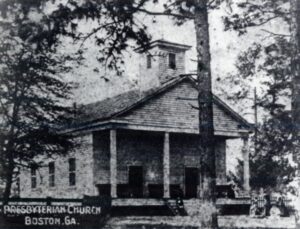
Thomasville History Center Collection: Presbyterian Church of Boston, c.1900.
Who Watson and Graves were may be more relevant, or at least Graves. Thomas Watson, the only Watson in Thomas County’s early years, moved from North Carolina in the 1830s. He did own property in the general vicinity of our Boston, but has no apparent ties to Boston, Massachusetts. Eli Graves (1803-1868), a Presbyterian minister, moved to Thomas County from Vermont when he was hired as the first pastor of First Presbyterian Church of Thomas County, located in land lot 271, the site of “Old Boston,” owned by Roderick McIntosh. He was in Thomas County no later than 1842. Most of the Graves family lived in and around Boston, Massachusetts.
The First Presbyterian Church of Thomas County, as it is named in deeds, later became known as the First Presbyterian Church of Boston. It is possible this early church, and settlement along with it, became known as “Boston” because Eli Graves named it. It is also possible that Graves and the devout Presbyterians in the area named it for another Thomas Boston – the one from Scotland, who 100 years earlier became well known as a Presbyterian theologian with a coarse demeanor, who was having a bit of a revival “moment” as a philosopher in the 1840s and 1850s.
So why, by 1923, did Irwin MacIntyre think Boston was named for Thomas Mickleberry Boston? Because there was a third Boston. Not Old Boston in land lot 271 nor “New” Boston but a third Boston, 20 miles west of the location of modern-day Boston on the Brooks County bank of the Withlacoochee River just off of U.S. 84. It was founded by Thomas Mickleberry Boston around 1848 or 1849 when it was still Lowndes County. He purchased some land around a sulfur spring he found there adjacent to the Withlacoochee and built a hotel, establishing what became known as Boston’s Spring. Soon a village emerged around it, which became known as Boston.
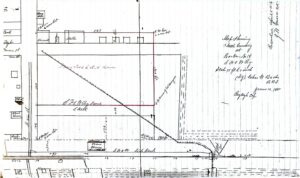
Thomasville History Center Collection: Irwin County District 13 – Land Lot 326 – Dec. 20, 1869 – Atlantic & Gulf to Daniel Horn
Moving forward to 1860, the Atlantic & Gulf Railroad was being built from Savannah to Bainbridge. Seeing the route through Quitman and Grooverville, the people of “Old Boston,” or so goes the story, believed the railroad would build through their settlement. Instead, the Atlantic and Gulf purchased right-of-way land about a mile east and half-a-mile south of where “Old” Boston was located on the far north-center of land lot 326 but enlarged to include part of land lots 327 and 365. This land was (conveniently) owned by former United States Representative James Seward. Stop Number 17 was first called “Seward’s Station” and then became known as Boston.
Soon after, Seward sold an acre to the trustees of the First Presbyterian Church of Thomas County. The story is smooth and easy and clean – they built the railroad southeast of Boston, so the whole town packed up and rolled over to new Boston! Except absolutely nothing works like that.
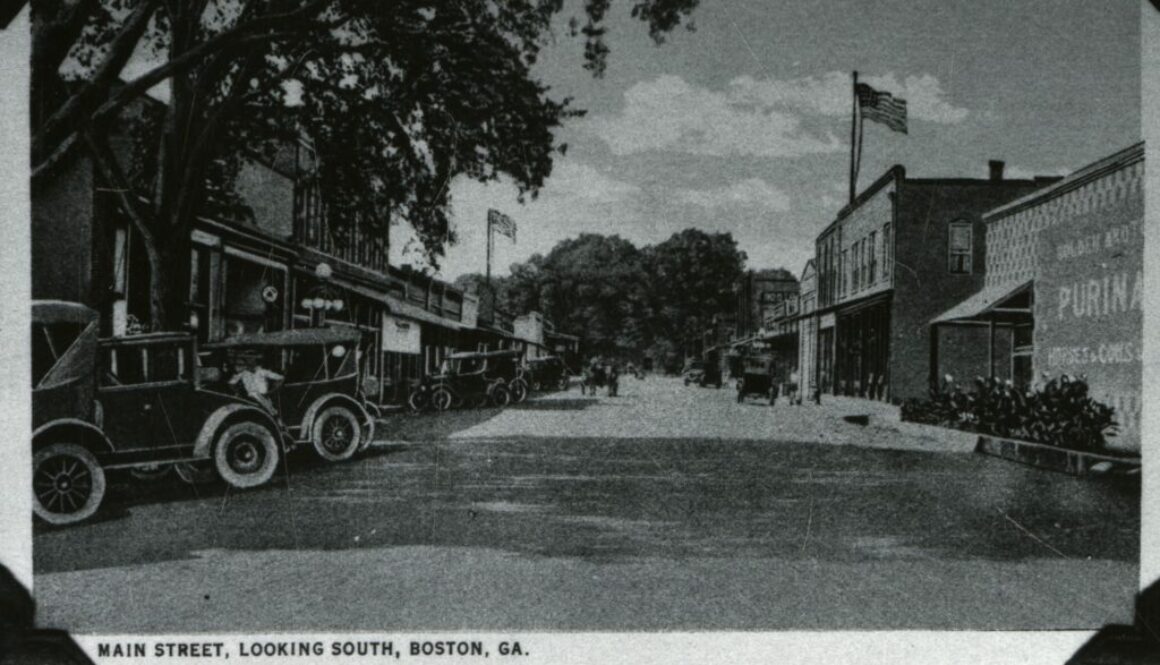
Deed records show that nothing really happened immediately. The land all around the depot was still owned by the Atlantic and Gulf Company – travel just a little beyond that and you’re including land that “Old Boston” people already owned. So by 1861, when they were calling the new depot stop Boston, there were three settlements named Boston along what is U.S. 84 today, all within 25 miles. “New” Boston didn’t really start to develop until 1869, when the Atlantic & Gulf Road sold all that land around the depot to Daniel Horn, who laid out and sold individual lots, and that’s really when Main Street and Jefferson Street started to become the heart of Boston. Things developed quickly and Boston, as we know it, was incorporated by Georgia in 1870.
Thomasville History Center Collection: Article on Boston Springs, July 15, 1868.
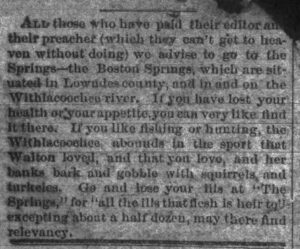
The third Boston, in Brooks County on the Withlacoochee, stopped being known as Boston, or Boston Springs, or Boston’s Spring through the 1860s, and by 1870 was known as Blue Springs, and was a fairly popular summer resort and recreation area for 30-40 years.
While it’s a bit more involved, the most likely explanation for Irwin MacIntyre attributing the founding of Thomas County’s Boston to Thomas M. Boston was a good ol’ fashioned mix up over time. He typically did not cite sources but was likely told all of this by an older member of the Boston community, or one of their children. I think it may be fair speculation that it was another well-known Thomasville citizen from a Boston family – Dr. Thomas Murdoch McIntosh – that likely shared this version of the story when he was older in 1923. The story also includes a side note about how the First Presbyterian Church of Thomas County became known as “McIntosh Presbyterian Church” in honor of Roderick McIntosh. There is no known contemporary evidence that the church was known by that name, only this claim from 1923.
Finally, there is one more “missing” bit of information: Why are there no contemporary accounts of Old Boston and New Boston? The first mention of there being an “Old Boston” is the 1890 history, which used it in the context of the church being moved. But it was really around 1892, 30+ years after the fact, that the term “Old Boston” as a place came into common use. We believe it is most likely that the original Boston – which was unincorporated and did not have formalized borders until 1870 – was a farm region or district of Thomas County. Most of the known landowners owned hundreds of acres of land, that easily traversed the areas that later became known as “Old” and “New” Boston.
Only over time did memories of the location of the first church and still existing graveyard in the McIntosh lands lead to the idea of there being an Old Boston. Add in a third Boston down the road, a reverend with family from the Massachusetts Boston, and a guy named Tom Boston, and you have a recipe for confusion. An absolute, ironclad answer to how the Thomas County city got its name may not be knowable; but at least we know what it is not.
TheThomasvilleHistoryCenterhasbeenawardeda$10,000 matching grant through the 1772 Foundation in partnership with the Georgia Trust for Historic Preservation to support exterior rehabilitation of the historic Metcalfe Courthouse.
The award is part of $125,000 in preservation funding distributed this year to fourteen nonprofit organizations across Georgia maintaining historic sites and community landmarks.
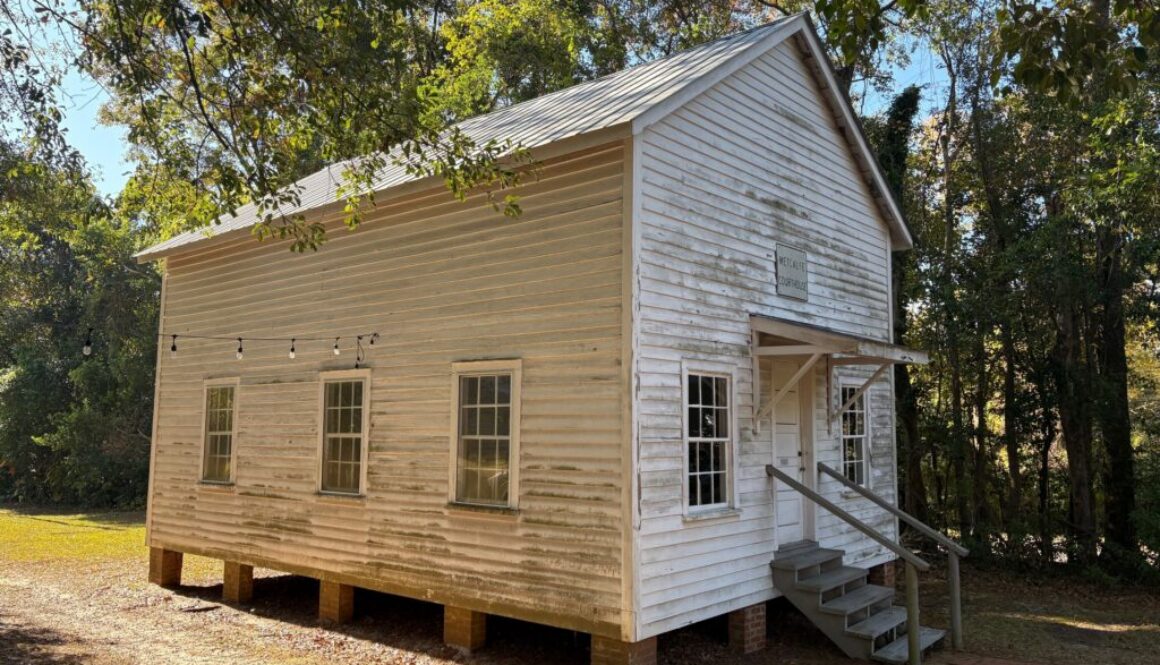
Located on the History Center’s campus at 725 N. Dawson Street, the Metcalfe Courthouse represents the civic history of one of Thomas County’s early railroad communities. Metcalfe, located eight miles southeast of Thomasville, was founded in 1889 as a lumber- and agriculture-based boomtown that developed around its rail depot. By 1892, residents petitioned Thomas County to construct a courthouse for magisterial purposes. Although the building was never used for formal court proceedings, it became the civic heart of the community and served for generations as a public gathering place and voting precinct until 2002.
In 2003, after years of deterioration, the structure was placed up for auction by Thomas County. The Thomas County Historical Society (now the Thomasville History Center) successfully acquired the building and relocated it to the History Center campus in 2004, along with original contents including benches, ballot boxes, and voting materials, to ensure its long-term preservation.
Grant funding will support exterior stabilization and restoration work, including repair and replacement of deteriorated wood elements, surface preparation and repainting, reglazing of historic windows, and other measures intended to protect the building from moisture intrusion and long-term deterioration.
“This grant represents an important investment in one of the most unique and meaningful structures on our campus,” said Austin Bell, Executive Director of the Thomasville History Center. “The Metcalfe Courthouse tells the story of rural civic life in Thomas County, and we are deeply grateful to the Georgia Trust and the 1772 Foundation for helping us preserve it for future generations. Special thanks as well to the Metcalfe Heritage Society, the Thomas County Board of Commissioners, and the Thomasville-Thomas County Chamber of Commerce for their support during the grant process.”
The exterior work will also allow the History Center to begin planning concurrently with the Metcalfe Heritage Society and other stakeholders for future interpretation, programming, and visitor experience improvements, with the goal of advancing that next phase in 2027. The grant-funded exterior project is expected to be completed by May 2027.
Three Thomasville cultural organizations —Pebble Hill Plantation, Thomasville Center for the Arts, and the Thomasville History Center — are proud to announce their participation in the 2026 Blue Star Museums program, a national initiative offering free summer admission to currently serving military personnel and their families.
The participation of multiple Thomasville organizations in Blue Star Museums reflects the strength of the arts, history, and cultural life in the community. Together, these organizations offer military families the opportunity to explore a connected story of Thomasville and the Red Hills region through art, architecture, local history, creativity, landscape, and community memory.
Blue Star Museums is a partnership between the National Endowment for the Arts and Blue Star Families, in collaboration with the Department of Defense and participating museums across the country. The 2026 program begins on Armed Forces Day, Saturday, May 16, and continues through Labor Day, Monday, September 7.
“Blue Star Museums has opened doors for military families to explore, connect, and feel at home,” said Kathy Roth-Douquet, CEO of Blue Star Families. “As we approach America’s 250th anniversary, we’re proud to continue this partnership with the National Endowment for the Arts and museums nationwide—welcoming military families into the heart of our nation’s story and celebrating them every step of the way.”
Through the program, currently serving members of the United States military — including the Air Force, Army, Coast Guard, Marine Corps, Navy, Space Force, Reserves, National Guard, U.S. Public Health Service Commissioned Corps, and NOAA Commissioned Officer Corps — may receive free admission for themselves and up to five family members by presenting a valid military ID.
“Having multiple Thomasville cultural institutions take part in Blue Star Museums is a testament to the strength of the arts in our community,” said the directors of Pebble Hill Plantation, Thomasville Center for the Arts, and the Thomasville History Center in a joint statement. “Together, our organizations have the opportunity to thank military families for their service and welcome them into the cultural treasures, local stories, and creative experiences that make Thomasville so special.”
Each participating organization offers a distinct experience while contributing to a broader understanding of Thomasville and the Red Hills region. Pebble Hill Plantation invites visitors to experience the history, architecture, collections, gardens, and 3,000-acre grounds of a 20th-century Southern sporting estate. Thomasville Center for the Arts connects the community through inspiring exhibitions, year-round arts education, annual festivals and hands-on art experiences for all ages. The Thomasville History Center invites guests to explore the people, places, buildings, and stories that have shaped Thomasville and the Red Hills region over time.
Together, these organizations provide military families with a meaningful way to experience Thomasville’s story from multiple perspectives through art, history, and community. Admission procedures, hours, and available experiences may vary by location. Visitors are encouraged to check with each participating organization before planning their visit.
To learn more about Blue Star Museums or to find participating museums across the country, visit arts.gov/BlueStarMuseums.
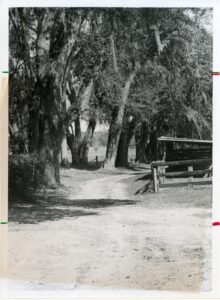
Thomasville History Center Collections: Russell Road in Boston, Georgia, 1976. 1977.34.033.
By Ephraim Rotter
The origin story of the Thomas County city of Boston, the second oldest city in the county, has been well honed since America’s Bicentennial in 1976. The telling goes something like this: A man named Thomas Boston was a frequent visitor to early Thomas County, by way of stagecoach. He (in some tellings) purchased significant land holding in the vicinity of what has been known as “Old Boston” since the late 1800s or became friends with a man who did own significant land in the vicinity of “Old Boston,” John Parramore. As settlers arrived through the 1820s and 1830s, possibly as early as 1831 or maybe as late as 1839,the settlement located off of Sally Road today at the Russell Farm was named Boston, either in honor of Thomas Boston as a local landowner, or in celebration of his frequent visits to his good friend John Parramore, who the story tells us had a stagecoach stop in the vicinity of Old Boston. But is this version of events accurate?
Several months ago, the History Center received a request from researchers in that other Boston – the Massachusetts one. A recently retired couple, determined to find the origin story of each place named “Boston” in America, called to ask about Thomas County’s iteration. The History Center benefits from and appreciates the research that came before it, but from time-to-time we will revisit the stories and then the source documents to try to find out more, especially as new research tools have made materials both more available and more searchable.
The first step was to gather all the origin stories for Boston we could: the earliest is from 1890 and the most recent from 1989. The most influential was Irwin MacIntyre’s History of Thomas County written in 1923. It is cited by Dr. William Warren Rogers in his books about Thomas County history and numerous other places. This is where we first find the claim that Boston was founded by a man named “Major Thomas M. Boston” around 1831, and that he purchased significant land holdings there, presumably including the site of Old Boston. All other origin stories, including the stagecoach stop theory, are variations of this, excepting the first history of Boston, written in the April 14, 1890 edition of the Times-Enterprise.
That history was part of a series titled “Highways and By-Ways of Thomas County” written by an anonymous County elder identifying himself as “W.” According to him, Boston was founded in the mid-1830s by two men with the last names of Graves and Watson who came to Thomas County from Boston, Massachusetts. With these stories to work with, identifying exactly who is this “Major Thomas M. Boston” was my first priority. At times referenced as “Captain” Thomas M. Boston, he was quickly profiled to be Thomas Mickleberry Boston, born 1815 in Screven County, Georgia. On the 1830 census, he is listed as living with his parents in Screven County. Even with shorter lifespans, the thought of a sixteen-year-old dependent getting a town named in honor of him in 1831 seems unlikely.
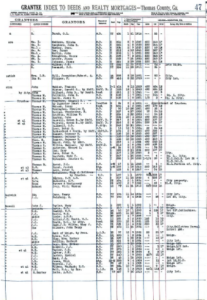
Thomas County Grantee Index 1825-1910, Boston-Boswell.
A visit to the Thomas County Deed Room confirmed this. He did not show up on any Georgia property tax rolls until the late 1830s. He did eventually buy property in Thomas County and was a hotelier in Thomasville. The very first land Tom Boston purchased in Thomas County was in Thomasville in 1851. While his Uncle John purchased lots in the 8th district (Colquitt County today) and a lot in today’s Brooks County between 1839-1841, none of the family’s properties were in the vicinity of “Old” or “New” Boston. Tom Boston himself never owned any property near Boston.
The variation of this theory, that he was friends with John Parramore and visited by way of stagecoach at a stagecoach stop Parramore hosted on his property, is also without evidence. The stagecoach routes of Georgia – particularly the one Thomas Boston would have had to take to get to south Thomas County – were extremely well documented. These were commercial operations that required reliable stops every 40-50 miles where horses could be changed and people get something to eat or even a place to stay overnight.
While John Parramore was a large landowner in the vicinity of “Old” Boston, and certainly popular and well known in the area, his property is simply not listed as a stagecoach stop nor changing station in any newspaper or gazetteer, particularly the Gazetteer of the State of Georgia for 1837. Thomasville is listed, as is Troupeville, Albany, and other places on either the route through Albany or the route from the east. The primary logic problem being that for a state-wide stage operator, the Parramore property was too close to Thomasville for there to be an additional stop.
Thomas County Post Office Book, 1844-1857.
The next key data point for us to discover was to find the very earliest use of the name “Boston” for a place in Thomas County. The United States Postmaster Book lists Aaron Daniel as the postmaster of a Boston in Thomas County in 1847. This is the first verifiable use of the name we can find thus far. By 1850, it appears with some frequency. Which brings us back to the original history written by “W” in 1890 who claimed, “Watson and Graves” moved from the “Old Bay State.”
So who is W? And who are Watson and Graves? Those are questions we’ll have to save for next time!
Thomasville Insights podcast, City of Thomasville, April 17, 2026
Welcome to Thomasville Insights with the City of Thomasville! Located in Thomasville, Georgia, the podcast will cover everything from Thomasville history and events to daily operations and City business, all while having some fun in the process.
On this episode, we interview History Center Curator Ephraim Rotter, who fills us in on some important local history and more.
Some of the topics include:
• History Center Lunch and Learn updates plus what’s next • How Thomas County and Thomasville get their names • Why Lot 39 matters to the city’s beginning • Henry O. Flipper’s legacy through the wider Flipper family’s achievements • Why politicians and public figures choose to visit Thomasville • John F. Archbold’s local influence beyond building a hospital • Why does Thomasville have an odd street layout?
To learn more about the city of Thomasville, visit Thomasville.org.
The Payroll Development Authority welcomed the Georgia Red Carpet Tour to Thomasville over the weekend.
Hosted annually during the Masters Tournament, this prestigious, invitation-only event brings global business leaders to Georgia to experience firsthand what makes the Peach State a strong place to live, work, and invest. With stops in both Thomasville and August, the City of Roses had a unique opportunity to shine on a statewide stage.
The Georgia Red Carpet Tour, led by partners including the Georgia Allies, Georgia Chamber of Commerce, Georgia Department of Economic Development, and the local Payroll Development Authority, is designed to “soft sell” Georgia by connecting decision makers with communities and showcasing real opportunities for growth and opportunities.
Attendees begin with a dinner at the Governor’s Mansion on Wednesday night, before attending the Master’s Tournament on Thursday morning. Thursday afternoon, they then boarded a flight, arriving in Thomasville late that evening, where they checked into the Marriott for the duration of their stay.
While in Thomasville, guests got a true taste of the community and all it has to offer.
Attendees had the chance to enjoy a round of golf at the prestigious Glen Arven Country Club, explore the city’s rich history on a guided trolley tour, or experience sporting clays at The Ranges at Oakfield. Visitors spent the afternoon at Box Hall Plantation and Pebble Hill Plantation for beautiful scenic views, a dog trial presentation, and discussions on historic preservation. Each experience highlighted the quality of life and unique assets that make Thomasville such a special place.
“The feedback we got was great,” said Shelley Zorn, President and CEO of the Payroll Development Authority. “They were so impressed with the downtown and very complimentary during the history tour.”
Friday evening, guests returned to Pebble Hill Plantation for a catered dinner, featuring all of Thomasville’s local fare.
The spread featured an array of cheeses from Sweet Grass Dairy, a whole hog from Liam’s, barbecue from Climmie’s, and hors d’oeuvres from JB Crumbs.
“We gave them a taste of Thomasville,” she said. “Our hospitality people worked really hard.”
Zorn praised everyone the attendees came across, and noted that it had a direct impact, as every person stated they plan to return.
“It had a great economic impact, beyond just showing off our community,” she said.
Since the tour, Zorn has already been contacted by a business owner whose friend attended the Georgia Red Carpet Tour with inquiries about home prices and industrial building prices.
“He thought it was so great looking that he wanted to refer a friend,” she explained.
Zorn said the hosts are likely to refer more projects to Thomasville down the road, though.
“We deal with them all the time, so it’s great to let them see the community so they can bring someone else back,” she said.
Now that Thomasville has become a stop on the Red Carpet Tour — the first non-metro stop, Zorn said the city will likely be added to a 10-year rotation and have the opportunity to show off again in the future.
For now, though, she is proud to have played a role in such an impactful event and looks forward to the opportunities it will bring to the region.
The Thomasville History Center will join in this year’s Rose Show & Festival with a series of special offerings that highlight the community’s traditions during Thomasville’s historic bicentennial year.
At the Lapham-Patterson House, the History Center will present Thomasville & Tiaras, a pop-up exhibit featuring a curated display of past Thomasville Rose Queen gowns and crowns. The exhibit offers visitors a rare opportunity to explore the pageantry and legacy of one of Thomasville’s most cherished annual traditions within an iconic historic home.
The exhibit will be on view from April 23 through May 16, 2026, and is included with regular guided tour admission at the Lapham-Patterson House, offered Thursday through Saturday. Tickets are available online or at the Thomasville History Center front desk.
As part of Rose Show weekend, the Lapham-Patterson House will also host a free open house on Saturday, April 25, from 10:00 a.m. to 4:00 p.m. Visitors are invited to explore the exhibit at their own pace and experience the elegance and craftsmanship of Rose Show traditions in Thomasville’s only National Historic Landmark.
Guests can also attend a meet-and-greet from 11:30 a.m. to 12:00 p.m. with Miss Thomasville Ana Chambers, Miss Thomasville’s Teen Kinley Harrison, Court Member Madeline Patz, and Court Member Savannah Harpe.
In addition to activities at the Lapham-Patterson House, the History Center campus will feature demonstrations by the Thomasville Amateur Radio Club, which will be set up outside the front of the museum from 10:00 a.m. to 4:00 p.m. The History Center and its gift shop will also be open to visitors during those hours.
The History Center will also participate in the Rose Parade on Friday, April 24, when Curator of Collections Ephraim Rotter will drive Bill Cox’s 1923 Ford Model T down Broad Street with special dignitaries in tow. The Model T is one of four historic vehicles in the History Center’s collection, all on permanent exhibit in the Roberts Garage.
“These offerings reflect our commitment to being an active participant in the life of the community,” said Executive Director Austin Bell. “During this bicentennial year, we are especially excited to contribute to the Rose Show by sharing the stories, traditions, and experiences that make Thomasville so special.”
On March 20, the Thomasville History Center will debut Perfect Alignment: An Equinox Evening with Lapham, a new immersive fundraising dinner at the historic Lapham-Patterson House.
Timed with the spring equinox, the evening centers on a rare architectural phenomenon: on just two days each year, sunlight aligns with key features of the house, revealing effects that reflect the intentional design of its original owner, Charles Lapham. A dabbling Spiritualist, Lapham incorporated symbolism, orientation, and belief into the layout of the home — themes that will guide the evening’s program.
“This house was designed with intention — not just structurally, but symbolically,” said Austin Bell, Executive Director of the Thomasville History Center. “The equinox gives us a rare opportunity to see the Lapham-Patterson House exactly as Charles Lapham meant it to be experienced. Perfect Alignment allows us to connect architecture, belief, and the natural world in a way that feels both historic and immediate, while directly supporting the preservation of this extraordinary home.”
The evening begins at 5:30 p.m. with a cocktail hour featuring live piano music performed from period sheet music preserved in the History Center’s collection. Guests will enjoy hors d’oeuvres, a signature equinox-inspired sangria, and a selection of regional wines while exploring the house. Tarot card readings and docent-guided equinox light viewings will add to the immersive experience.
Dinner will be served in the courtyard, weather permitting, allowing guests to enjoy the evening and a presentation on Lapham’s Spiritualist beliefs and their influence on the home’s architecture. The evening concludes with period phonograph recordings playing as guests take a final stroll through the house.
Seating is intentionally limited to preserve the intimate nature of the experience, and table sponsorship opportunities are available.
Perfect Alignment is the first annual fundraiser created exclusively to support the preservation and programming of the Lapham-Patterson House, which operates with its own dedicated budget under the stewardship of the Thomasville History Center in partnership with the Georgia Department of Natural Resources’ Historic Preservation Division.
Advance tickets are required and must be purchased by Friday, March 13. For tickets and information, visit www.thomasvillehistory.org.