Perfect Alignment: The Lapham-Patterson House
Twice a year, a strange occurrence takes place at the Lapham-Patterson House… During the Spring and Fall Equinoxes, sunlight streams through the stained-glass windows on the first and third floor, casting colorful light across the floor and shining shadows of the ornate bargeboard alongside. To commemorate this phenomenon, we recently hosted our event Perfect Alignment: An Equinox Evening with Lapham. Guests were able to explore the house during the Spring Equinox, take Spirit Photos like the one in our collection of Charles Lapham, and have their tarot cards read. While a great time was had, it leaves many asking a question about this phenomenon: why? Why did the Lapham family build their house in such a strange way? Let’s do a little deep dive into the Lapham family and this unique landmark in Thomasville.
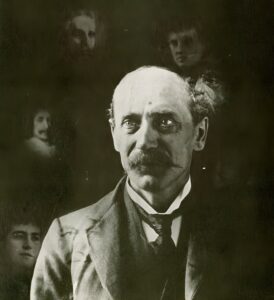
Charles Willard Lapham was born on July 21 in 1852 in Danby, Vermont. His family had been farmers in Danby since the founding of the town in the 1600s. Danby was a popular place for Quaker settlers to live during the 1600s and 1700s and the Laphams, like their neighbors, were Quakers. By the 1820s, American Quakers were splitting into three main groups: one group held onto the old ways, one group considered themselves very liberal, and one group did a little of both but very loudly through revivals. The Laphams likely fell into the very liberal category. We can’t say for sure as we haven’t found it written down, but they did seem to live in liberal Quaker hot spots. Danby, Vermont was one of those places. When Charles Lapham was a child, his family moved to Kalamazoo, Michigan, another spot that was quickly becoming “a Quaker colony.” But there was something else going on among these more liberal-minded Quakers: Spiritualism!
The tenets of this cult wouldn’t be formally listed until the 1890s, but those liberal-minded Quakers were some of the first to incorporate their practices into their religious life. And wherever those colonies of liberal Quakers could be found, Spiritualism gained a popular foothold. While Charles’s family left for Chicago in 1870, they were in the right part of Michigan at the right time to see the Spiritualist movement really taking off. Within Lake County, a local woman purchased property that would one day be home to the State’s largest Spiritualist camp. Even before the birth of Battle Creek, as the spot later came to be known, the local Kalamazoo Gazette reported on various seances and other Spiritualist practices happening in private homes in the area.
By 1870, Charles’s father had opened a new business in Chicago, Illinois. His leather business was located at 163 Kinzie Street (now the home of Trump Tower Garage) and the family lived just half a mile away at 206 Erie Street. Charles and his younger brother worked as clerks for their father. But just as their business was getting going, a tiny problem occurred. On October 8, 1871, a fire broke out in a barn on the west side of town and rapidly spread across the city which had been in a drought for several months. Not only that, but most structures throughout the city were still made of wood as were the sidewalks and some of the paved streets. The fire burned for three days, leaving over 300 people dead, and one third of the town destroyed. Another 100,000 people were left homeless, including the Lapham family.
Over the ensuing years, Charles started his own business selling shoes with his younger brother working under him. Newspapers in Chicago reported about the “energetic” young businessman and the enormous amount of work he was doing. In 1880, Charles returned to his familial stomping grounds to marry a young woman named Emma Mary Conger. Emma was born in 1857 to a New York banking family who originated in Danby, Vermont — the same ancestral home of the Laphams. Like the Laphams, Emma’s family had been Quakers in Danby since nearly day one.
The newlyweds made their home in Chicago and quickly started their new family. Charles was still searching for a health cure when he came across Thomasville in 1883. After testing the waters over one winter, Charles saw the potential for the town and purchased a plot of land in 1884 — technically. In actuality the land was purchased in Emma’s name, a common practice for the time when businessmen wanted to add a layer of protection to their assets in case their business went bankrupt. Over the summer of 1884, Charles employed a contractor and crew to create his new winter home. But Charles didn’t want just any home and he certainly wouldn’t trust just any architect to build it. Enter, our architect: Tudor Rommerdall.
“Tudor,” as he was called in Thomasville, was born Theodor Jens Peter Romerdahl in Denmark in 1848. When he was in his late teens, he began studying masonry. According to the Rommerdall family in the United States, he immigrated to Chicago, Illinois at the age of twenty and helped with the construction of the Chicago Water Tower in 1869.
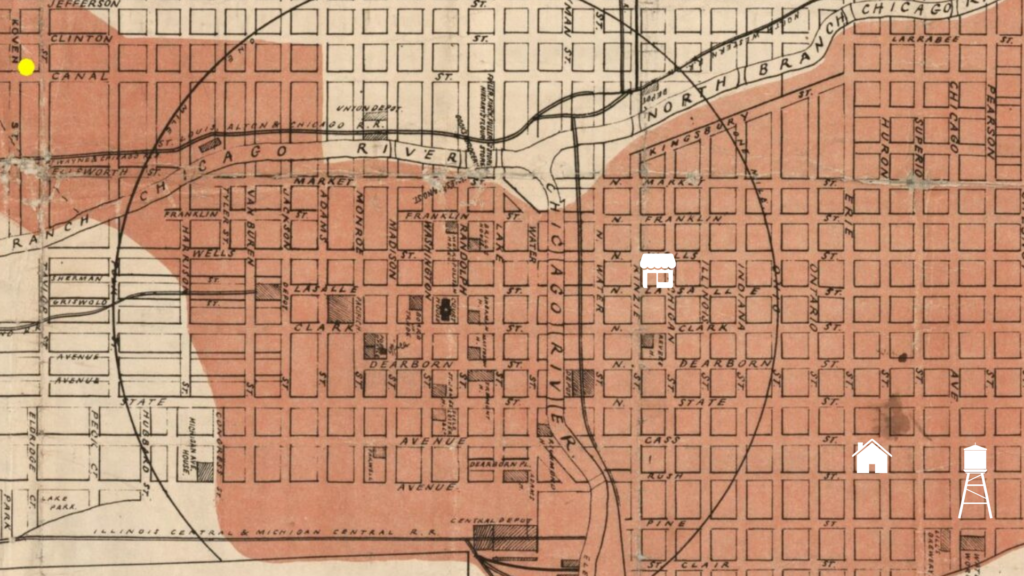
This would have been a significant matter for Charles Lapham. If we look back at the location of Chicago Water Tower during the Great Chicago Fire of 1871, we can see it was right in the midst of the conflagration. But unlike so many structures around it, the water tower is one of the few things that survived. It became a symbol of Chicago’s resilience. And as someone who lived down the street from this building, who lived through the fire, Charles was looking for something equally resilient.
After being hired by the Laphams, Tudor assembled a crew of workmen, mostly of Irish and Canadian backgrounds, and brought them down to Thomasville for the summer. They quickly got to work and before long, Tudor was being hired for other jobs around town. The first was the MacIntyre Building though you may know it today as The Gift Shop. Then the Frank Hopkins House (no longer standing), the Ballowe-Quinn House on Clay Street, Cleveland Park (also gone), Allen Normal Industrial School (mostly gone), the Henry W. Hopkins House (now Mosaic Psychology Services), the A.H. Mason House or Yellow Jacket House on Colton Avenue, a few store interiors downtown, the Mrs. M. Parker Anderson House (status unknown), the Masury Hotel (demolished), and the town water works (also demolished). By the end of his short career here, Tudor had put his mark on over a dozen structures. And his work carried specific signatures that can be seen developing in the Lapham-Patterson House before featuring in these other works.
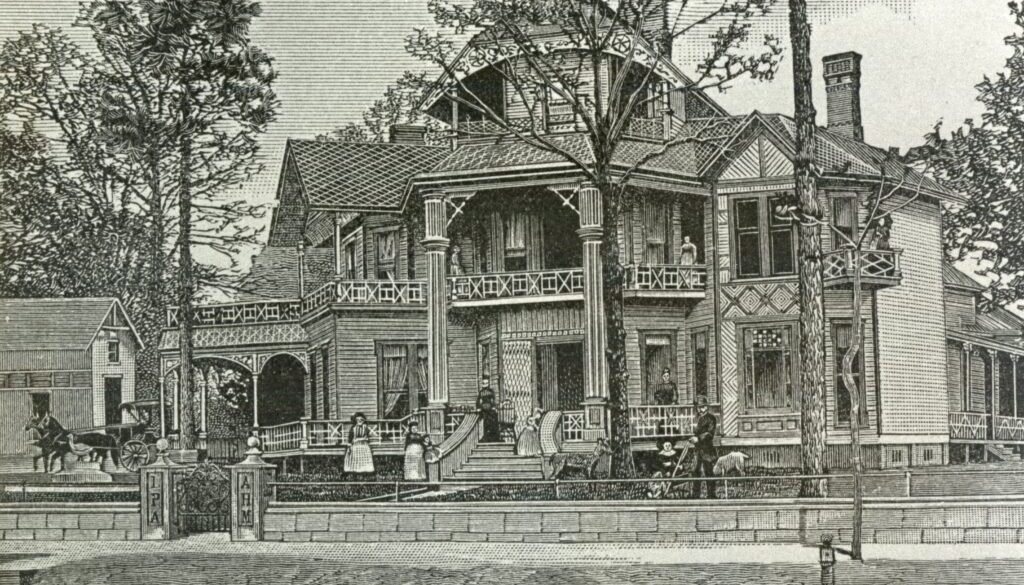
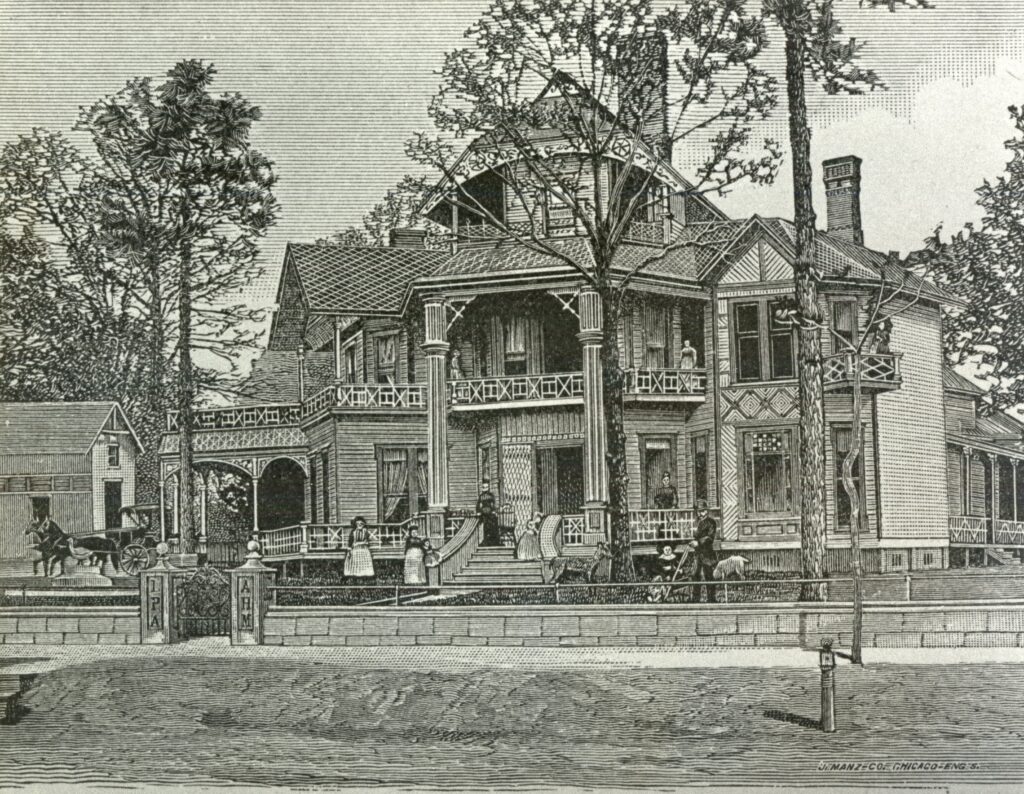
Victorian Style is a great umbrella term for the many different styles that were becoming popular during the period this house was built. One of the most popular was the Queen Anne Style which called for asymmetrical layouts, wrap around porches, multi-gabled roofs, decorative fish scale shingle siding, and ornate gingerbread trim. All of which can be found on the Lapham-Patterson House. Much of the appearance of the house, and therefore Tudor Rommerdall’s style, can be attributed to the trend of the Queen Anne Style. But Charles had other ideas that would make his house stand out.
The third floor of the house has a convoluted history. We know the last family, the Pattersons, used the room for storage, but trunks and old belongings don’t need a fireplace to keep them warm or beautiful windows to inspire them. The Larmons used the room for entertaining — and from experience, it definitely works for that. We aren’t really sure how the Laphams intended to use the room. But we do have clues.
Quakers, and many other religions, have long viewed the spring equinox as a time of rebirth and renewal. Why not align your house to capture those sunbeams to awaken your home as winter ends and spring begins? Take a further look at the bargeboard — the decorative trim across the front of the house. Those aren’t random symbols carved into the wood. They are the same symbols you might see painted on barns throughout Pennsylvania and greater New England, the stomping grounds of American Quakers. A six-sided star within a circle harkens back to a starburst or sunshine – some say the symbol even works as a talisman to ward off evil. The intertwining vines recall nature. And that odd shape in the middle — which some people have called a lamp or cow’s head referring back to the myth of Mrs. O’Leary’s cow knocking over a lantern and causing the Great Chicago Fire — could easily be a tulip in an artistic style.
But what about the Spiritualism? Well, we know that family legend coming through the Conger side of the family states that Charles was a minister. He could easily have been a Quaker minister as anyone in the faith could preach if so led. But he easily could have dabbled in Spiritual healing. We also have that spirit photo of Charles surrounded by his loved ones and other spirit guides. Much of the appeal for Liberal Quakers to take up Spiritualist practices was the emphasis on an inner light guiding us all, a common theme that ties the practices together both figuratively in their religious practice and literally in their preference for light. That lets our windows with their equinox light show serve double purpose for both Quaker and Spiritualist practices.
Spiritualists developed their own architectural prerequisites. There are a few established Spiritualist homes across the country including the most famous, the Winchester House in California. There’s the Spiritualist campgrounds like Lily Dale in New York or educational spaces like the original Pratt Institute. From these houses and structures we can gather what was important to practitioners. For one, they needed sacred spaces set aside for meditation and the occasional seance. Seance rooms varied from house to house, but wealthier practitioners preferred larger rooms that could hold a crowd. They also had ideas about corners. Many Spiritualists of the time believed that spirits rested in corners, right angled ones especially – a bit like cobwebs. By rounding your walls as much as possible, you could dissuade evil spirits from overstaying their welcome.
These traits come together well on the third floor. When we give tours of the Lapham-Patterson House — especially to students, I like to ask guests to tell me what the third floor reminds them of. Many of them think of a church. There is an inspirational feel to the room thanks to the high, vaulted ceiling combined with the stained glass window and the dais toward the end. Feelings don’t make fact, but they can tell us a bit about the intended experience the owners designed for a room. Kitchens are utilitarian to help us move efficiently and focus on work; bedrooms are relaxing to help us sleep; living rooms can be showy to impress our guests or comfortable to attract our family to gather around. Sometimes a churchy room is meant to be churchy. We can never say for sure that the third floor was the Lapham family’s attempt at a religious space within their home, but the clues they left behind make an argument for that idea.
So what can we truly say about the Lapham-Patterson House? Its a combination of the time period, the architect’s own experiences and design choices, and the needs and beliefs of the owners that cause it to look the way it does and to remain a unique landmark for our town.