
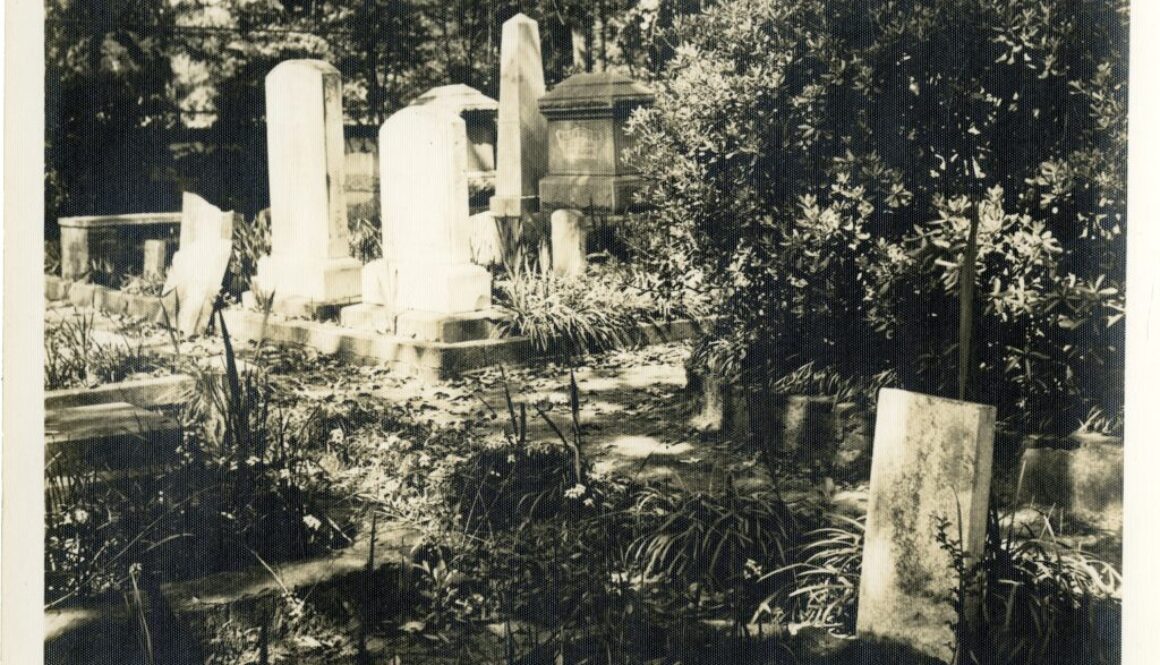
Grave Matters: The Tale of Edward Remington Seixas
As we continue our spooky tales during the month of October, let’s travel to the Old City Cemetery to meet one of its unfortunate residents. This cemetery was the first public cemetery installed in Thomasville in 1858, almost 30 years after the establishment of the town. Prior to the establishment of the public burial grounds, most people were buried on their own or family property or they were buried in the graveyard of the church to which they belonged. As you might imagine, this practice became a problem as people moved around frequently, the town began to outgrow its original limits, and ideas about sanitation evolved.
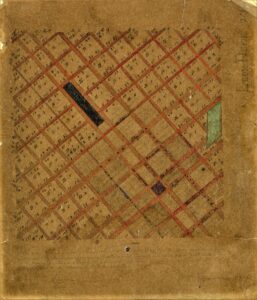
The original cemetery grounds covered from one end of the current lot down to what is now known as the Flipper Cemetery. Early burials here include Revolutionary War Veterans, town founders, and even enslaved workers found among the families they served. After the Civil War, the long lot of land was split by the newly laid out Jerger Street. The second half of the land formed Old Magnolia Cemetery, now Flipper Cemetery, a public burial ground specifically for the Black citizens of Thomasville. Years later, a portion of the original City Cemetery was given to the American Legion on which their facilities were built. As with many cemeteries of this age, many graves are unmarked or “lost” though some records remain of who was buried here.
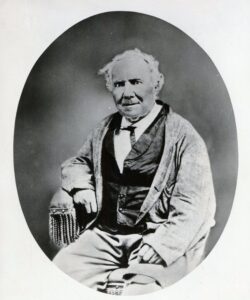
But the grave I want to discuss today is still standing in the Seixas family plot. Edward Seixas was born in New York as the son of a Jewish immigrant who reportedly escaped from Haiti carrying only the family silver in a tablecloth. Edward converted to Christianity, married Huldah Smith — the daughter of a prominent Rhode Island merchant and sister to Simeon A. Smith who gave us Paradise Park — and moved to Thomasville. Edward started a pharmacy in town and became highly successful. Together, he and Huldah had three children and settled in what is now one of the oldest houses in Thomasville, the Seixas House located on Dawson Street.
While Edward is interesting in his own right, today I’d like to focus his only son, Edward Remington Seixas. Little Ed was born in Thomasville in 1839, the middle child between his two sisters. In the 1860 census, Ed was listed as working as a clerk, probably under his father at the family pharmacy. His family and community may have expected big things from Ed but any dreams for his future were tragically cut short in 1860.
Ed was a member of the Thomasville Guards, a local home guard organized to protect the town. One of his superiors was a man named Columbus Sidney Davis Johnson, a farmer and the town Marshall. Around the middle of September 1860, the two men got into an argument and challenged each other to a duel. If you’ve seen the highly acclaimed Broadway musical Hamilton, you might already know that dueling is illegal in the United State, even back then. But if your opponent is the Marshall then who is going to stop you?
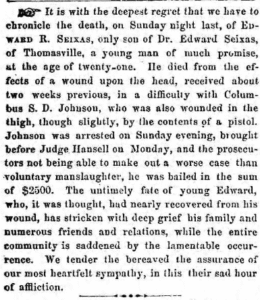
The men met at an undisclosed location with their pistols and their seconds. In a matter of minutes the duel began and promptly ended. Ed’s shot hit Johnson in the thigh, wounding him slightly while Johnson’s shot hit Ed along the head. An article in the newspaper, The Southern Enterprise, from October 3, 1860 tells the story of what happened next.
“It is with the deepest regret that we have to chronicle the death, on Sunday night last, of Edward R. Seixas, only son of Dr. Edward Seixas, of Thomasville, a young man of much promise, at the age of twenty-one. He died from the effects of a wound upon the head, received about two weeks previous, in a difficulty with Columbus S.D. Johnson, who was also wounded in the thigh, though slightly, by the contents of a pistol. Johnson was arrested on Sunday evening, brought before Judge Hansell on Monday, and the prosecutors not being able to make out a worse case than voluntary manslaughter, he was bailed in the sum of $2500. The untimely fate of young Edward, who, it was thought, had nearly recovered from his wound, has stricken with deep grief his family and numerous friends and relations, while the entire community is saddened by the lamentable occurrence. We tender the bereaved the assurance of our most heartfelt sympathy, in this their sad hour of affliction.”
Many people in town sided with the Seixas family, including a few of his fellow Guards who memorialized Ed in the newspaper. Johnson was allowed to leave town and moved to Liberty County in Florida, bringing his family out with him in the following years. The Seixas family quietly buried their only son at the City Cemetery before joining him there many years later.