What must it have been like to live in Thomasville at the brink of the Civil War? Here at the History Center we have the transcript of a diary written by a young, seventeen-year-old woman over the year of 1861. This diary not only gives us insight into this question but also paints a vivid picture of life in South Georgia and how it was about to drastically change. Follow along as we explore the world from Henrietta Armstrong’s point of view in this blog series!
Our last visit with Henrietta concluded with the last entry in her diary. After some excitement in the autumn, her schedule quickly became too encumbered for her to keep up with her daily writing. We do not have any other journals or writings from her in our collection. So, what happened next? We do know a few things about her life after 1861 and the fate of her loved ones as they made their way through the American Civil War thanks to some hints from Henrietta.
While her entries stopped in December of 1861, Henrietta did come back after the end of the War to write an epilogue, located in the back of her diary, indicating that she likely did not keep another journal throughout the War but felt the need to record this important message for future readers. Her words are straightforward but give us a glimpse into her personal feelings:
“Lieut. Aeneas Armstrong was drowned in the James River, below Richmond, January 26, 1865. He was kind, gentle, amiable, and brave; Noble in his deeds; just to all.”
A shocking end to our heroine’s husband! And how did this happen? The Richmond Examiner, a newspaper in Virginia, wrote a version of the story shortly after the incident that gives us the details.
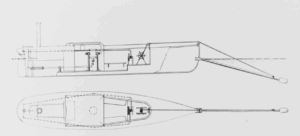
Design plans of the torpedo boat CSS Squib. This boat was similar to the CSS Hornet, the torpedo boat Aeneas was on when he drowned.
“The flag of truce steamer William Allison, on her return trip up the river on Thursday evening encountered the “Torpedo,” a small steamer commanded by Lieutenant Armstrong, of the navy, carrying a crew of seven men, and employed in the torpedo work of the river. The “Torpedo” attempted, in the darkness, to cross the bow of the Allison, and was cut in twain, the Torpedo sinking immediately, and leaving the commander and crew struggling in the chilly waves. The Allison was at once put about, and succeeded in picking up all of the crew, but Lieutenant Armstrong was drowned. His body was not recovered,” (The Richmond Examiner, January 28, 1865).
It gets worse:
“The Torpedo is a total loss. We learn through an officer who was on board the Allison, that the collision occurred at a point between Drewry’s Bluff and Chaffin’s Farm, in the dusk of the evening. When the engineer of the “Torpedo” observed the approach of the other steamer, he reversed his engine, which made three reverse revolutions, when the Allison struck her, and being a light, frail vessel, with one gun, she broke in two, and as the parts went down all on board sprang into the water.
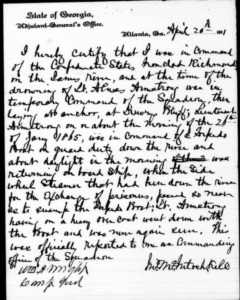
Letter of Support from John McIntosh, April 20, 1907. The letter recalls Aeneas’s drowning and mentions the “heavy overcoat” he was wearing that led to his death.
Lieutenant Armstrong grasped one of the crew and was supporting himself, when the seaman exclaimed, “Lieutenant let go; you’ll drown us both.” The self-sacrificing lieutenant replied, “Man, I’ll not drown you,” and let go his hold. The seaman was rescued and Lieutenant Armstrong floated off a short distance. They shouted to him from the Allison to hold on, and the reply faintly came, “Make haste; I’m benumbed.” The boat was within fifteen feet of him when he went down the first time, but coming up again, he said, “It is no use; I’m gone,” and disappeared.”
Remember from our earlier entries, Aeneas was not a well man. He began the War still suffering from the effects of what was likely Malaria. And being January in Virginia, it was likely a rather cold day leading to an even colder night and frigid waters. According to a witness, Aeneas was in “a heavy overcoat,” part of his full wool uniform which would have absorbed water like a sponge and weighed him down. With these factors in mind, it’s little wonder he didn’t survive the incident. As the newspaper reveals, his remains were never recovered from the site of the accident.
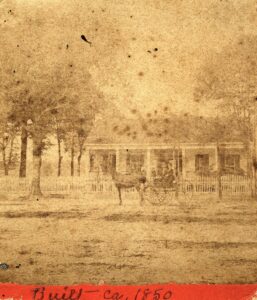
Henrietta never remarried after the loss of her husband. Looking at her note at the end of her diary, she may not have found anyone she thought was good enough. Like many Southerners following the War, the details surrounding Henrietta’s life get a little murky at this point. What became of the plantation and the people who lived there requires further research. However, by 1870, she had moved to Thomasville to live with her mother and half-brother, Albert. Their home was a one-story, wooden house located at 344 East Jackson Street – today the location of Bennett Real Estate.
Before we get too far into Henrietta’s life after the War, let’s see what happened to her brother, Buddie. When we left off in 1861, Buddie volunteered to join the Confederate Army. This was a short stint for Buddie. By 1864 he was back home working on his plantation and had paid a substitute to take his place in the fighting.
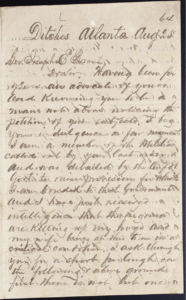
P. N. Vickers to Governor Brown, Sept. 1, 1864. U.S. Civil War Correspondence.
But his break did not last long! By August of that year, Buddie found himself in Atlanta, having been called up to join the State Militia by Governor Joseph Brown to defend the state against the Union Army. As part of Company C of the 12th Georgia Militia, Buddie served as a Corporal under the leadership of Thomasville resident, J.J. Ivey. Around this time, Buddie wrote to the Governor to ask for a short furlough that would allow him to return home to help out his wife who was in a “critical condition” (Annie may have been pregnant at this time, but if she was, the child did not survive – this may be the person named Matthew Vickers who is buried in the Ponder family plot at Laurel Hill Cemetery). Whether or not Buddie’s request was granted requires further research.
Despite his brief stints in the fighting and defense of the state during the War, Buddie came out mostly unscathed. He and his wife, Annie, went on to have another child, Charles Walter Vickers, and the family lived at their plantation until Buddie’s death in 1873 at the young age of 34. The cause of his death is currently unknown, but there was an outbreak of Yellow Fever in the area during this time. Annie brought her children to live with family in Thomasville after Buddie’s passing where she became a teacher.
This brings us back to Henrietta, who was also settling into life in Thomasville. Like Annie, and many other Southern women who found themselves displaced after the War, Henrietta needed a job to support herself and her family. Henrietta became a music teacher and took in young girls and women who were attending school in town. Young’s Female College was just a few blocks from the Vickers-Foster home on Jackson Street, placing them in prime territory for taking in student boarders. In 1907, Henrietta applied for a Widows Pension from the State of Georgia in payment for Aeneas’s services during the War. She received $1 a year.
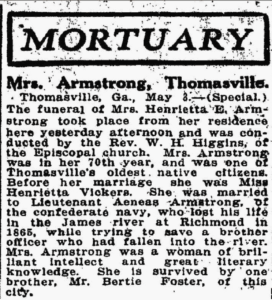
Henrietta’s obituary as it appeared in the Atlanta Constitution on May 4, 1912.
Henrietta spent the rest of her life in this way until her death on May 1, 1912 at the age of 68. She was buried in Laurel Hill Cemetery. She left any money and property she had left to her brother, Albert.
What must it have been like to live in Thomasville at the brink of the Civil War? Here at the History Center we have the transcript of a diary written by a young, seventeen-year-old woman over the year of 1861. This diary not only gives us insight into this question but also paints a vivid picture of life in South Georgia and how it was about to drastically change. Follow along as we explore the world from Henrietta Armstrong’s point of view in this blog series!
It’s been a while since we last checked in on Henrietta. When we last left off, she was suffering from the summer doldrums, but what will the next few months hold in store? A lot is happening around the world, and Henrietta may soon find herself appreciating those down times she once took for granted.
The first two weeks of August passed much like the previous weeks: everyone is still stuck at home, everyone is still sick, and the weather is awful in some form or another (this time it’s constant rain!). But thankfully for the family (and the reader), Aeneas proposed a trip to Thomasville! After riding in their own carriage from Smithville to Albany, the couple took “a miserable hack” or stagecoach on the final leg of the trip to Thomasville (Thursday, August 15, 1861). After arriving in town, they rented a carriage from Jim McLendon and rode to Buddie’s house just past the Florida border.
At this same time, things are heating up on the battlefields of the Civil War: Henrietta reports on a battle that has taken place in Leesburg, Virginia where the Federalists went into a retreat and lost three to four hundred men with fourteen hundred taken prisoner (Saturday, August 17, 1861). Keep in mind, Henrietta’s information is a little inflated. The fighting she refers to is the Battle of Ball’s Bluff where a little over two hundred Union troops were killed and over five hundred were captured – a still impressive figure considering the wild discrepancy in size between the Union and Confederate Armies at this time.
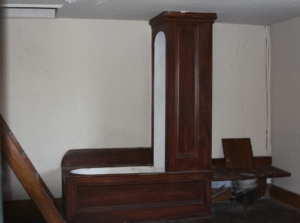
An original 1850s “shower bath” from Dunleith Historic Inn in Natchez, Mississippi – likely similar to what Buddie and Annie Vickers owned. Image curtesy of Natchez National Historical Park.
Over the next few days, Henrietta starts to have some fun again. Having been reunited with her sister-in-law, Annie, the two go out on the town (with Annie’s baby and an enslaved maid named Eliza in tow). Their activities include all the things gentlewomen could be expected to do: calling on friends, reading new books, strolling in the moonlight, and taking showers (Tuesday, August 20, 1861). Yes, the modern shower as we know it today is not quite so new in time as we tend to think. At this point in time, showers were not hooked up to plumbing, and instead used a reservoir of water that was recycled through the drain-to-shower head system. While they may seem primitive by our modern standards, they were high tech and novel for people in Henrietta’s time. As Henrietta did not have a shower at home (she likely used a tub as most people did) she wrote about her novel experiences taking showers several times (thrice in one week!) during her trip to Thomasville.
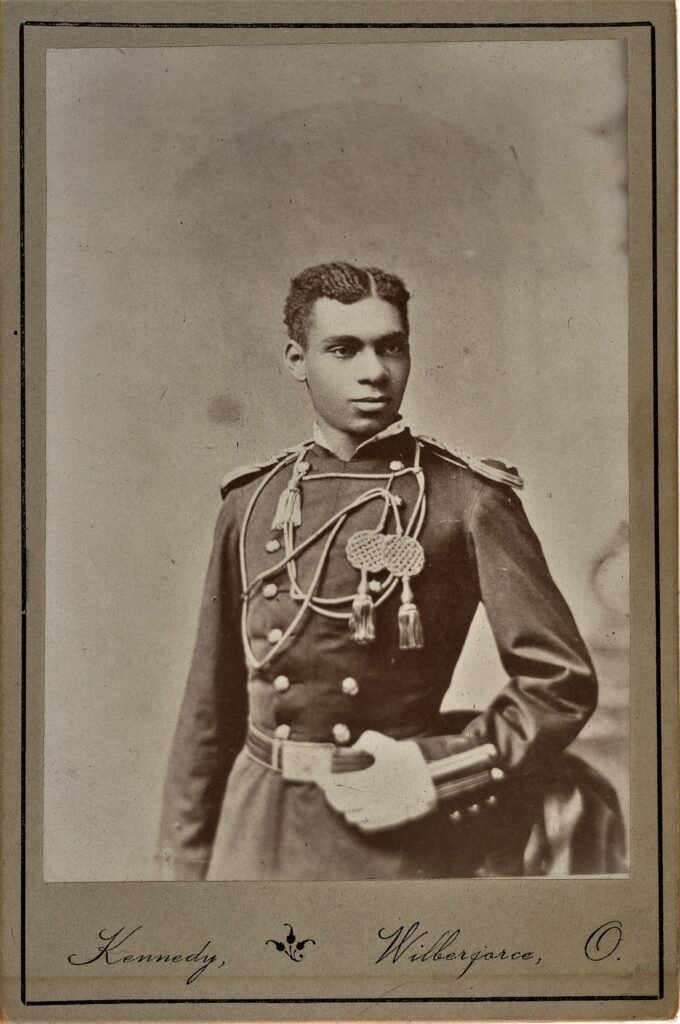
Backing up a bit, who were some of these friends that the ladies called on? Several families are mentioned like the Barkers and Aldermans. One individual included on their calls was Annie’s cousin, Ephraim Ponder. Henrietta gives us a few words on him, stating, “Mr. Ephraim Ponder is here and looks very badly,” (Wednesday, August 21, 1861). He had every reason to look badly. Ephraim Ponder may sound familiar as he is known today in Thomasville for being the enslaver of the Flipper family of Lieutenant Henry O. Flipper fame. While the Flipper family has gone down in the history books for Henry’s historic role as the first Black graduate of West Point, Ephraim’s reputation has not held up as well. Back in 1853, Ephraim married Ellen Gibson Gregory, a woman nearly twenty years his junior who was known for her beauty, spunk, and popularity. Unfortunately, she was a little too popular with other men for Ephraim’s taste and in a few months from Henrietta’s diary entry, he divorced her. Henry Flipper’s autobiography mentions her behavior:
Lt. Henry O. Flipper, 1880.
“The mistress of this fortunate household, far from discharging the duties and functions of her station, left them unnoticed and devoted her whole attention to illegitimate pleasures. The outraged husband appointed a guardian and returned broken hearted to the bosom of his own family,” (Henry Flipper, Black Frontiersman, 1963).
And this is where Henrietta finds him in August, having left his wife at their Atlanta plantation in hopes of finding comfort with his Thomasville family.
Other fun activities for the family included shopping, running a store for a friend who volunteered for the Confederate Army, more showers, and some hijinks:
“Buddie dressed up this afternoon in women’s clothes, put on a mask and frightened us a good deal.” (Friday, August 30, 1861).
But the fun and games were slowly winding down in the month of September. The first bit of panic arrived early in the month when Mrs. Barker came with news:
“I passed a very wretched night, I did not sleep any at all. Mrs. Barker came up about ten o’clock [the night before] and told us that Lincoln’s forces had landed at Fernandina and that they were fighting there and that every man that could shoulder a musket meet in Tallahassee at eight o’clock this morning. Aeneas and Buddie went down to T[allahassee] this morning and left by sunrise. They returned at nine tonight and informed that it was altogether a false alarm. I have been very unwell today.” (Friday, September 6, 1861).
Henrietta’s concerns for her husband and brother were allayed but not before setting the family off on a spell. Other rumors would circulate through town including accounts of the Confederates capturing Washington DC (not true) to British steamers breaking the blockade at Savannah (partly true).
To make matters worse, after several weeks of constant rain, a true storm came through the area. Most likely what we would consider a hurricane today, Henrietta described the aftermath in her diary:
“The wind commenced rising about eleven o’clock and about two it was a perfect gale. I could feel this house shake from its foundations. This morning was a perfect picture of desolation. The pailings were all blown down and the trees all over town. The wind has been blowing all day and I think it will be clear tomorrow,” (Friday, September 27, 1861).
Henrietta and her family were visiting friends in Thomasville when this storm came through. For those of us who have experienced the days after a hurricane, we can imagine what this scene might have looked like. And in a time before government sponsored clean-up crews, the work to restore the town following such a storm must have been massive, with most of it left to private citizens to organize and enslaved workers to perform.
By early October, Henrietta and Aeneas were staying with their Thomasville relatives, the Sewards. James Lindsey Seward (1813-1886), the head of the household, had an illustrious career in government, serving in the Georgia House of Representatives, the United States House of Representatives, and, at the time of Henrietta’s diary, the Georgia Senate. When the family was home in Thomasville, each member was highly involved in local events. Henrietta’s visit coincided with the family taking part in a tableau, a popular Victorian activity where participants dressed up in costumes and posed around scenery to create a living picture of famous stories.
“I have been busy all day helping Mattie [the Seward’s daughter] to get ready for the Tableaux tonight. She is to represent Florida in the ‘Secession of the States.’ I made her flag and trimmed it with a garland of flowers and also a wreath to go over her shoulder,” (Wednesday, October 2, 1861).
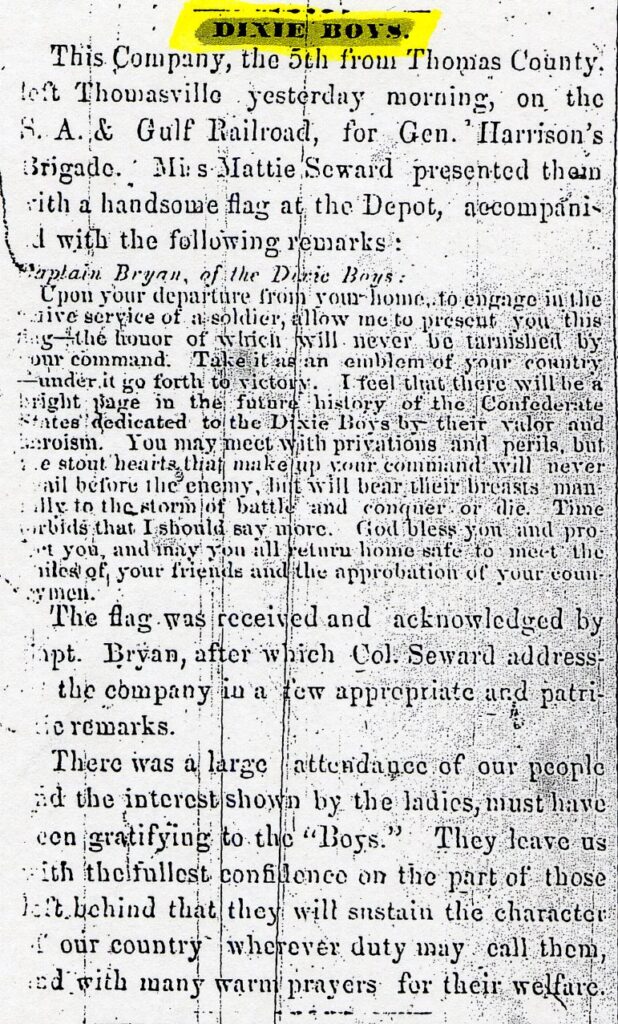
As public support for the War grew, Henrietta and her crew became even more involved. Mrs. Seward and Henrietta’s mother worked diligently to make pants and coats for the local volunteers. In the meantime, Henrietta helped Mrs. Seward sew and decorate a flag for Lucious Bryan’s unit, known as “The Dixie Boys.”
“I have painted the stars on the Blue Field of the flag this morning. Mrs. Seward sent the white stripes to Mr. Walcott to have an inscription on it. The company leaves Thursday morning and Mattie will present the flag to them at the depot,” (Friday, October 4, 1861).
“Dixie Boys,” Thomasville Times, October 9, 1861.
Mr. Walcott’s inscription read, “D.B. Victory or Death, August 10, 1861,” (Thomasville Times, February 26, 1893). Henrietta attended the flag presentation where Mattie made a “very neat little speech.” The Dixie Boys carried the flag throughout the war until 1864 when it was captured by Union forces at Vicksburg. Though later returned, it was in too fragile a state to be used and a replacement was made and used during the rest of the War. Currently, the original Dixie Boys flag is believed to be in private ownership. A similar flag belonging to the 29th Georgia Infantry is on display at the Thomasville History Center.
By mid-month, the Armstrong family returned home to Albany to find trouble at home. Once again their overseer was causing trouble and economic and trade challenges were making it difficult to supply their enslaved workforce with proper clothing.
“Everybody is looking gloomy, distressed, owing to the depresure [sic] in money matters. None can get credit; the cash must be paid,” (Friday, October 16, 1861).
With more work on her hands and the harvest season upon them, Henrietta soon had little time for keeping her journal. The entire months of November and December only received a few days coverage with Henrietta admitting, “My Journal is stopped for this year,” (Monday, November 25, 1861). Her last entry came on Monday, December 30, 1861 where she recorded the names of Confederate Generals as well as the President and Vice President.
While this may seem a rather disappointing end to Henrietta’s diary, worry not – there’s still a little more to come. Tune in next time for an epilogue where we answer several lingering questions: will Buddie and Aeneas survive the War unscathed? What will Henrietta’s life look like after the fall of the Confederacy? How did Thomasville change with the loss of so many young men on the battlefields? Find out next time!
What must it have been like to live in Thomasville at the brink of the Civil War? Here at the History Center we have the transcript of a diary written by a young, seventeen-year-old woman over the year of 1861. This diary not only gives us insight into this question but also paints a vivid picture of life in South Georgia and how it was about to drastically change. Follow along as we explore the world from Henrietta Armstrong’s point of view in this blog series!
When we last checked in on Henrietta, she had just learned that her brother was joining the Confederate Army. At the same time, she was home in Smithville nursing her sick husband and wondering what would come next. Her diary is heading into the summer of 1861 at this point. The weather is heating up, the crops are drying out, and tensions are rising alongside the thermometer. Let’s see what happens with Henrietta next.
Within the first few days of June, Henrietta is already having a very relatable Southern summer. Just as we are accustomed to here, the weather was hot and they were in desperate need of rain. As Henrietta most appropriately put it, “My garden is literally burning up” (June 11, 1861), showing that even over a hundred fifty years ago, teenagers were throwing the word “literally” into any sentence.
In the meantime, Aeneas continued to struggle with his health. Despite beginning the month on a good note, within two days he was back to ailing, this time with “weakness of the stomach.” Coincidentally, he had just started taking a new medicine prescribed by a Dr. Mettaver a few days before. But the pendulum would soon swing back in Aeneas’s favor as Henrietta reported,
“Aeneas is a great deal better today. He applied, last night, a mustard plaster to his stomach and it has relieved him almost entirely of the soreness in his stomach.” (Tuesday June 3, 1861).
Paper packet containing Mustard Plaster, by Seabury and Johnson, 1880-1900. Science Museum Group Collection
Mustard plasters were a popular remedy for aches and pains and were made by grinding up mustard seeds, mixing the powder with flour, and applying the mix under a bandage to the affected area much like the 1800s equivalent of an Icy-Hot Patch. The powdered mustard warms the skin and muscles – although leaving it on for too long could lead to burns. Whatever was ailing Aeneas this time, the patch seemed to help with the pain. But as seems typical for the Armstrong family, Aeneas’s good health only lasted a month until he spread a cold throughout the entire plantation.
Henrietta’s journaling from this time reveals her feelings about Smithville and life in the country in general during this time: it was dull. She states,
“We are lonesome. We see nobody at all and hear nothing.” (Friday, June 7, 1861).
The closest the Armstrong’s came to social interaction was through letters back home (including one that contained a picture of Buddie’s daughter, soon to be named Henrietta after her aunt) and conversing with the hired and enslaved workers on the plantation. The hired workers were Mr. Price, the plantation overseer, and his wife, both of whom seemed to be frequently in trouble for borrowing or taking more than they should of the Armstrong family’s food and resources.
With none of their family or friends around for dozens of miles and very little in town to do, their entertainment came from reading books (most of which they’d already read), playing the piano (which Henrietta forgot how to do), and trying out foods from the newfangled technology of cans and tins. From this we get thrilling updates like:
“Aeneas opened a can of fresh salmon this evening. He enjoyed it very much.” (Thursday, June 6, 1861).
The next day they tried canned corn and tomatoes which were “very nice indeed.” Complaining about their situation, Henrietta admits,
“This life is getting to be very wearisome and monotonous. Aeneas is improving though everyday and I hope that he will continue to exercise prudence and take good care of himself. He is still reading “The Last of the Barons.” I have nothing to read myself. I have read every thing in the house and I am, to use a French word ‘ennuyed’ almost to death. I wish I could get my [sewing] machine, I could then do some work. As it is I have nothing to do. Aeneas and I played cards awhile this evening and then he opened another can of salmon.” (Wednesday, June 12, 1861.)
But things were about to get going. Within a few days the couple ventured out to town to retrieve Henrietta’s sewing machine that was brought by train from Macon. After learning about the intensifying fighting in Virginia between the Union and Confederate troops, Henrietta felt invigorated to help the Confederate troops.
“We were victorious in every encounter. It looks as if Providence is on our side. Mrs. McAfee gave me some drawers to make for the soldiers, I have my machine now and can get along very well.” (Saturday, June 15, 1861).
On top of her work for the soldiers, she made several new clothes for the enslaved workers on the plantation including “three shirts for Edmond, Evans, and Wilson and two dresses for Adeline and Chloe” followed by “three pairs of britches, and one dress for Malinda,” and slip dresses for the children. To make matters more exciting, Henrietta spotted a comet passing by for several days in July, remarking,
“I was very much astonished tonight by seeing a large comet in the West.” (Tuesday, July 2, 1861)
“Great Comet of 1861, also known as C/1861 J1 or comet Tebbutt” by E. Weiss.
She went on to mention the comet over several days, with it only seeming to disappear from view by the middle of the month. This turns out to be “The Great Comet of 1861” which was first seen in Australia over a month before Henrietta could see it. Several notable people across North America also wrote about seeing the comet. And if you can wait around until 2267, you could see it too!
By the end of July, Henrietta remains fairly bored with the occasional bit of news keeping her spirits from sinking too low.
“Next Wednesday is my birthday, I will be eighteen years old. I feel ten years older at least… I wish some of our relatives would visit us.” (Friday, July 26, 2861).
Unfortunately, Henrietta would have to wait another few weeks to see her family and friends. In the meantime, she lost some friends following the death of two Macon men during a battle in Virginia and the elopement of a young woman from a neighboring home who ran away with the Armstrong’s previous overseer.
Despite her ongoing boredom in Smithville, things were heating up across the country and the consequences of the Civil War were soon to come home to the Armstrong family. Will Buddie and Aeneas be called up? Will Henrietta get to leave Smithville? Will canned salmon be on the menu again? Join us next time to hear how life is about to get more interesting for Henrietta and Aeneas.
What must it have been like to live in Thomasville at the brink of the Civil War? Here at the History Center we have the transcript of a diary written by a young, seventeen-year-old woman over the year of 1861. This diary not only gives us insight into this question but also paints a vivid picture of life in South Georgia and how it was about to drastically change. Follow along as we explore the world from Henrietta Armstrong’s point of view in this blog series!
Last time we heard from Henrietta, she had just left Thomasville to spend some time with family in Eatonton, Georgia. As she arrived, the action that would kick off the Civil War was just starting. Troops were marching through her area, and Henrietta predicted that a war between the Union and the Confederacy would lead to disastrous consequences for all involved. But what will happen next? Will Henrietta ever see her husband again?
The month of April kicked off to the beat of drums as Confederate troops arrived in Macon at the newly dubbed “Camp Oglethorpe.” In the commotion of the arriving troops and gossip about Governor Brown’s doings around the state, Henrietta yearned to hear from her husband, Aeneas, or even her mother-in-law who had traveled to Fernandina Beach in Florida, yet no letters came. Her only excitement came from a walk to the fairgrounds with her father-in-law:
“We walked to the Fair ground this afternoon and saw Governor Brown review the troops. There are about 1,000 and 50 in the regiment. There was a great crowd assembled and I did not hear very well the Governor’s speech, though I understand that it was very good. I came home perfectly exhausted from the long walk.” (Thursday, April 4, 1861).
She continued to write of receiving no news for several days until the war pace suddenly picked up. Mrs. Armstrong returned from Florida and Henrietta received word from Aeneas just as news came about that the Confederacy had attacked Fort Sumter in Charleston, South Carolina. Her brother sent her a letter from Savannah detailing what he had witnessed:
“Buddie had just arrived in Savannah from Charleston. He was present at the commencement of the Storming of Fort Sumter and looked on he said for two hours. Aeneas was in Savannah when Richard wrote. Richard expected to leave the next morning to cruise about Charleston… We have fallen upon stormy times. God be with us and grant us Victory.” (Sunday, April 14, 1861)
With the action in full swing, Henrietta got to work sewing pants for the relatives who were receiving orders to join the fighting. With each day, she received more news of states leaving the Union and the Union’s attempts to stop them. But still she had no word from Aeneas.
By the end of April, Henrietta was growing further worried about her husband. All she had were reports from family passing through Savannah stating that Aeneas was sick but would soon be home. She waited until he finally arrived:
“Received a telegraphic dispatch from Aeneas last night saying that he was sick and would be here this morning. Mrs. Armstrong and I went to the depot to meet him and found him scarcely able to move. He is so changed with sickness that it makes my heart ache to look at him. We moved back into our old room this afternoon. Think he is a little better tonight.” (Monday, April 29, 1861)
Like many people in the South during this time, Aeneas suffered from Malaria. Malaria is caused by a parasite transmitted by mosquitos making it especially prevalent in tropical and sub-tropical locations like South Georgia. Though we have nearly eradicated the disease here in the United States, it used to kill thousands on a yearly basis. In Aeneas’s case, working in the Navy exposed him to infected mosquitos repeatedly over his lifetime, causing him to be frequently reinfected and leaving him sickly. The cure for the disease at that time was taking quinine, a medicine made from the bark of trees in South America, something Henrietta kept in-stock at their home near Albany. She likely prescribed it for them as she wrote about his improvement the next day:
“Aeneas is a little better this morning. He has had no fever all day. I have not been well myself, but it will not do for me to complain. I have been reading the “Dodds Abroad” by Lever, it is very amusing. The news today is still bad, I have not the heart to think about it. Mrs. Freeman and Mrs. Scott came here this morning. Mrs. Freeman thinks that everything will end well. I would like to feel so, but cannot. I hope Aeneas will be well soon. I joined the Ladies Relief Society.” (Tuesday, April 30, 1861).
In case she didn’t have enough going on, Henrietta had a new cause to take on. The Ladies Relief Society focused on obtaining supplies for Confederate troops from items like socks and pants to food provisions and even flags. Mrs. Armstrong joined alongside Henrietta and went to work making a flag for one of her son’s units. Henrietta took on the no less monumental task of making two uniforms. At the next meeting of the Ladie’s, she gave $5.00 to relief efforts, an amount that would equal a little over $145 today. But as all this happened in Macon, there were similar stirrings in Thomasville:
“I received a letter from Buddie today and wrote one to Ma. Buddie writes me that there are two volunteer Companies in Thomasville ready for service.” (Monday, May 6, 1861)
These companies would become the Thomasville Guards and the Ochlocknee Light Infantry. These groups were reorganized under the Confederate States Army as Companies F and E, respectively, of the 29th Georgia Regiment that summer. Of the 246 men who joined those regiments, 105 died during the War.
As Aeneas continued to convalesce, Henrietta and her mother-in-law continued their relief efforts in between concerts, trips to see the troops, and ice cream socials. Much like Americans today, the Armstrong family were big fans of ice cream. The Armstrong ladies’ contributions to the troops that month included multiple pairs of pants, shirts, flannel underwear, and a sack coat. It should be mentioned that not only did Henrietta and Mrs. Armstrong work on these clothes, they were also assisted by the enslaved women of household, including Flora who often took up the finishing work when Henrietta was sick or tending to Aeneas.
By the end of the month, word arrived from Thomasville that Buddie had joined a company in Duncanville. Duncanville was a small town west of Thomasville near the area we know today as Beachton along the border of Thomas and Grady County. Henrietta had little to say on the matter, perhaps too worried about Buddie and her ailing husband to commit her thoughts to paper.
The late spring of 1861 was shaping up to be a busy time for Henrietta with little hope for rest in sight. As the month of May came to a close, she and her husband packed their bags and began their journey home to their plantation near Albany. What would they find when they got there? Will Aeneas ever recover? And how will the family cope with Buddie’s decision to join the army? Find out next time!
At the time of this blog’s posting, school children across our community are busy with end of year testing: from Milestones Finals to AP exams and all the standardized bubble sheets in between. But what was school like before government-mandated testing and number two pencils? And how did Thomas County handle educating the youth of the past? Let’s take a step back in time and learn a little about the history of education in our own backyard!
While Thomas County wasn’t founded until 1825 (two hundred years ago this December!), the State of Georgia was addressing the topic of education as early as 1777. In Georgia’s first constitution, the delegates made a provision stating, “ Schools shall be erected in each county, and supported at the general expense of the State as the legislature shall hear after point out and direct.” In case you’re wondering how serious these people were about education, our state government went on to put out three more constitutional updates before 1861, with all but the second one containing some sort of educational provision.
There were two ways to enforce this part of the constitution within a county: 1) start a “Poor School” funded mostly by the State and local government or 2) start an “Academy” which charged students tuition to cover expenses (minus a time between 1820 and 1840 where the State did provide some financial assistance to these schools and students). With these steps in place the State had a new issue: defining a “poor” student.
Henry Mitchell’s School Book, Thomasville History Center Collection.
According to the State of Georgia in the early nineteenth century, “poor” students were either male or female and ranged in age from 8 to 18. They were mostly White although there were Free People of Color living throughout the state, including in Thomas County, who may have had the opportunity to attend school. (As an aside, The Georgia Slave Code prohibited teaching enslaved people to read; however, we know from anecdotal evidence and later documentation that this ruling did little to stop people from teaching the enslaved whether for religious and moral reasons or business reasons.) Poor students were entitled to three years of “poor schooling” which provided them with skills in reading, writing, and arithmetic (the infamous “Three R’s”). This system could be considered a precursor to modern public schooling. But for the people of early Georgia, it was considered unfashionable and even embarrassing to participate in the system. By 1840 only 12 students in all of Thomas County took advantage of State funds to achieve their education.
For the rest of Thomas County’s youth who had the resources to attend school, their educational career could be far longer and in depth. These students could find classes starting as early as five years old for both girls and boys, with subjects differing by gender. Tutors could be brought into the home, or children could be sent to various “Academies” as were available to them.
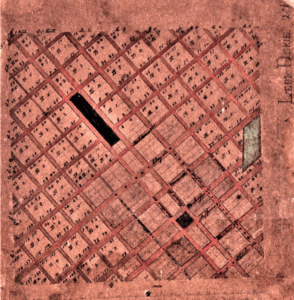
1860 Plat Map of Thomasville showing the Academy Lots. Thomasville History Center Collections.
Thomasville’s first academy was chartered in 1830 with a classroom built on the corner of Madison and Monroe Streets (currently the site of a parking lot). Classes began in 1832 with 42 students, male and female, in attendance. The curriculum originally only covered the Three R’s mentioned earlier before expanding as enrollment grew. By 1836, a new classroom was built on the corner of Broad and Monroe Streets (currently the site of the Hayes House) and by 1838 new secondary courses were added such as music and languages. The Academy continued for the next decade before losing steam in light of other schools developing around the County.
Despite the lack of public education, in 1840 Thomas County, only 330 out of 6,766 white adult citizens (women included) were illiterate, a mere 4.9% of the community. By then, more schools were opening throughout the county. These were mostly temporary schools set up by groups of families and neighbors who paid a tutor to work with their children for a few months out of the year. By 1850, Thomas County’s literacy rates improved even more with only 148 out of 10,103 White citizens being illiterate or 1.5% of the population. At that point there were 14 common or public schools in the County, educating 216 students with 12 teachers.
Fletcher Institute Report Card for Mattie Jones, 1860. Thomasville History Center Collection.
The 1850s were an educational boom time in Thomas County. In 1850, the co-ed Fletcher Institute was founded where Harper Elementary School stands today. In 1855 the County had three schools. Grooverville Academy on the border of modern-day Brooks County had two teachers, Mrs. Smith and W.H. McMurray, and over 50 students. In Thomasville, Cornelia Hansell started the Female Seminary with three teachers including Cornelia, Addie Armstrong, and Professor Parsons teaching a number of young girls. Down the street (near the current Marriot Hotel in downtown) was John M. Dyson’s “Lecturing School” where he taught young boys the art of oration as well as ancient languages and mathematics. By 1857 a Mrs. Simmons opened Piscola Academy and by 1859 two more schools were added with Miss S.M. Kellog’s Academy teaching young children the Three R’s and secondary subjects and Mrs. Julia Fisher’s Tockwotten Academy. By the end of the decade, the movers and shakers of the town were planning for the next level of education they thought Thomas County desperately needed: a women’s college.
Like all boom times, this one quickly came to an end with the advent of the Civil War. Just as we experienced with the lock downs during Covid, students were sent home from schools across the State. For many families, education was put on the back burner as children were needed to help out at home while the men of the family were involved in war efforts. Likewise, teachers were also assisting with the War. Julia Fisher of Tockwotten Academy closed her doors in order to lead the Ladies Aid Society gathering and making supplies to send to local military units. Formal schooling became close to non-existent throughout Thomas County.
After the end of the Civil War in 1865, the 14th Amendment and Reconstruction efforts across the South ushered in a new wave of students and an increased appreciation for education. With formerly enslaved people now able to obtain and education, schools were built specifically for their benefit with a Freedman’s school and later several private schools popping up in Thomas County. Meanwhile, many of the larger schools in place before the War continued, such as the Fletcher Institute which later evolved into South Georgia College. Young’s Female College, interrupted by the War, finally opened its doors in 1871. Throughout the rest of the nineteenth century, small schools popped up around Thomas County to serve both White and Black communities reach varying levels of education.
While it will take some more research to measure how the Civil War affected literacy rates in Thomas County, it’s clear to see that many students lost out on the opportunity to learn in a formal setting during the War years. Just as we experienced during Covid, many students had to learn at home. Students were dependent on family members who may or may not have had the resources or education themselves to help younger learners. Fortunately, the lost opportunities gave way to an increased interest in education for the next generation of students. Before long, Thomas County would begin the long process to the standardized public education system we are familiar with today.
What must it have been like to live in Thomasville at the brink of the Civil War? Here at the History Center we have the transcript of a diary written by a young, seventeen-year-old woman over the year of 1861. This diary not only gives us insight into this question but also paints a vivid picture of life in South Georgia and how it was about to drastically change. Follow along as we explore the world from Henrietta Armstrong’s point of view in this blog series!
Last time we heard from Henrietta, she had just learned of the State of Georgia’s secession from the United States of America. She was excited about this news in January of 1861. Will her feelings change along the way? In the meantime, how does she spend her days as a lady of leisure? Let’s find out.
When we last left off, Henrietta was home in Albany, but she and her husband, Aeneas, were planning to travel to her brother’s home near Lake Iamonia. Pleasant Nixon Vickers (1838-1873), otherwise known as “Buddie,” owned a plantation along the South Georgia border with Florida. Buddie’s wife, Annie, had recently given birth to their first child, a little girl who would later be named after Henrietta.
“This is the First day of February and it has been windy and rainy. Aeneas and Buddy went off this morning on a collecting tour and will be gone I expect four or five days. We have been working in the parlor all day. Annie wanted to have her room scoured and cleaned up generally. Ma and I helped to finish Annie’s delaine dress and I have been sewing on a dress for the babie [sic]. I have had a bad Headache all day. After supper I hurt my finger badly, not withstanding, I played Whist with Annie against Ma and Mr. Gunn. The wind blows hard.” (Friday Feb. 1, 1861)
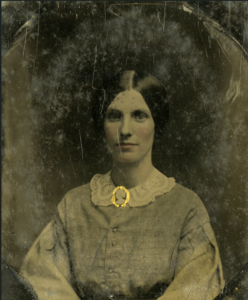
Fig. 1: Unidentified Woman, c. 1860. Thomasville History Center, 2024.045.0005.
The men of the family are said to be on a “collecting tour” but the “what” being collected is never specified. It may have been money from borrowers or renters who lived in the area or even taxes. Meanwhile, the women stayed behind to help Annie by making clothing (the delaine dress mentioned is a type of wool and cotton fabric blend used for day dresses like the one pictured in Figure 1) and entertaining (Whist was a popular card game). Interestingly, Henrietta mentions Annie having her room scoured. Most likely the enslaved maids on the plantation would do a deep clean of the room, taking out all the linens to be washed and scrubbing down the floors and furniture. As anyone who has brought home a newborn can tell you, Annie’s room was probably pretty messy.
If this sounds like a pretty dull start to this journal, you aren’t wrong for thinking so. Like many women of her time, social status, and location, Henrietta spent a lot of time doing chores in the daytime and finding ways to pass the night until morning came around again. Her biggest excitement came two weeks later.
“It was raining this morning but cleared up about twelve. Aeneas wrote to Mr. Folsom ordering a sewing machine and Buddie sent him the letter by Elias. We received an answer in the afternoon from Mrs. Folsom saying that he would be here with one to morrow [sic] or next day. Buddie and Aeneas went fishing this evening and caught over thirty of the finest speckled perch that I ever saw.” (Thursday Feb. 14, 1861)
A sewing machine may not sound like a romantic Valentine’s gift for some, but for (accident prone) Henrietta, it meant her sewing projects moved at lighting speed (unbeknownst to her, this would come in handy over the next few months as her friends and neighbors joined the Confederate Army and needed uniforms). As for her Valentines Day meal of perch that she was so excited about, that would all change by February 20th when she wrote, “I am perfectly sick and tired of fish.” And just as fish and house guests tend to smell after a few days, the whole family made an exciting trip to Thomasville!
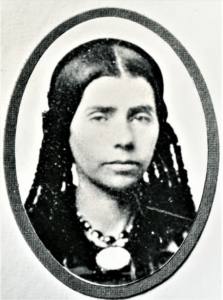
Fig. 2: Frances Amanda Tooke Seward, c.1850. Thomasville History Center, 1978.010.1492.
When the Vickers and Armstrongs visited Thomasville, they stayed with relatives. Henrietta was connected to the Seward family of Thomasville through her father’s first marriage to the mother of Frances Amanda Tooke Seward (Figure 2). Frances was married to James Lindsey Seward, who had served in both the Georgia and United States Houses of Representatives. Henrietta doesn’t go into detail about her stay with the family at this time, but she does talk about visiting friends and the fun she could have in town.
“We left Buddie’s this morning. The day is very pleasant though cloudy. Buddie came to town with us and will not go home until tomorrow. We all stopped at Mrs. [Frances] Seward’s. After dinner we went to town and I bought several articles then went round to see Lena Seixas, but did not find her at home. I called in at Mrs. H. Seward’s [Mary Harvey Seward, sister-in-law of Frances and James] and saw several of my old friends. I received a note from Lena tonight. We have put off leaving until tomorrow night.” (Tuesday Feb. 26, 1861)
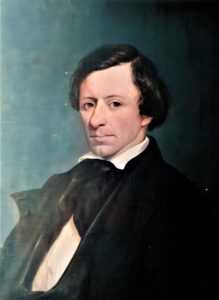
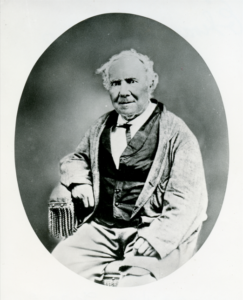
Lena Seixas was the daughter of Edward Seixas (Figure 3), a Thomasville pharmacist and Huldah Smith, a member of the Smith family that gave Thomasville the land for Paradise Park. The Seixas family were some of the earliest settlers of the town. However, just a few months prior in September of 1860, Lena’s brother was mortally wounded in a duel. This meeting may have been the first time Henrietta would have seen Lena following the incident. So how was the family doing? Henrietta met them the next day:
Fig. 3: Edward Seixas, 1860. Thomasville History Center, 1978.010.1450.
“Another pretty, but rather cloudy day. I went over to see Lena this morning. They were all glad to see me. I promised Lena to go to the Daguerreian Room this afternoon… Lena and I had our tintypes taken this afternoon, she gave hers to me. We left Thomasville on the stage [coach] at eleven o’clock to-night… There are a very few passengers in the stage.” (Wednesday Feb. 27, 1861)
Henrietta refers to a “Daguerreian Room” or what we would call a photography studio. At the time of this diary entry there were two studios in town: Remington’s Photographic Gallery was likely in the area that is now the Plaza and Professor Jeffers’s studio, later named the Sky Light Gallery and located on the second floor of a building downtown. Henrietta doesn’t specify which gallery they went to, but she does mention the only way to travel out of Thomasville at the time: stage coach, the 1800s precursor to a Grey Hound bus.
If February was a dull month, March quickly picked up the pace. March 4, 1861 marked Abraham Lincoln’s inauguration as President of the United States. Meanwhile, Henrietta and Aeneas made a detour to see his family in Macon before heading home to the Albany area. Just as soon as they got home, Aeneas was ordered to join a the CSS Savannah, a former steamboat called Everglade before it was converted into a gun boat for coastal defense.
“… I received a letter from Aeneas this afternoon. He is in Savannah and has been ordered to join the War Steamer, “Savannah,” formerly the “Everglade” a passenger steam boat. I do not know when I will see him, not very soon…” (Wednesday Mar. 6, 1861)
Seventeen-year-old Henrietta was left with a choice: stay home and tend to the plantation in her husband’s absence or go stay with her aunt in Eatonton, Georgia. Henrietta chose her aunt. She followed up with more news the next day: “Fort Sumter, it is expected, will be evacuated very soon, but the Yankees are so tricky that we cannot tell anything about it.” As quiet as Eatonton was, the rest of the country was heating up, and within a month, the first shots at Fort Sumter would signal the official start of the Civil War.
After three weeks in Eatonton, Henrietta went to her mother-in-law’s home in Macon to keep house while the rest of the family traveled to Florida for business and health reasons.
“Mrs. Armstrong is better this morning and has determined to go to Fernandina with Mr. Villepigue [Frederick L. Villepigue, Aeneas’s sister’s husband and Secretary of State for Florida from 1853-1863]. I will remain here and keep house until she returns. I did not hear from Aeneas today. I have remained in the house all day. I shall be very lonesome by myself, but I am fast learning to expect nothing and to bear misfortune as quietly and phlegmatically as possible. Mr. Villepigue makes himself very pleasant. I have nothing of importance to write in my Journal tonight, so I will put it up and let it alone. For to-night.” (Tuesday Mar. 26, 1861)
A few days later, Henrietta would have more of importance to record:
“…From accounts in the papers we may hope for a peaceful settlement to the difficulties between the North and South. But Lincoln and his cabinet are so tricky we cannot rely on anything they say. I will not be surprised if we have War and if we do there will be more blood shed than has ever been known. God grant that it may be otherwise.” (Thursday Mar. 28, 1861)
As the month continued, thousands of Federal troops arrived in Macon on their way to Pensacola, Florida to be shipped home. Henrietta had no idea how prophetic her words would prove to be over the upcoming months and years as the Civil War swept through our area and the nation. Tune in next time to see how Henrietta adapts to her newly changing world on the brink of the American Civil War!
What must it have been like to live in Thomasville at the brink of the Civil War? Here at the History Center we have the transcript of a diary written by a young woman over the year of 1861. This diary not only gives us insight into this question but also paints a vivid picture of life in South Georgia and how it was about to drastically change. Follow along as we explore the world from Henrietta Armstrong’s point of view in this blog series!
Henrietta Eugenia Vickers Armstrong (1843-1912) was born in Thomasville, the third youngest of four children born to James M. (1810-1849) and Anna E. Miller Vickers Sr. (1821-1905). By the time of writing her diary, Henrietta had already known the pains of loss: her older sister died right before her birth, her father died when she was six, and her baby brother, James Jr., died when she was 15 after he drowned in the Ochlocknee River.
Despite these hardships, there were good times too: in 1850 her mother remarried and had another son just a few years later. In 1858 Henrietta married Aneas Armstrong, a member of the United States Navy and plantation owner. At the age of seventeen, she was in charge of overseeing the family home: a job which included nursing, clothing, and directing the work of sixty-seven enslaved laborers. Within a few weeks of beginning her diary, Henrietta’s older brother had his first child, a daughter he named Henrietta Eugenia after his sister.
On the note of family, Henrietta had an extensive extended family made up of several VIPs of the time period. Her father’s first wife was Mary Polly Jones Tooke, the mother of Henry Harlowe Tooke (a seasoned clerk in the Thomas County court) and Frances Amanda Tooke (the wife of James Lindsey Seward, a member of the United States House of Representatives before the Civil War and member of the Georgia Senate.) Henrietta’s brother, Pleasant Nixon Vickers, was married to Ann Ponder Theus whose mother was part of the Ponder family. They are known in Thomas County for the Ephraim Ponder House (her uncle’s home) on Dawson Street and their enslavement of the Flipper family, including Henry Ossian Flipper.
Through her husband, Henrietta was connected to the Armstrong family of Bibb County which included his father, a plantation owner and Major General, and Aneas’s eleven brothers and sisters. Several of his brothers became high-ranking naval officers for the Confederacy. One of his sisters married the Florida Secretary of State, Frederick L. Villapigue, who was instrumental in orchestrating Florida’s secession from the Union. Henrietta’s family was well-connected within Georgia and Florida society and government, affording her family many opportunities that were not available to the average citizen.
Unbeknownst to Henrietta, a dark period in American history, and her own life, was about to begin. On January 19th, the State of Georgia seceded from the Union. Several other Southern states followed, leading to the creation of the Confederate States of America and tipping off the American Civil War. A day after Georgia left the Union, Henrietta wrote in her diary:
“We are out of the ‘Union’ at last, thank God. I hope the abolitionists will suffer for what they have done.”
Unfortunately for Henrietta, her family would be swept up into the ensuing war with dire consequences for some members (but you’ll have to wait for another installment of this series to find out who!).
Over this year, we will follow along with Henrietta and the Vickers-Armstrong family as they dealt with the turn of events that marked 1861 as the start of the Civil War. Learn about her family, her daily life, and the ins-and-outs of being the wife of a plantation owner in Southwest Georgia. Despite how much life has changed in the 164 years between now and the time of Henrietta’s diary, many aspects may feel familiar to our own lives and give us a peek into the Thomas County she experienced.
Here at the History Center, we like to supply our collections department interns and volunteers with interesting projects that illustrate what life in Thomas County’s past was like for her citizens. We have many letters, records, diaries, and documents that give sneak peeks into the daily lives of people who were more like us than we may realize.
One of our interns, Kayla Reeves (who recently attained her bachelor’s degree in history from Florida State University), was tasked with transcribing a collection of letters from Private Peter Dekle (1836-1863) to his wife Susan Dunbar Dekle (1839-?) of Thomasville. Peter’s letters span from April of 1862 to August of 1863 when he served in the Confederate Army in Company F of the 29th Infantry. For most of his military service, Peter was stationed around Savannah but was later sent to North Carolina and Mississippi before he was wounded at the Battle of Chickamauga. After several months, he succumbed to his injuries; however, the whereabouts of Susan following her husband’s death are currently unknown.
Here’s what Kayla had to say about Peter and his letters to Susan:
“As a drafted soldier, Peter did not generally discuss ideological reasons behind the war in his letters, rarely mentioning secession or even regional animosity. However, Peter’s letters provide valuable insight into the experiences and mentality of an average soldier, demonstrating themes of homesickness, despair, adventure, and adjusting to the general monotony of camp life.”
In this blog series, Kayla explores some of these themes with excerpts from Peter’s letters. Please keep in mind that Peter was writing in the language and attitudes of his time which we now consider to be racist and prejudice.
In one of his letters, Peter mentions efforts to evangelize some of the soldiers and notes the varying morality of different soldiers in the regiment.
“precher [preacher] Danels are preaching in camps to knight [tonight] at this time while I am writing, Moat Stephens are going to be Baptiesed [Baptized] tomorrow evening. he joyened [joined] the Church last knight [night]. I wosh [wish] the whole regiment were prepared to go in the water with him.
Peter does not frequently elaborate on his own religious beliefs in his letters besides common phrases like “God-willing” or “God bless”; however, from the context of this passage and what we know of his family, he likely considered himself a member of the Baptist Church. In this excerpt, one can see that Peter views Christianity as a positive force in the camp.
But the presence of Preacher Daniels did not entirely prevent immoral behavior from happening. Peter continued his letter by condemning the behavior of his fellow troops in the camp, stating,
“if they were [baptized] they would not be so much meanness going on in some are gambling, sum cursing, sum dancing while sum are praying. any thing you want to see you can see it in camps. I have seen so much going on untill I am nearly worn out at the sight of a man. if this war last two years longer the soldiers will no more cere for there soles [souls] if they had none. I have bin [been] beat so bad in meenness [meanness] until I have got ashaimed [ashamed] of my self and quit it”
Even Peter admits falling prey to sin alongside his fellow troops, though through what means he does not say. Granted, his ideas of sinfulness (gambling, cursing, and dancing) might seem rather tame to our modern eyes. In light of this, we need to take Peter’s condemnation of his fellow troops with a grain of salt as his idea of a den of iniquity is a bit stricter than what we might imagine.