Spring is in the air and so is the pollen! As we shake off the last frosty days of winter, many plants are blooming and turning Thomasville into a beautiful sight to behold. And many people are getting out and returning to their gardens. With several historic garden clubs in our area and a rose show that has been around for over a century, it’s no wonder that the flora of Thomasville is uniquely lush and beautiful.
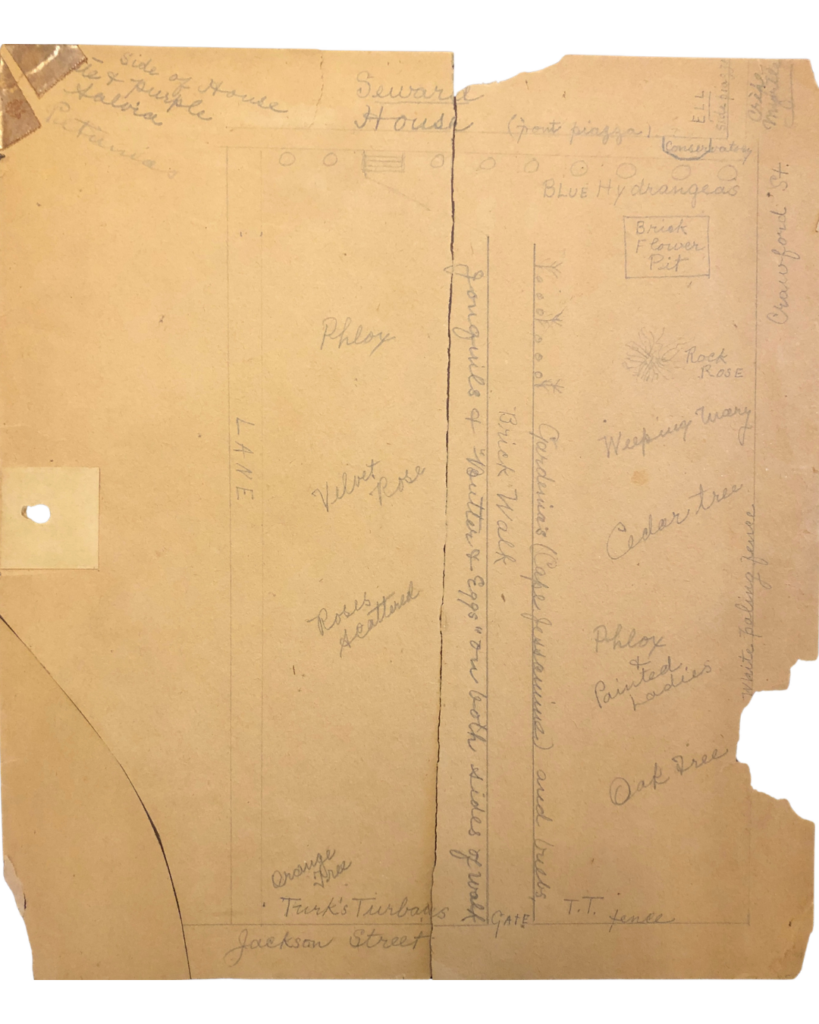
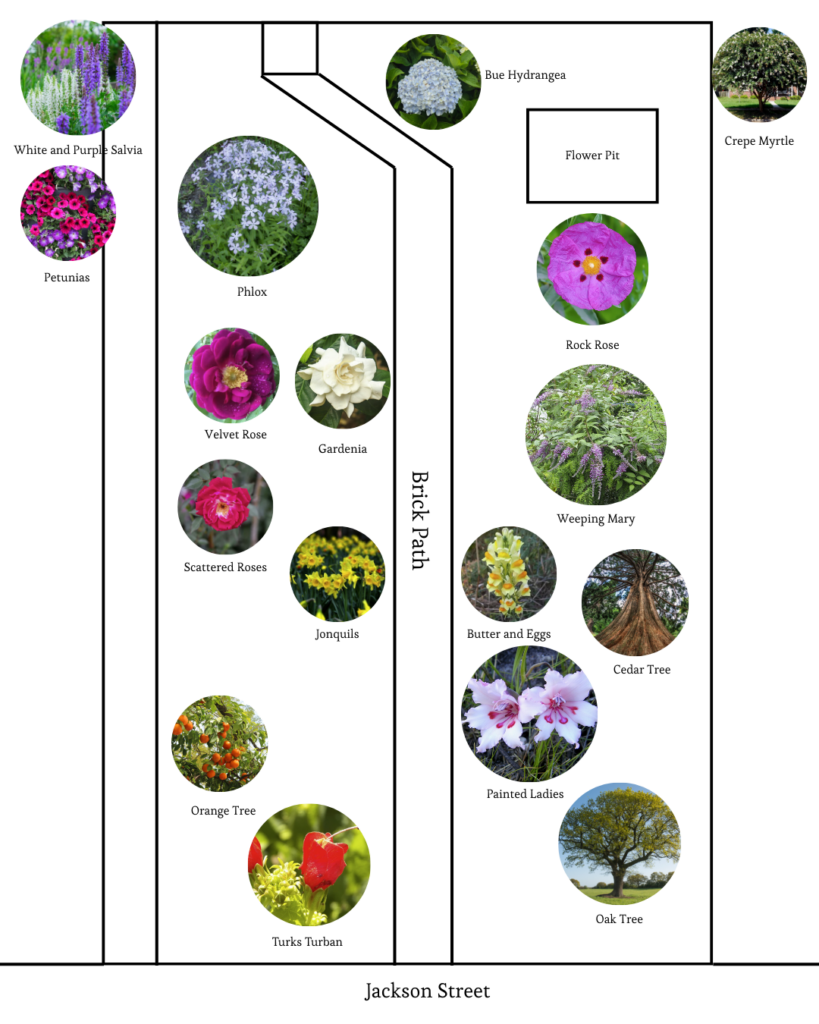
Plan of the Seward House Garden as it appeared in the 19th century, c.1925
If you’re looking for ideas for transforming your garden, why not take a historic approach? The History Center’s collections offer us many pictures of past gardens, but a deeper look through the files shows us a map of a very special garden – the original 19th century garden that once decorated the front yard of the Seward House. This layout can be easily recreated or worked on to create a classic Southern garden for any level of gardener (including those of us with sickly green and brown thumbs).
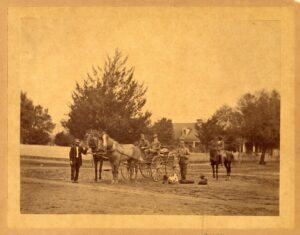
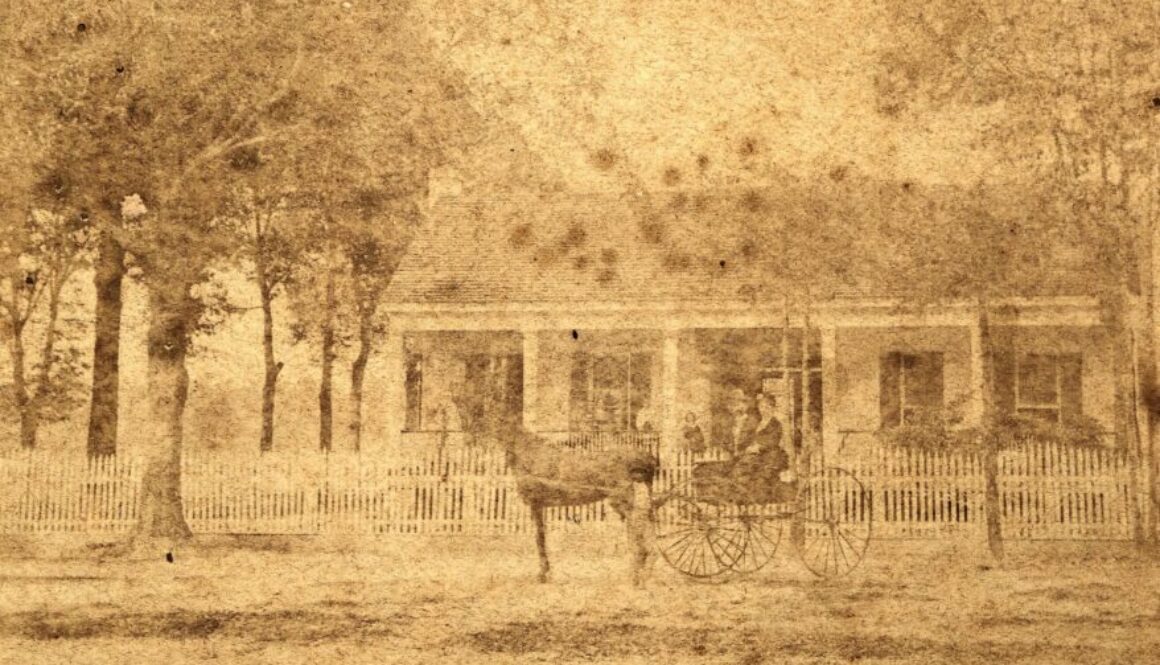
A hunting party in front of the Seward House, c. 1885. The buggy occupants are H. W. Hopkins on the left and Dr. Thomas Metcalfe.
Before diving into the gardens, let’s get a little background on this house and why we have the garden plans in our collections. The Sewards in question for this property were Senator James Lindsey Seward (1813-1886) and his wife Frances Amanda Tooke Seward (1822-1897). Formerly located along the middle of Crawford Street facing Jackson Street, the site is now the location of several businesses including Hong Yip, the headquarters of the Republican Party in Thomasville, and AJ Moonspin. The house was likely built prior to 1865 and added onto with the gardens developing over that time.
Most of the plantings in this garden are familiar names to us: cedar, oak, hydrangeas, etc. But a few of them require a little deep dive to find the intended plant. For example, take the Weeping Mary (be sure to add “plant” after the name in your google search or else you’ll be flooded with religious iconography). The scientific name for this plant is Buddleja lindleyana. It is native to China but was introduced to the United States in the 1800s. The plant is reminiscent of wisteria in its growth habit (though a little less likely to take over your yard).
If you’re looking to add Phlox to your garden, there are several native varieties to pick from that are likely what the Sewards planted. Phlox subulata or Moss Pink and Phlox nivalis or Trailing Phlox are good for sunny areas. Have a shady spot? Try Phlox divaricate or Woodland Phlox or Phlox Pilosa (Downy Phlox) for those areas.
In the great Thomasville debate between camellias and roses, the Sewards seem to have been rose fans. One of the notes mentions “roses scattered” through the garden. These would have been what we now call antique varieties that existed before the first hybrids came about in the mid-late 1800s. Some cultivars include “Blush Noisette” which arrived in America in 1817, “Madame Plantier” in 1835, “Souvenir de la Malmaison” in 1843, and a Thomasville favorite, “Louis Phillippe” in 1834. The “Velvet Rose” mentioned likely refers to Rosa gallica or “Tuscany.” Thomas Jefferson received one of these in 1808.
But some of their roses aren’t roses. Rock rose or Pavonia lasiopetala is a Mediterranean plant that appears rose-like. Though not native to this country, this plant does well in rougher terrains. They’re even known to be fire-resistant!
Mixed between the jonquils and gardenias (or Cape jessamine as it is referred to here) is another flowering plant called “Butter and Eggs” or Linaria vulgaris. Like it’s name suggests, it is a light yellow and white colored flower that would have mixed in well with the yellow jonquils and cream gardenias.
Our Painted Ladies are Gladiolus carneus. This plant does not flower in the summer but in the winter, adding some beauty while the other plants lie dormant. It is native to South Africa and holds up well when cut for arrangements.
Along the fence line, the Sewards planted Turks Turbans. This could refer to several types of plants including a type of squash that produces brilliant red flowers and the cutest hat-shaped gourds. But in this case, the name likely refers to Mavaviscus arboreus from the hibiscus family.
Finally, if you want to recreate the garden faithfully, the map makes note of a “brick flower pit” close to the front of the house. This is your chance to be creative with your flower choice! This space would be great for wildflowers, experimental plants, or even an ornamental vegetable.
While this garden is long gone, there are many throughout Thomasville that still harken back to these historic plans. You may have some of these growing in your own yard or have seen them in your neighborhood as they start to bloom. But what do you think? How would your garden grow?
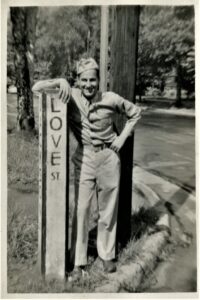
Thomasville History Center Collection: Unidentified Soldier standing by sign on corner of Love and Jackson Streets, 1944.
Love is in the air and on the shelves this time of year, making it a good time to talk about love in Thomasville. Not the gushy community love or loving our neighbors, but love with a capital L. The Love that can be found on Love Street in the Tockwotten Neighborhood. How did this street get its name? Was it Victorian sentimentality? Or is there more to the story? Let’s find out!
Look at a map of Thomasville and you will see that Love Street runs for about four blocks in town, from Washington Street to Remington Avenue. It’s a residential street lined with dozens of vernacular Victorian houses of all different shapes, colors, and sizes. But what’s Love got to do with it? To answer that question, we have to get to know the neighborhood.
In the History Center’s map collection, we have a series of maps put together by the late Judge Roy M. Lilly Jr. who researched the various city limits of Thomasville over the last 200 years. In 1857, the city limits expanded to cover the area we now know as Love Street. This was huge growth for Thomasville as the former city limits had not included this area nor a nearby town known as Fletcherville. So why were they adding this land to the city limits? The area only covers a neighborhood today, so why was it not part of the original limits? We have a clue to this question hiding in our maps.
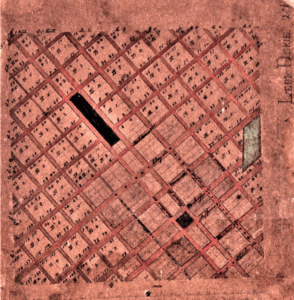
Thomasville History Center Collections: Map of Thomasville by Lebb Dekle, 1857.
Lebb Dekle, a well-to-do merchant, politician, and overall man-about-town, made his own map of Thomasville in this time period. It barely covers the area that would become Love Street. In fact, that space on his map is demarcated with a giant blue trapezoid. But if you look very closely you can see that the space reads “Tan Yard.” Tanning yards were work spaces for tanners or people who turn animal hides into leather. It’s a smelly business as you might imagine so tanning yards were often on the outskirts of town – just close enough for the workers to walk there from home and into town but not close enough to make people complain about the smell. From this we can gather that the tanning yard was on the move around 1857, opening up the land for citizens to build a residential community.
But where does the name “Love” come into this tanning yard-turned neighborhood? For that answer, we need to look into the homes dotting the street. Take a walk down Love Street and you’ll notice those Victorian houses mentioned previously. One of those houses bears a wooden plaque marking it as the P. E. Love House. But who was P. E. Love, and what did he do to have a street named after him?
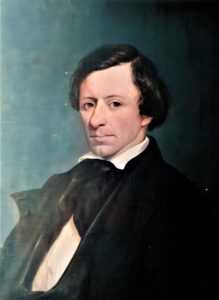
Thomasville History Center Collection: Colorized copy of Portrait of Peter Early Love, 1850.
Peter Early Love was born in 1818 in the town of Dublin, Georgia, about three hours northeast of Thomasville. His parents died when he was still a young boy so his older sister and her husband raised him. When Peter was old enough, he attended Franklin College, now known as the University of Georgia. After graduating, he traveled north to study medicine at the University of Pennsylvania, which was the place for Southern students to learn medicine at the time. He quickly realized his heart was not in medicine and decided to take up law instead.
In 1839, Peter returned to middle Georgia and began his study of law alongside several future Thomasville lawyers. Peter and the young lawyers descended upon the still fairly new town of Thomasville and set up shop. As Peter rose through the ranks, he became a delegate in the electoral college during the presidential election of 1840. His vote helped elect William Henry Harrison as the nation’s 9th president (before he died of pneumonia one month into his term). A few years later, Peter was made Solicitor General of the Southern Circuit, meaning he rode all over Southwest Georgia trying cases for the State. This also meant he spent a lot of time away from home – but that didn’t stop him from putting down roots in Thomasville.
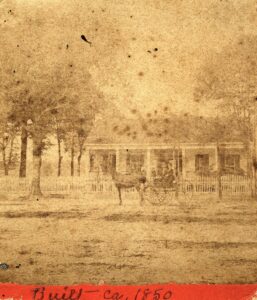
Thomasville History Center Collection: Love House on South 141 Love Street, 1875.
Back on the farm, Peter was setting up a home with his wife and four children. He bought a large tract of land in what is now known as the Love-Tockwotten neighborhood. Peter began dividing up the land soon after and selling it to his many friends including the Hansell family and the Remington family. He kept just enough land for himself and built a simple wood-frame dwelling around the year 1850. He called his house “Love Mansion.” Work on the house finished just in time for Peter to leave Thomasville to act as a Georgia Senator in Milledgeville.
After his term as a senator, Peter was made Judge of the Southern Circuit, replacing his friend Augustin H. Hansell. On top of that, Peter started his own local newspaper: The Wiregrass Reporter ran for several years before the start of the Civil War. He was also made captain of the Thomasville Guards, a local militia group, and helped lead the formation of Young’s Female College in town. When he grew restless for the next big adventure, Peter became a member of the United States House of Representatives.
This was a short-lived trip. Peter was elected just as the Civil War was breaking out. He was pro-secession, so when Georgia and many other states left the Union, Peter and his fellow Southern congressmen packed up their bags as well. He returned home to Thomasville, but not quietly.
Peter returned to his post as captain of the Thomasville Guards. In the years before the War, the Guards mainly spent time doing drills and participating in parades and social events. Despite being a militia, the Guards were more of a social club for the young men of Thomasville. Even Peter admitted the “Light Infantry is a company of boys, as brave, as enthusiastic as any, but still most of them are boys… They would ostracize me if they only knew that I had doubted for a moment their perfect equality with all other companies…” Despite his feelings, the Guards were sent to fight in the Civil War – this time, without Peter as their captain.
Peter stayed behind to serve in the Georgia State Legislature, now one of eleven states making up the Confederate States of America. Not long after, he was made mayor of Thomasville.
The end of the Civil War brought Union troops to Thomasville as part of President Andrew Johnson’s plans for Reconstruction. Ever true to his personal beliefs and staunch support of secession, Peter resigned from his post as mayor. Having burned the candle at both ends all his life, Peter died on November 8, 1866 at the age of 48. He was buried in his family’s plot at the City Cemetery, only a few blocks away from the courthouse he spent so much time in.
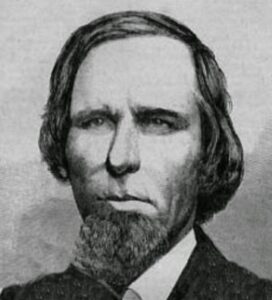
Public Domain: Peter Early Love, 1860.
As for the street, it earned its official name around the 1870s. The earliest mention of the street by that name shows up in a newspaper article from 1875. That was one of the first years the town of Thomasville held Independence Day celebrations following the Civil War. The Thomasville Guards marched from Broad Street down to the Love Mansion on Love Street where attendees gave speeches and read the Declaration of Independence, a fitting tribute to the man who gave his name for this street.
What must it have been like to live in Thomasville at the brink of the Civil War? Here at the History Center we have the transcript of a diary written by a young, seventeen-year-old woman over the year of 1861. This diary not only gives us insight into this question but also paints a vivid picture of life in South Georgia and how it was about to drastically change. Follow along as we explore the world from Henrietta Armstrong’s point of view in this blog series!
Our last visit with Henrietta concluded with the last entry in her diary. After some excitement in the autumn, her schedule quickly became too encumbered for her to keep up with her daily writing. We do not have any other journals or writings from her in our collection. So, what happened next? We do know a few things about her life after 1861 and the fate of her loved ones as they made their way through the American Civil War thanks to some hints from Henrietta.
While her entries stopped in December of 1861, Henrietta did come back after the end of the War to write an epilogue, located in the back of her diary, indicating that she likely did not keep another journal throughout the War but felt the need to record this important message for future readers. Her words are straightforward but give us a glimpse into her personal feelings:
“Lieut. Aeneas Armstrong was drowned in the James River, below Richmond, January 26, 1865. He was kind, gentle, amiable, and brave; Noble in his deeds; just to all.”
A shocking end to our heroine’s husband! And how did this happen? The Richmond Examiner, a newspaper in Virginia, wrote a version of the story shortly after the incident that gives us the details.
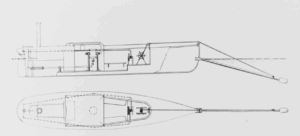
Design plans of the torpedo boat CSS Squib. This boat was similar to the CSS Hornet, the torpedo boat Aeneas was on when he drowned.
“The flag of truce steamer William Allison, on her return trip up the river on Thursday evening encountered the “Torpedo,” a small steamer commanded by Lieutenant Armstrong, of the navy, carrying a crew of seven men, and employed in the torpedo work of the river. The “Torpedo” attempted, in the darkness, to cross the bow of the Allison, and was cut in twain, the Torpedo sinking immediately, and leaving the commander and crew struggling in the chilly waves. The Allison was at once put about, and succeeded in picking up all of the crew, but Lieutenant Armstrong was drowned. His body was not recovered,” (The Richmond Examiner, January 28, 1865).
It gets worse:
“The Torpedo is a total loss. We learn through an officer who was on board the Allison, that the collision occurred at a point between Drewry’s Bluff and Chaffin’s Farm, in the dusk of the evening. When the engineer of the “Torpedo” observed the approach of the other steamer, he reversed his engine, which made three reverse revolutions, when the Allison struck her, and being a light, frail vessel, with one gun, she broke in two, and as the parts went down all on board sprang into the water.
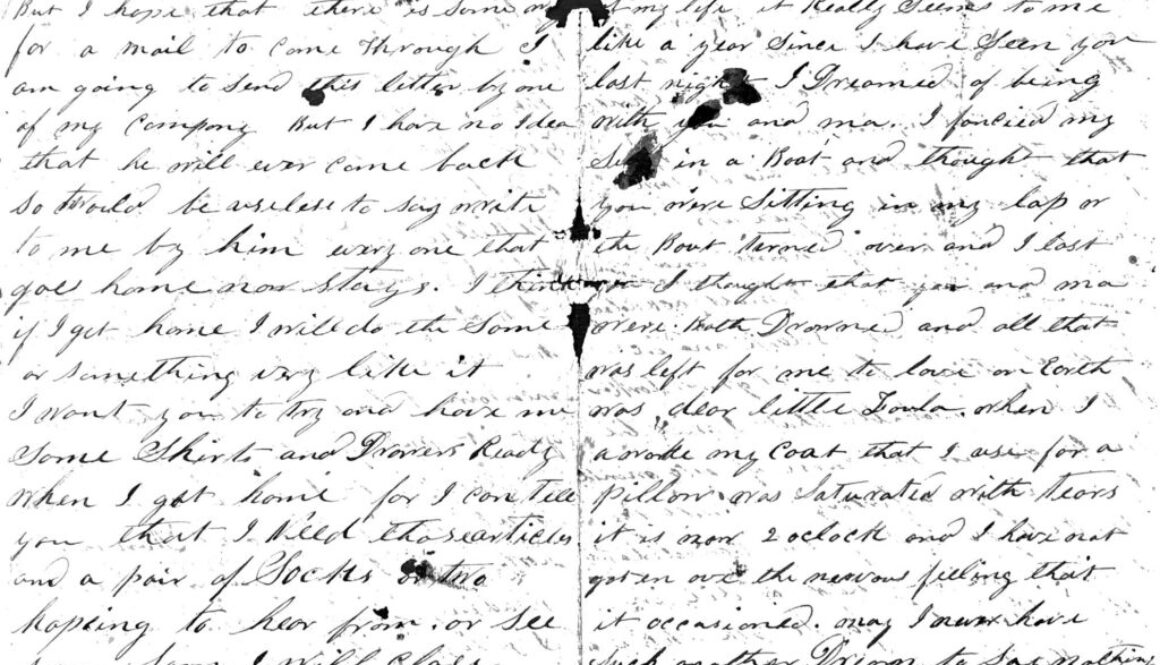
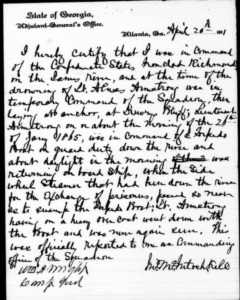
Letter of Support from John McIntosh, April 20, 1907. The letter recalls Aeneas’s drowning and mentions the “heavy overcoat” he was wearing that led to his death.
Lieutenant Armstrong grasped one of the crew and was supporting himself, when the seaman exclaimed, “Lieutenant let go; you’ll drown us both.” The self-sacrificing lieutenant replied, “Man, I’ll not drown you,” and let go his hold. The seaman was rescued and Lieutenant Armstrong floated off a short distance. They shouted to him from the Allison to hold on, and the reply faintly came, “Make haste; I’m benumbed.” The boat was within fifteen feet of him when he went down the first time, but coming up again, he said, “It is no use; I’m gone,” and disappeared.”
Remember from our earlier entries, Aeneas was not a well man. He began the War still suffering from the effects of what was likely Malaria. And being January in Virginia, it was likely a rather cold day leading to an even colder night and frigid waters. According to a witness, Aeneas was in “a heavy overcoat,” part of his full wool uniform which would have absorbed water like a sponge and weighed him down. With these factors in mind, it’s little wonder he didn’t survive the incident. As the newspaper reveals, his remains were never recovered from the site of the accident.
Henrietta never remarried after the loss of her husband. Looking at her note at the end of her diary, she may not have found anyone she thought was good enough. Like many Southerners following the War, the details surrounding Henrietta’s life get a little murky at this point. What became of the plantation and the people who lived there requires further research. However, by 1870, she had moved to Thomasville to live with her mother and half-brother, Albert. Their home was a one-story, wooden house located at 344 East Jackson Street – today the location of Bennett Real Estate.
Before we get too far into Henrietta’s life after the War, let’s see what happened to her brother, Buddie. When we left off in 1861, Buddie volunteered to join the Confederate Army. This was a short stint for Buddie. By 1864 he was back home working on his plantation and had paid a substitute to take his place in the fighting.
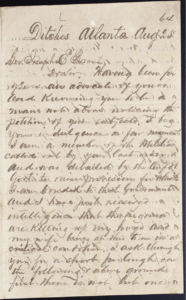
P. N. Vickers to Governor Brown, Sept. 1, 1864. U.S. Civil War Correspondence.
But his break did not last long! By August of that year, Buddie found himself in Atlanta, having been called up to join the State Militia by Governor Joseph Brown to defend the state against the Union Army. As part of Company C of the 12th Georgia Militia, Buddie served as a Corporal under the leadership of Thomasville resident, J.J. Ivey. Around this time, Buddie wrote to the Governor to ask for a short furlough that would allow him to return home to help out his wife who was in a “critical condition” (Annie may have been pregnant at this time, but if she was, the child did not survive – this may be the person named Matthew Vickers who is buried in the Ponder family plot at Laurel Hill Cemetery). Whether or not Buddie’s request was granted requires further research.
Despite his brief stints in the fighting and defense of the state during the War, Buddie came out mostly unscathed. He and his wife, Annie, went on to have another child, Charles Walter Vickers, and the family lived at their plantation until Buddie’s death in 1873 at the young age of 34. The cause of his death is currently unknown, but there was an outbreak of Yellow Fever in the area during this time. Annie brought her children to live with family in Thomasville after Buddie’s passing where she became a teacher.
This brings us back to Henrietta, who was also settling into life in Thomasville. Like Annie, and many other Southern women who found themselves displaced after the War, Henrietta needed a job to support herself and her family. Henrietta became a music teacher and took in young girls and women who were attending school in town. Young’s Female College was just a few blocks from the Vickers-Foster home on Jackson Street, placing them in prime territory for taking in student boarders. In 1907, Henrietta applied for a Widows Pension from the State of Georgia in payment for Aeneas’s services during the War. She received $1 a year.
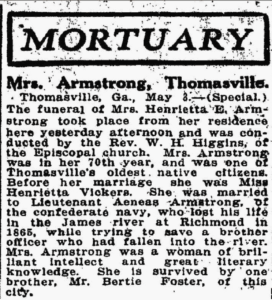
Henrietta’s obituary as it appeared in the Atlanta Constitution on May 4, 1912.
Henrietta spent the rest of her life in this way until her death on May 1, 1912 at the age of 68. She was buried in Laurel Hill Cemetery. She left any money and property she had left to her brother, Albert.
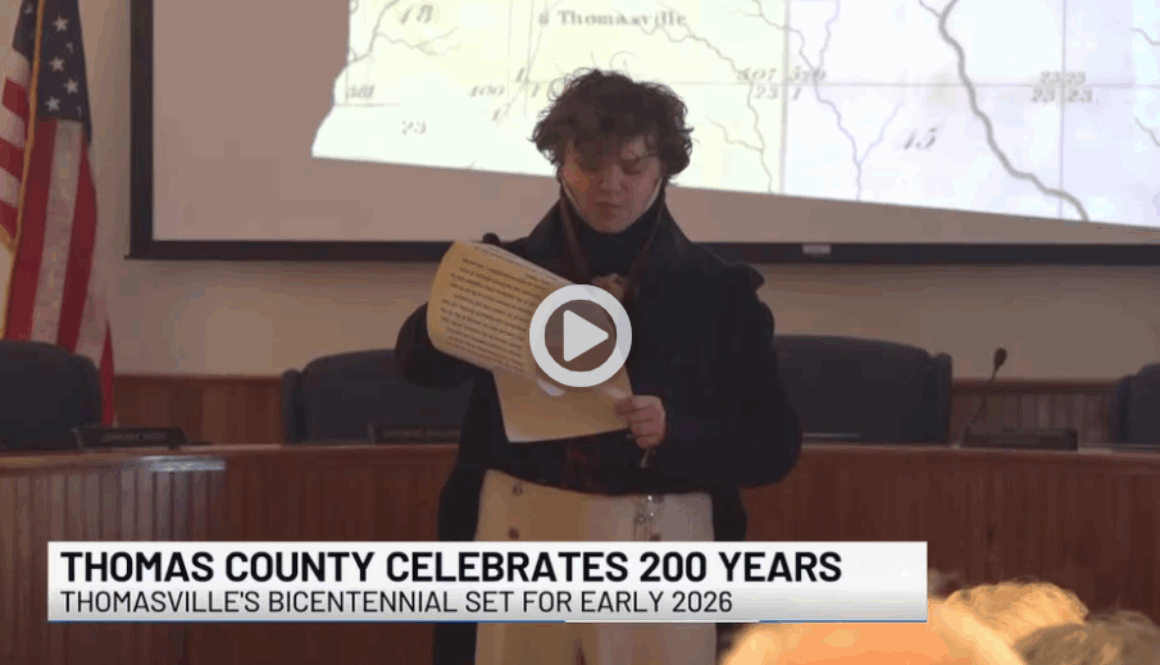
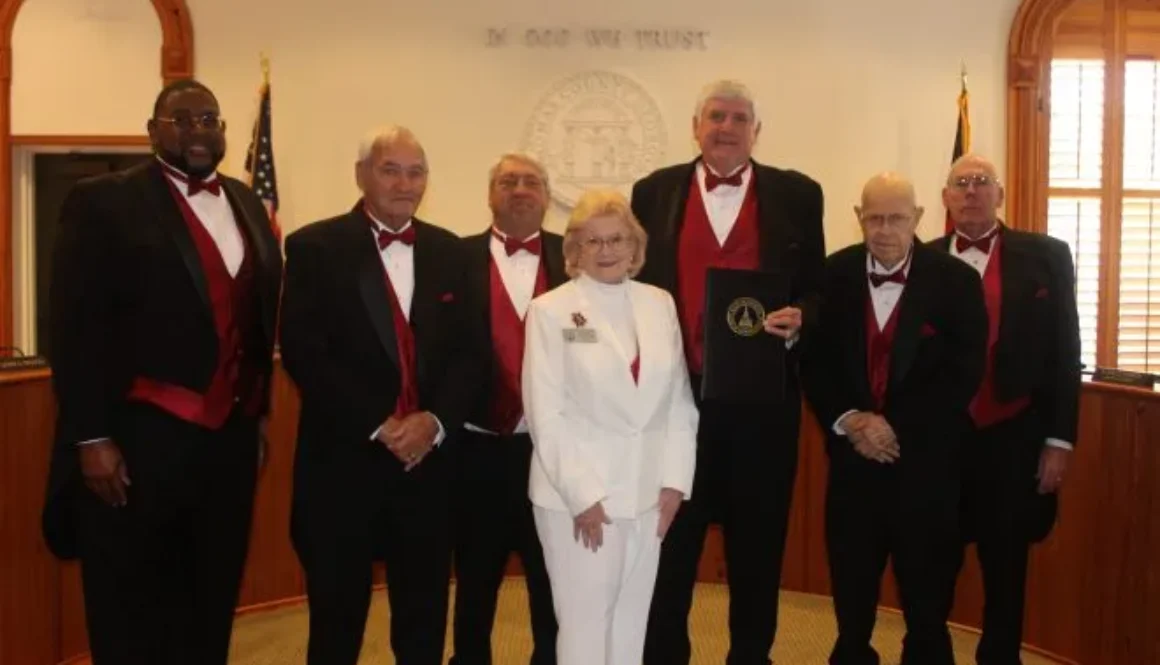
To mark 200 years of history, stewardship and service, the Thomas County Board of Commissioners held a Bicentennial Commemoration board meeting Tuesday. The special meeting included a reenactment of the proclamation reading in which Thomas County was formed on Dec. 23, 1825. The Thomasville History Center also presented a 30-minute historical video, giving the community a look at the county’s changes throughout the years. Read more here.
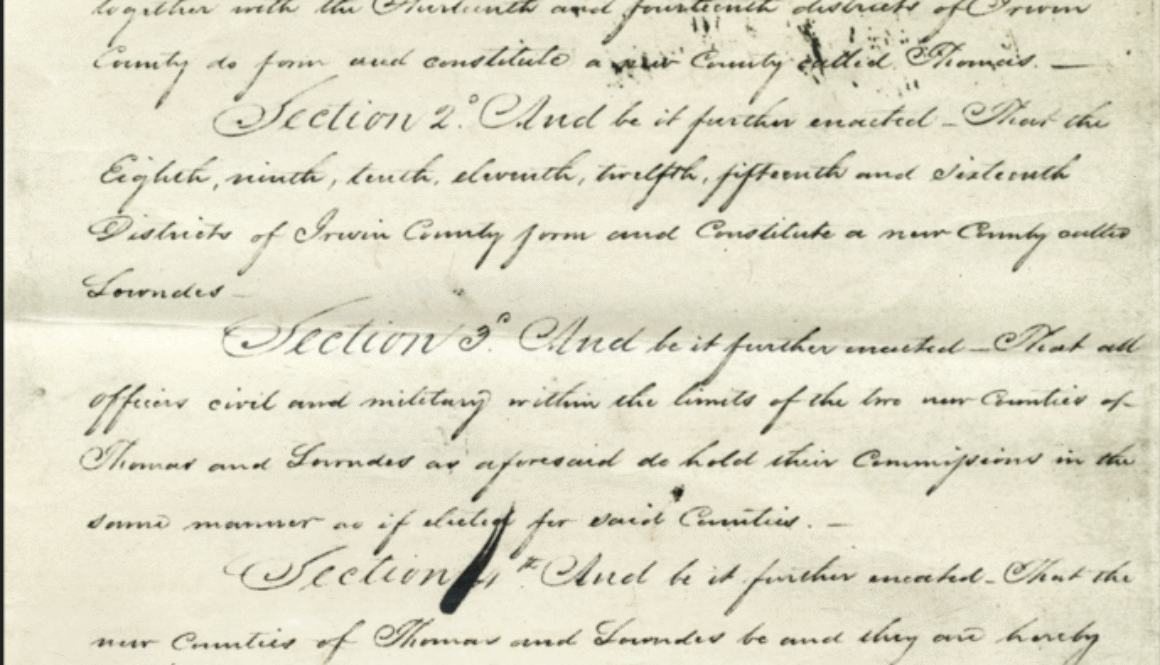
The Thomas County Board of Commissioners gathered on Tuesday, December 23, 2025, to mark 200 years of service, stewardship, and shared history. Donned in matching period attire, the Commissioners held a Commemorative Board meeting, where those in attendance heard a presentation of the Act of the General Assembly of December 23, 1825, to form two new counties from the preexisting counties of Irwin and Decatur. The Act established that the seventeenth and eighteenth districts in Decatur, along with portions of the twenty-third and nineteenth districts that lie on the east side of the Ohlockonee River, together with the thirteenth and fourteenth districts of Irwin County, would form a new county known as Thomas. Read more here.
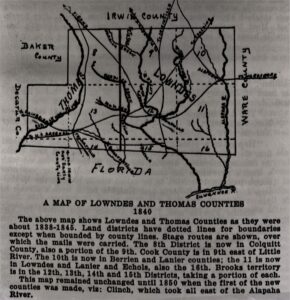
You might have heard that Thomas County turns 200 years old this year. This specifically happens on December 23, 2025, the day when, 200 years ago, the Georgia House of Representatives passed an act which created two new counties: Lowndes County to our right and Thomas County, a much bigger county than what we know it as today. So, what was going on as this momentous occasion occurred? Who was there, and what were they up to? And what does it say about us 200 years later (and going)? Let’s take a look.
Southwest Georgia-Early, Irwin, and Appling County in 1818
The area that was soon to become Thomas County was carved out of Irwin County, founded in 1818 as part of the land ceded by the Muskogee people, and Decatur County which had only recently been carved out of Early County. Today, the Thomas and Irwin County are over eighty miles apart from one another, but in 1825 Irwin County stretched from its current location down to the state line and over to the west, encompassing a large swath of South Georgia. The county was divided into sixteen districts which were twenty-mile plots of land further divided in to 490-acre square lots. Districts 13 and 14 went into Thomas County. Decatur County reached from the Alabama-Georgia border in the west over to Irwin County and from the Florida-Georgia Border in the south up to its current northern border. Parts of districts 23 and 19 went into Thomas County.
Within these original counties, there were pockets of settlement, mostly in the northern part of Irwin County, with little developments trickling southward. Looking backwards in 1875, the newspapers in Thomasville suggested Thomas Hill Bryan was the first United States citizen to settle in what would become Thomas County back in 1819. We can’t be totally sure of that information, but he was definitely among the earliest of the new settlers. In the 1820 census, there were nearly 400 White citizens in Irwin County with 39 enslaved workers. The settlement of Glasgow first popped up around this time close to the Florida border near present-day Metcalfe. As you might guess from the name, the settlers were mostly of a Scottish background.
A Map of Lowndes and Thomas Counties in 1840
One of the early settlers we know of was Thomas Jefferson Johnson. His property in the southern part of Irwin County became the plantation we know today as Pebble Hill. Johnson was responsible for introducing the bill to create Thomas and Lowndes Counties. He was also responsible for naming the county, choosing to name it after his distant relative General Jett Thomas, a veteran of the War of 1812 and the architect behind the oldest buildings at the University of Georgia. Whether or not he chose this relative because they shared a name is up for debate.
Once Thomas County was officially recognized as its own county, the people of the area put forth a list of men to serve as commissioners: Duncan Ray, William J. Forson, Simon Hadley Sr., Michael Horn, and Thomas Hill Bryan. They decided to hold court in the middle of the new county at the home of Charles Kingsley. The Kingsley property covered Land Lot 54, or what would become part of the boundaries of Thomasville by the end of the 19th century. It was conveniently located next door to Land Lot 39, later owned by Thomas Jefferson Johnson who sold it to the County Commissioners in 1826 to form the new town of Thomasville.
With this event and two hundred years change, we end up in modern Thomas County. And you can help us mark such a momentous occasion by joining us on Victorian Christmas at the Historic Courthouse for a reading of our founding document. Alongside our hosts, the Thomas County Board of Commissioners, we’ll be bringing out artifacts from the past two hundred years of Thomas County’s history and making new memories as a community. We hope to see you there!
What must it have been like to live in Thomasville at the brink of the Civil War? Here at the History Center we have the transcript of a diary written by a young, seventeen-year-old woman over the year of 1861. This diary not only gives us insight into this question but also paints a vivid picture of life in South Georgia and how it was about to drastically change. Follow along as we explore the world from Henrietta Armstrong’s point of view in this blog series!
It’s been a while since we last checked in on Henrietta. When we last left off, she was suffering from the summer doldrums, but what will the next few months hold in store? A lot is happening around the world, and Henrietta may soon find herself appreciating those down times she once took for granted.
The first two weeks of August passed much like the previous weeks: everyone is still stuck at home, everyone is still sick, and the weather is awful in some form or another (this time it’s constant rain!). But thankfully for the family (and the reader), Aeneas proposed a trip to Thomasville! After riding in their own carriage from Smithville to Albany, the couple took “a miserable hack” or stagecoach on the final leg of the trip to Thomasville (Thursday, August 15, 1861). After arriving in town, they rented a carriage from Jim McLendon and rode to Buddie’s house just past the Florida border.
At this same time, things are heating up on the battlefields of the Civil War: Henrietta reports on a battle that has taken place in Leesburg, Virginia where the Federalists went into a retreat and lost three to four hundred men with fourteen hundred taken prisoner (Saturday, August 17, 1861). Keep in mind, Henrietta’s information is a little inflated. The fighting she refers to is the Battle of Ball’s Bluff where a little over two hundred Union troops were killed and over five hundred were captured – a still impressive figure considering the wild discrepancy in size between the Union and Confederate Armies at this time.
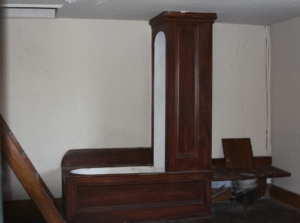
An original 1850s “shower bath” from Dunleith Historic Inn in Natchez, Mississippi – likely similar to what Buddie and Annie Vickers owned. Image curtesy of Natchez National Historical Park.
Over the next few days, Henrietta starts to have some fun again. Having been reunited with her sister-in-law, Annie, the two go out on the town (with Annie’s baby and an enslaved maid named Eliza in tow). Their activities include all the things gentlewomen could be expected to do: calling on friends, reading new books, strolling in the moonlight, and taking showers (Tuesday, August 20, 1861). Yes, the modern shower as we know it today is not quite so new in time as we tend to think. At this point in time, showers were not hooked up to plumbing, and instead used a reservoir of water that was recycled through the drain-to-shower head system. While they may seem primitive by our modern standards, they were high tech and novel for people in Henrietta’s time. As Henrietta did not have a shower at home (she likely used a tub as most people did) she wrote about her novel experiences taking showers several times (thrice in one week!) during her trip to Thomasville.
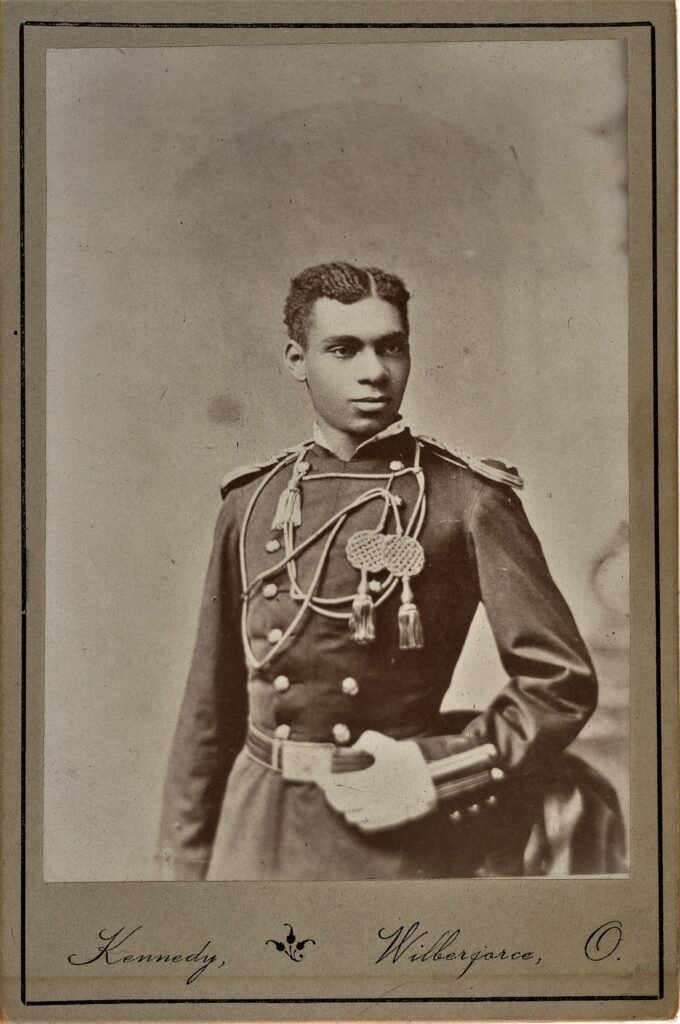
Backing up a bit, who were some of these friends that the ladies called on? Several families are mentioned like the Barkers and Aldermans. One individual included on their calls was Annie’s cousin, Ephraim Ponder. Henrietta gives us a few words on him, stating, “Mr. Ephraim Ponder is here and looks very badly,” (Wednesday, August 21, 1861). He had every reason to look badly. Ephraim Ponder may sound familiar as he is known today in Thomasville for being the enslaver of the Flipper family of Lieutenant Henry O. Flipper fame. While the Flipper family has gone down in the history books for Henry’s historic role as the first Black graduate of West Point, Ephraim’s reputation has not held up as well. Back in 1853, Ephraim married Ellen Gibson Gregory, a woman nearly twenty years his junior who was known for her beauty, spunk, and popularity. Unfortunately, she was a little too popular with other men for Ephraim’s taste and in a few months from Henrietta’s diary entry, he divorced her. Henry Flipper’s autobiography mentions her behavior:
Lt. Henry O. Flipper, 1880.
“The mistress of this fortunate household, far from discharging the duties and functions of her station, left them unnoticed and devoted her whole attention to illegitimate pleasures. The outraged husband appointed a guardian and returned broken hearted to the bosom of his own family,” (Henry Flipper, Black Frontiersman, 1963).
And this is where Henrietta finds him in August, having left his wife at their Atlanta plantation in hopes of finding comfort with his Thomasville family.
Other fun activities for the family included shopping, running a store for a friend who volunteered for the Confederate Army, more showers, and some hijinks:
“Buddie dressed up this afternoon in women’s clothes, put on a mask and frightened us a good deal.” (Friday, August 30, 1861).
But the fun and games were slowly winding down in the month of September. The first bit of panic arrived early in the month when Mrs. Barker came with news:
“I passed a very wretched night, I did not sleep any at all. Mrs. Barker came up about ten o’clock [the night before] and told us that Lincoln’s forces had landed at Fernandina and that they were fighting there and that every man that could shoulder a musket meet in Tallahassee at eight o’clock this morning. Aeneas and Buddie went down to T[allahassee] this morning and left by sunrise. They returned at nine tonight and informed that it was altogether a false alarm. I have been very unwell today.” (Friday, September 6, 1861).
Henrietta’s concerns for her husband and brother were allayed but not before setting the family off on a spell. Other rumors would circulate through town including accounts of the Confederates capturing Washington DC (not true) to British steamers breaking the blockade at Savannah (partly true).
To make matters worse, after several weeks of constant rain, a true storm came through the area. Most likely what we would consider a hurricane today, Henrietta described the aftermath in her diary:
“The wind commenced rising about eleven o’clock and about two it was a perfect gale. I could feel this house shake from its foundations. This morning was a perfect picture of desolation. The pailings were all blown down and the trees all over town. The wind has been blowing all day and I think it will be clear tomorrow,” (Friday, September 27, 1861).
Henrietta and her family were visiting friends in Thomasville when this storm came through. For those of us who have experienced the days after a hurricane, we can imagine what this scene might have looked like. And in a time before government sponsored clean-up crews, the work to restore the town following such a storm must have been massive, with most of it left to private citizens to organize and enslaved workers to perform.
By early October, Henrietta and Aeneas were staying with their Thomasville relatives, the Sewards. James Lindsey Seward (1813-1886), the head of the household, had an illustrious career in government, serving in the Georgia House of Representatives, the United States House of Representatives, and, at the time of Henrietta’s diary, the Georgia Senate. When the family was home in Thomasville, each member was highly involved in local events. Henrietta’s visit coincided with the family taking part in a tableau, a popular Victorian activity where participants dressed up in costumes and posed around scenery to create a living picture of famous stories.
“I have been busy all day helping Mattie [the Seward’s daughter] to get ready for the Tableaux tonight. She is to represent Florida in the ‘Secession of the States.’ I made her flag and trimmed it with a garland of flowers and also a wreath to go over her shoulder,” (Wednesday, October 2, 1861).
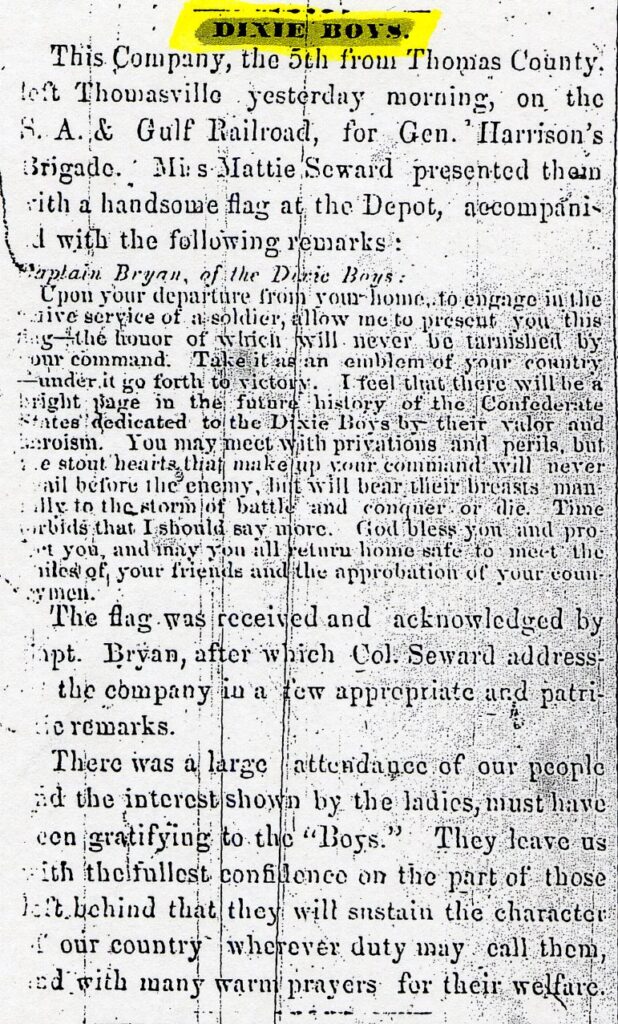
As public support for the War grew, Henrietta and her crew became even more involved. Mrs. Seward and Henrietta’s mother worked diligently to make pants and coats for the local volunteers. In the meantime, Henrietta helped Mrs. Seward sew and decorate a flag for Lucious Bryan’s unit, known as “The Dixie Boys.”
“I have painted the stars on the Blue Field of the flag this morning. Mrs. Seward sent the white stripes to Mr. Walcott to have an inscription on it. The company leaves Thursday morning and Mattie will present the flag to them at the depot,” (Friday, October 4, 1861).
“Dixie Boys,” Thomasville Times, October 9, 1861.
Mr. Walcott’s inscription read, “D.B. Victory or Death, August 10, 1861,” (Thomasville Times, February 26, 1893). Henrietta attended the flag presentation where Mattie made a “very neat little speech.” The Dixie Boys carried the flag throughout the war until 1864 when it was captured by Union forces at Vicksburg. Though later returned, it was in too fragile a state to be used and a replacement was made and used during the rest of the War. Currently, the original Dixie Boys flag is believed to be in private ownership. A similar flag belonging to the 29th Georgia Infantry is on display at the Thomasville History Center.
By mid-month, the Armstrong family returned home to Albany to find trouble at home. Once again their overseer was causing trouble and economic and trade challenges were making it difficult to supply their enslaved workforce with proper clothing.
“Everybody is looking gloomy, distressed, owing to the depresure [sic] in money matters. None can get credit; the cash must be paid,” (Friday, October 16, 1861).
With more work on her hands and the harvest season upon them, Henrietta soon had little time for keeping her journal. The entire months of November and December only received a few days coverage with Henrietta admitting, “My Journal is stopped for this year,” (Monday, November 25, 1861). Her last entry came on Monday, December 30, 1861 where she recorded the names of Confederate Generals as well as the President and Vice President.
While this may seem a rather disappointing end to Henrietta’s diary, worry not – there’s still a little more to come. Tune in next time for an epilogue where we answer several lingering questions: will Buddie and Aeneas survive the War unscathed? What will Henrietta’s life look like after the fall of the Confederacy? How did Thomasville change with the loss of so many young men on the battlefields? Find out next time!
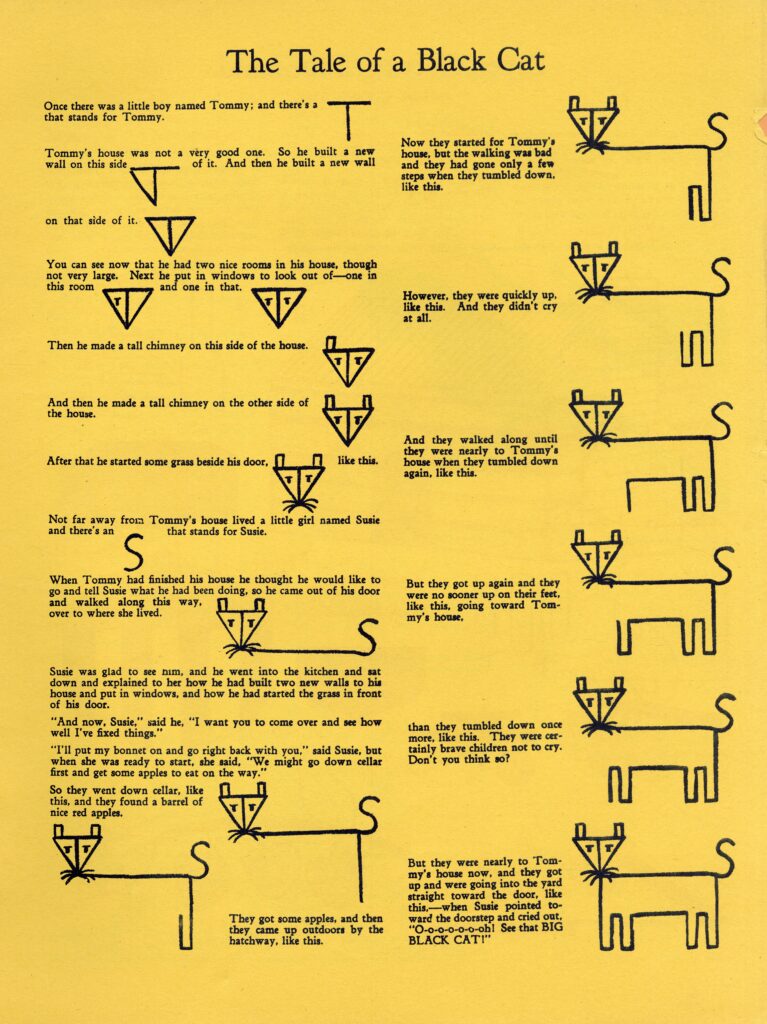
We’re kicking it old-school this week with some Halloween activities you can do at home! We’ve pulled some pages from a book in our collections entitled, My Activity Book: The How and Why Program Activity Unit for Mother, Teacher, Child, a workbook of games, activities, crafts, and lessons put together by educators from around the United States in 1945. Many parents and teachers used books like this one to entertain their children while also encouraging them to think creatively and practice rudimentary skills like handwriting and basic math. Did you grow up with workbooks like this one? Try out these activities at home with your youngin’s or the young-at-heart!
Our first lesson is in drawing. Using simple shapes like circles, you can add in detail to create something new from a spooky Jack-O-Lantern to a flying witch. What creepy Halloween critters can you come up with?
Ready for more of a challenge? Follow along for the misadventures of Tommy and Susie.
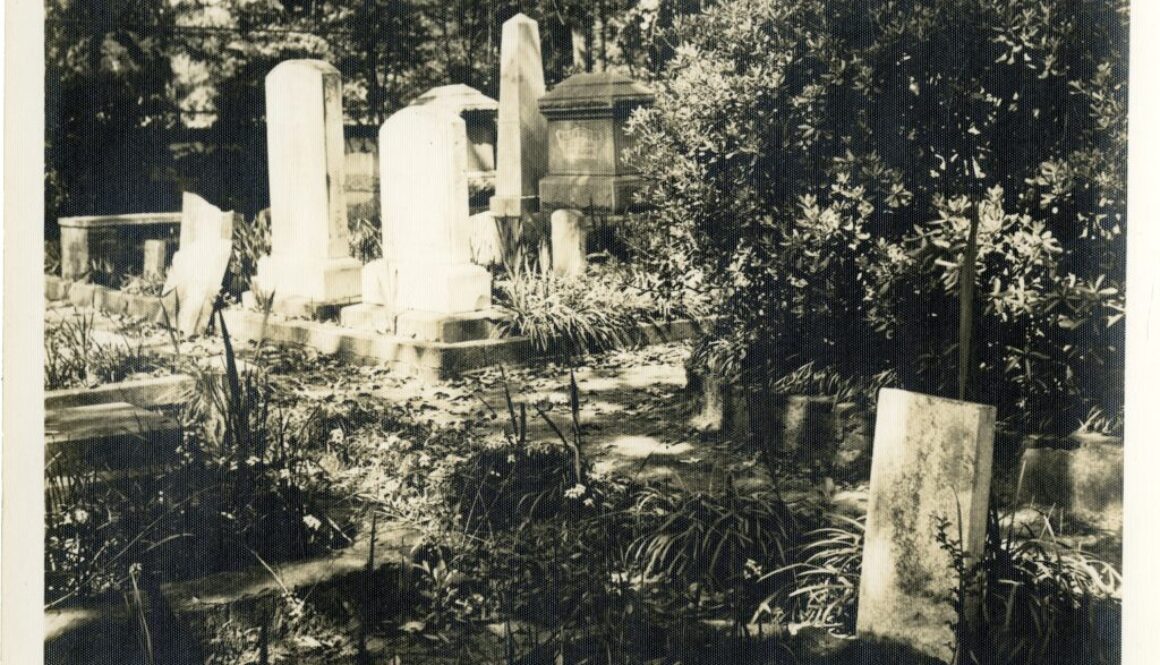
As we continue our spooky tales during the month of October, let’s travel to the Old City Cemetery to meet one of its unfortunate residents. This cemetery was the first public cemetery installed in Thomasville in 1858, almost 30 years after the establishment of the town. Prior to the establishment of the public burial grounds, most people were buried on their own or family property or they were buried in the graveyard of the church to which they belonged. As you might imagine, this practice became a problem as people moved around frequently, the town began to outgrow its original limits, and ideas about sanitation evolved.
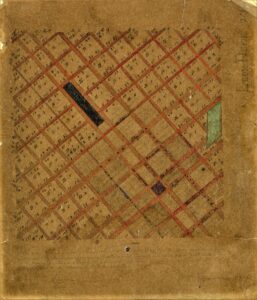
Dekle, Ansel, “Plat Map of Thomasville, Georgia,” 1857. Thomasville History Center Collections, 1978.010.1595 (Note that the black rectangle denotes the original boundaries of the City Cemetery).
The original cemetery grounds covered from one end of the current lot down to what is now known as the Flipper Cemetery. Early burials here include Revolutionary War Veterans, town founders, and even enslaved workers found among the families they served. After the Civil War, the long lot of land was split by the newly laid out Jerger Street. The second half of the land formed Old Magnolia Cemetery, now Flipper Cemetery, a public burial ground specifically for the Black citizens of Thomasville. Years later, a portion of the original City Cemetery was given to the American Legion on which their facilities were built. As with many cemeteries of this age, many graves are unmarked or “lost” though some records remain of who was buried here.
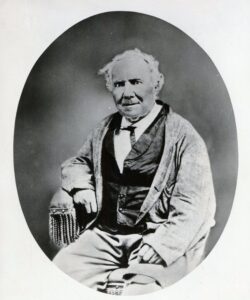
Edward Seixas Sr., 1860. Thomasville History Center Collections, 1978.010.1450.
But the grave I want to discuss today is still standing in the Seixas family plot. Edward Seixas was born in New York as the son of a Jewish immigrant who reportedly escaped from Haiti carrying only the family silver in a tablecloth. Edward converted to Christianity, married Huldah Smith — the daughter of a prominent Rhode Island merchant and sister to Simeon A. Smith who gave us Paradise Park — and moved to Thomasville. Edward started a pharmacy in town and became highly successful. Together, he and Huldah had three children and settled in what is now one of the oldest houses in Thomasville, the Seixas House located on Dawson Street.
While Edward is interesting in his own right, today I’d like to focus his only son, Edward Remington Seixas. Little Ed was born in Thomasville in 1839, the middle child between his two sisters. In the 1860 census, Ed was listed as working as a clerk, probably under his father at the family pharmacy. His family and community may have expected big things from Ed but any dreams for his future were tragically cut short in 1860.
Ed was a member of the Thomasville Guards, a local home guard organized to protect the town. One of his superiors was a man named Columbus Sidney Davis Johnson, a farmer and the town Marshall. Around the middle of September 1860, the two men got into an argument and challenged each other to a duel. If you’ve seen the highly acclaimed Broadway musical Hamilton, you might already know that dueling is illegal in the United State, even back then. But if your opponent is the Marshall then who is going to stop you?
The Southern Enterprise, Oct. 3, 1860.
The men met at an undisclosed location with their pistols and their seconds. In a matter of minutes the duel began and promptly ended. Ed’s shot hit Johnson in the thigh, wounding him slightly while Johnson’s shot hit Ed along the head. An article in the newspaper, The Southern Enterprise, from October 3, 1860 tells the story of what happened next.
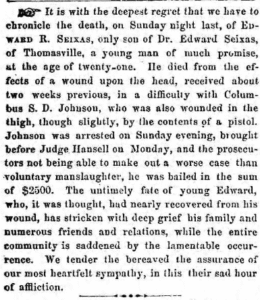
“It is with the deepest regret that we have to chronicle the death, on Sunday night last, of Edward R. Seixas, only son of Dr. Edward Seixas, of Thomasville, a young man of much promise, at the age of twenty-one. He died from the effects of a wound upon the head, received about two weeks previous, in a difficulty with Columbus S.D. Johnson, who was also wounded in the thigh, though slightly, by the contents of a pistol. Johnson was arrested on Sunday evening, brought before Judge Hansell on Monday, and the prosecutors not being able to make out a worse case than voluntary manslaughter, he was bailed in the sum of $2500. The untimely fate of young Edward, who, it was thought, had nearly recovered from his wound, has stricken with deep grief his family and numerous friends and relations, while the entire community is saddened by the lamentable occurrence. We tender the bereaved the assurance of our most heartfelt sympathy, in this their sad hour of affliction.”
Many people in town sided with the Seixas family, including a few of his fellow Guards who memorialized Ed in the newspaper. Johnson was allowed to leave town and moved to Liberty County in Florida, bringing his family out with him in the following years. The Seixas family quietly buried their only son at the City Cemetery before joining him there many years later.
Spooky season is soon approaching and the aisles of Walmart are lined with candy, costumes, and decorations for Halloween. Likewise, we’ll soon be gearing up for our Halloween offerings here at the History Center: from our cemetery tours to our trick-or-treat night in the historic backyard. If you can’t wait for tour season to start, why not use our handy guide for understanding the artwork carved into these mournful monuments while strolling through one of Thomas County’s many historic cemeteries? Take a look at these common images found on gravestones – we even made a bingo card for you and your spooky friends to play!
For the people of the 19th century, cemeteries were not just a burial ground. In densely packed cities and factory towns, they became an opportunity for green space where people could get out into fresh air. Re-envisioned as park spaces, people with the financial resources began decorating the graves of their loved ones with richly carved stones. Symbolic images told stories about the family’s feelings toward their departed loved one that words could not convey.
For our cemetery tours, we’ve compiled a list of common symbols or imagery found on stone grave markers and the meaning behind the carvings. How many of these have you seen while in a cemetery or graveyard?
Obelisk = faith, hope, and the strength to overcome adversity; immortality, eternal
Shells = religious pilgrimage and protection, and representing journeys to the afterlife or spiritual journeys through life; historically, shells were used practically in the American South to protect grave mounds from erosion, mimicking roofing shingles
Anchor = hope, steadfastness, and security; the anchoring influence of Christ
Florals arrangements = to add beauty, uniqueness, and a sense of individuality to the memorial, making it feel less standard; some flowers, like lilies, have their own symbolic meaning
Cross = faith in Jesus Christ, hope for eternal life, and the resurrection of the dead
Weeping Willow = profound grief and sorrow; rebirth, resurrection, immortality, and the enduring cycle of life
Square and compass = the Freemason’s symbol for the balance between moral uprightness and spiritual boundaries; denotes membership in the organization
Vines = eternity, growth, and the cyclical nature of life; ivy for eternal life; grapes for being a follower of Jesus; rose for love
Urn = the body as a vessel that once held the soul; mourning or a transition to the afterlife
Shroud or scarf = a veil separating the earthly realm from the spiritual
Broken column = a life cut short, representing that the person died young or in their prime, before reaching old age; the loss of the head of the family or a pillar of the community
Lamb = innocence, purity, and youth; frequently found on the graves of children and infants; Lamb of God referring to Jesus Christ and His sacrifice to take away the world’s sins
Tree stump or stack of logs = Jagged, rough breaks signify a sudden or unexpected end to a life; also used by members of the Woodmen of the World, an insurance organization
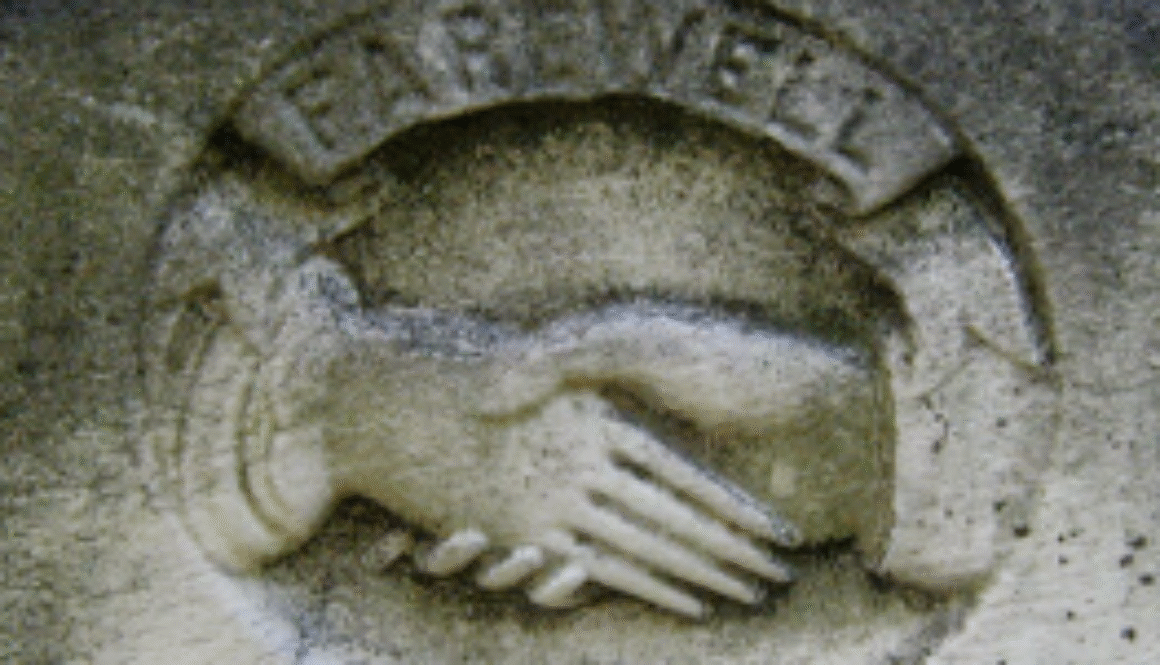
Clasped Hands = love, farewell, and the hope of rejoining in the afterlife; often representing a couple’s bond, a final goodbye, or a divine welcome into heaven
Hand pointing up = represents the deceased’s soul going to heaven, signifying the hope of an afterlife for the righteous and confirmation of a life after death


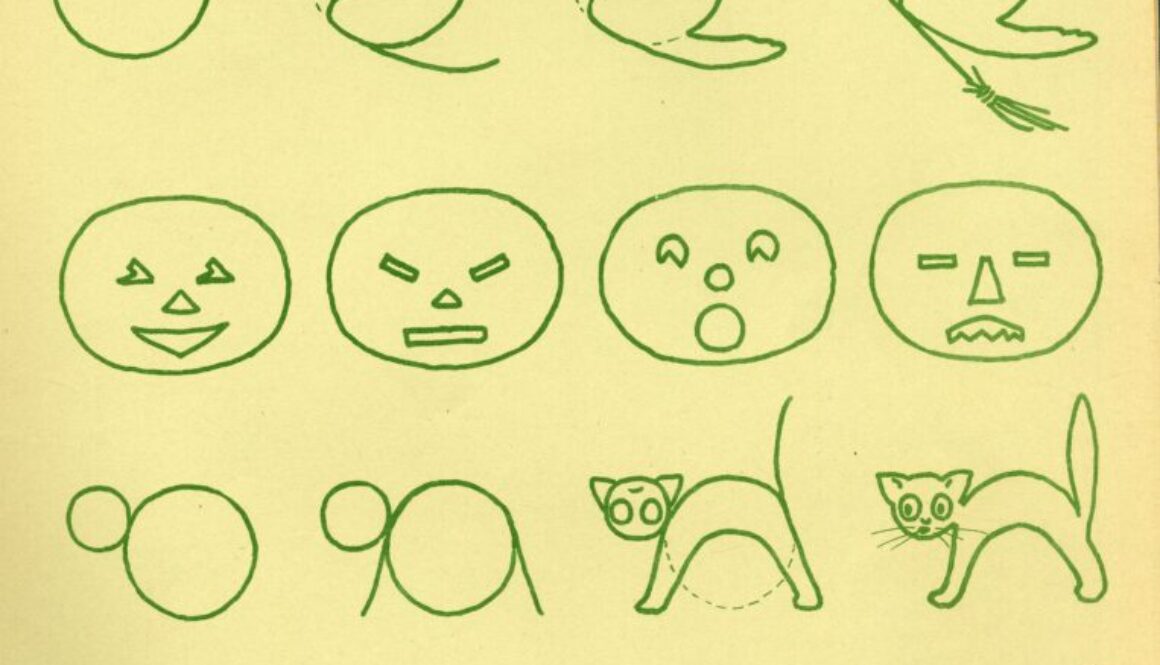
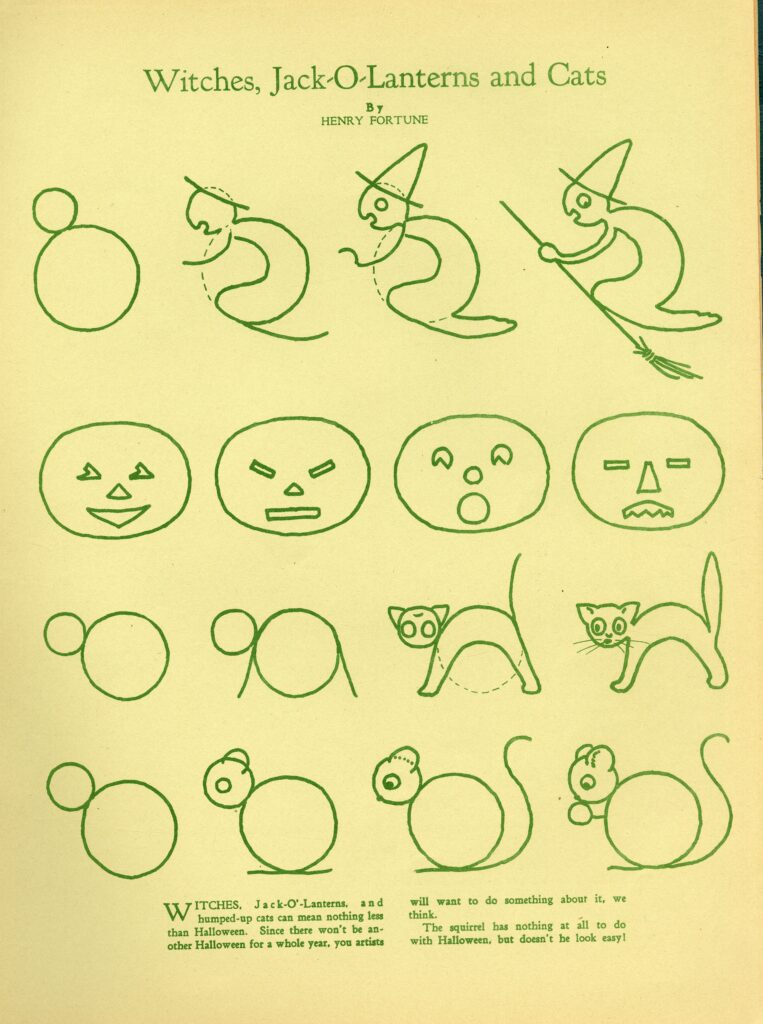 Our first lesson is in drawing. Using simple shapes like circles, you can add in detail to create something new from a spooky Jack-O-Lantern to a flying witch. What creepy Halloween critters can you come up with?