What must it have been like to live in Thomasville at the brink of the Civil War? Here at the History Center we have the transcript of a diary written by a young, seventeen-year-old woman over the year of 1861. This diary not only gives us insight into this question but also paints a vivid picture of life in South Georgia and how it was about to drastically change. Follow along as we explore the world from Henrietta Armstrong’s point of view in this blog series!
Our last visit with Henrietta concluded with the last entry in her diary. After some excitement in the autumn, her schedule quickly became too encumbered for her to keep up with her daily writing. We do not have any other journals or writings from her in our collection. So, what happened next? We do know a few things about her life after 1861 and the fate of her loved ones as they made their way through the American Civil War thanks to some hints from Henrietta.
While her entries stopped in December of 1861, Henrietta did come back after the end of the War to write an epilogue, located in the back of her diary, indicating that she likely did not keep another journal throughout the War but felt the need to record this important message for future readers. Her words are straightforward but give us a glimpse into her personal feelings:
“Lieut. Aeneas Armstrong was drowned in the James River, below Richmond, January 26, 1865. He was kind, gentle, amiable, and brave; Noble in his deeds; just to all.”
A shocking end to our heroine’s husband! And how did this happen? The Richmond Examiner, a newspaper in Virginia, wrote a version of the story shortly after the incident that gives us the details.
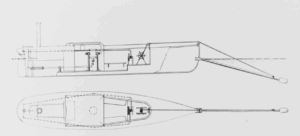
Design plans of the torpedo boat CSS Squib. This boat was similar to the CSS Hornet, the torpedo boat Aeneas was on when he drowned.
“The flag of truce steamer William Allison, on her return trip up the river on Thursday evening encountered the “Torpedo,” a small steamer commanded by Lieutenant Armstrong, of the navy, carrying a crew of seven men, and employed in the torpedo work of the river. The “Torpedo” attempted, in the darkness, to cross the bow of the Allison, and was cut in twain, the Torpedo sinking immediately, and leaving the commander and crew struggling in the chilly waves. The Allison was at once put about, and succeeded in picking up all of the crew, but Lieutenant Armstrong was drowned. His body was not recovered,” (The Richmond Examiner, January 28, 1865).
It gets worse:
“The Torpedo is a total loss. We learn through an officer who was on board the Allison, that the collision occurred at a point between Drewry’s Bluff and Chaffin’s Farm, in the dusk of the evening. When the engineer of the “Torpedo” observed the approach of the other steamer, he reversed his engine, which made three reverse revolutions, when the Allison struck her, and being a light, frail vessel, with one gun, she broke in two, and as the parts went down all on board sprang into the water.
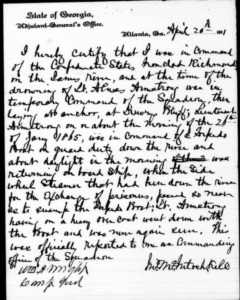
Letter of Support from John McIntosh, April 20, 1907. The letter recalls Aeneas’s drowning and mentions the “heavy overcoat” he was wearing that led to his death.
Lieutenant Armstrong grasped one of the crew and was supporting himself, when the seaman exclaimed, “Lieutenant let go; you’ll drown us both.” The self-sacrificing lieutenant replied, “Man, I’ll not drown you,” and let go his hold. The seaman was rescued and Lieutenant Armstrong floated off a short distance. They shouted to him from the Allison to hold on, and the reply faintly came, “Make haste; I’m benumbed.” The boat was within fifteen feet of him when he went down the first time, but coming up again, he said, “It is no use; I’m gone,” and disappeared.”
Remember from our earlier entries, Aeneas was not a well man. He began the War still suffering from the effects of what was likely Malaria. And being January in Virginia, it was likely a rather cold day leading to an even colder night and frigid waters. According to a witness, Aeneas was in “a heavy overcoat,” part of his full wool uniform which would have absorbed water like a sponge and weighed him down. With these factors in mind, it’s little wonder he didn’t survive the incident. As the newspaper reveals, his remains were never recovered from the site of the accident.
Henrietta never remarried after the loss of her husband. Looking at her note at the end of her diary, she may not have found anyone she thought was good enough. Like many Southerners following the War, the details surrounding Henrietta’s life get a little murky at this point. What became of the plantation and the people who lived there requires further research. However, by 1870, she had moved to Thomasville to live with her mother and half-brother, Albert. Their home was a one-story, wooden house located at 344 East Jackson Street – today the location of Bennett Real Estate.
Before we get too far into Henrietta’s life after the War, let’s see what happened to her brother, Buddie. When we left off in 1861, Buddie volunteered to join the Confederate Army. This was a short stint for Buddie. By 1864 he was back home working on his plantation and had paid a substitute to take his place in the fighting.
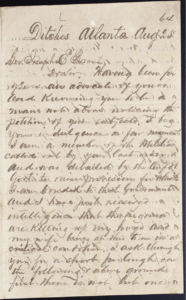
P. N. Vickers to Governor Brown, Sept. 1, 1864. U.S. Civil War Correspondence.
But his break did not last long! By August of that year, Buddie found himself in Atlanta, having been called up to join the State Militia by Governor Joseph Brown to defend the state against the Union Army. As part of Company C of the 12th Georgia Militia, Buddie served as a Corporal under the leadership of Thomasville resident, J.J. Ivey. Around this time, Buddie wrote to the Governor to ask for a short furlough that would allow him to return home to help out his wife who was in a “critical condition” (Annie may have been pregnant at this time, but if she was, the child did not survive – this may be the person named Matthew Vickers who is buried in the Ponder family plot at Laurel Hill Cemetery). Whether or not Buddie’s request was granted requires further research.
Despite his brief stints in the fighting and defense of the state during the War, Buddie came out mostly unscathed. He and his wife, Annie, went on to have another child, Charles Walter Vickers, and the family lived at their plantation until Buddie’s death in 1873 at the young age of 34. The cause of his death is currently unknown, but there was an outbreak of Yellow Fever in the area during this time. Annie brought her children to live with family in Thomasville after Buddie’s passing where she became a teacher.
This brings us back to Henrietta, who was also settling into life in Thomasville. Like Annie, and many other Southern women who found themselves displaced after the War, Henrietta needed a job to support herself and her family. Henrietta became a music teacher and took in young girls and women who were attending school in town. Young’s Female College was just a few blocks from the Vickers-Foster home on Jackson Street, placing them in prime territory for taking in student boarders. In 1907, Henrietta applied for a Widows Pension from the State of Georgia in payment for Aeneas’s services during the War. She received $1 a year.
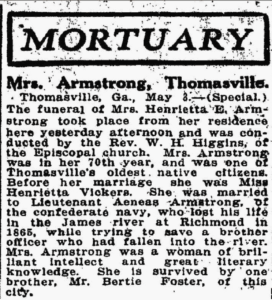
Henrietta’s obituary as it appeared in the Atlanta Constitution on May 4, 1912.
Henrietta spent the rest of her life in this way until her death on May 1, 1912 at the age of 68. She was buried in Laurel Hill Cemetery. She left any money and property she had left to her brother, Albert.