The Rev. C.I. Laroche: Faith & Flourishing In Thomasville
Tuesday, September 17 | St. Thomas Episcopal Church

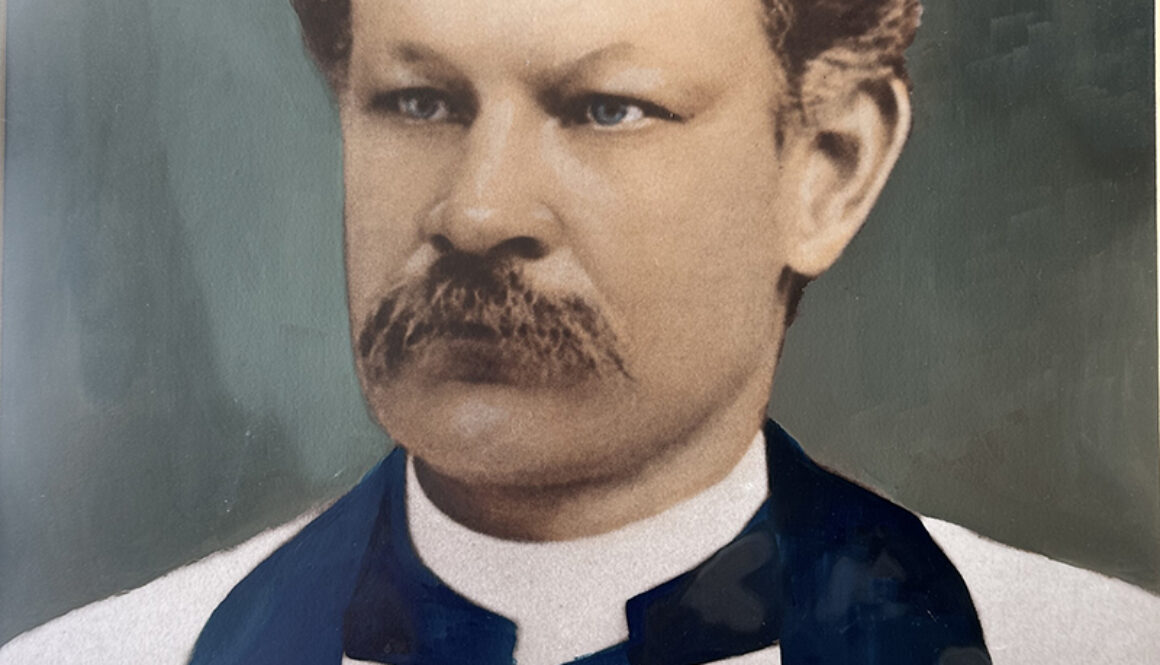
Tuesday, September 17 | St. Thomas Episcopal Church

Every so often, the museum receives a donation that includes a cookbook or recipe card. Sometimes the recipes are familiar comfort foods still served on many Thomas County tables. Others… well, let’s just say some recipes are best left in the past. This series highlights some of those recipes: from the classics to the experimental. If you try any of these recipes, successfully or not, let us know what you think in the comments!
Brunswick Stew by Mrs. Horace Alligood, January 1970
This recipe, like all the greats, was written on a piece of scratch paper by Myla Lee Miller Alligood (1914-2008). Myla Lee was one of six children born to John “Joe” Harris and Ona Mae Davis Miller of Meigs in Thomas County. After Myla Lee finished high school, she worked as a bookkeeper at an auto agency until she met and married Horace Columbus Alligood of Mitchell County, Georgia around 1942. The couple had three children whom they raised in Meigs. In her later years, Myla Lee moved to Atlanta where she lived until her death at the age of 93.
Myla Lee was 55 years old when she wrote down this recipe in the winter of 1970. If you’re considering using this recipe as part of a supper menu, she included pairing suggestions at the end of her instructions. Even after 54 years have passed, Brunswick Stew continues to be a classic recipe in our area.
Brunswick Stew:
1 3 to 4 lb hen (or 2 fryers)
1 qt. corn (whole grain)
1 pt. okra (1 pack)
2 medium onions
3 tbsp. butter
Salt and pepper to taste
1 qt. tomatoes (2 cans)
1 pt. butterbeans
½ tsp. Tabasco sauce
2 tsp. Worcestershire sauce
½ c. tomato catsup
Boil chicken until tender enough to leave bone. Pull meat off and cut into large cakes and return to water in which it was cooked. Add other ingredients and cook very slowly until mixture is thick; serve with rice, green salad and hot rolls.
Mrs. Horace Alligood Jan ‘70
Here at the History Center, we like to supply our collections department interns and volunteers with interesting projects that illustrate what life in Thomas County’s past was like for her citizens. We have many letters, records, diaries, and documents that give sneak peeks into the daily lives of people who were more like us than we may realize.
One of our interns, Kayla Reeves (who recently attained her bachelor’s degree in history from Florida State University), was tasked with transcribing a collection of letters from Private Peter Dekle (1836-1863) to his wife Susan Dunbar Dekle (1839-?) of Thomasville. Peter’s letters span from April of 1862 to August of 1863 when he served in the Confederate Army in Company F of the 29th Infantry. For most of his military service, Peter was stationed around Savannah but was later sent to North Carolina and Mississippi before he was wounded at the Battle of Chickamauga. After several months, he succumbed to his injuries; however, the whereabouts of Susan following her husband’s death are currently unknown.
Here’s what Kayla had to say about Peter and his letters to Susan:
“As a drafted soldier, Peter did not generally discuss ideological reasons behind the war in his letters, rarely mentioning secession or even regional animosity. However, Peter’s letters provide valuable insight into the experiences and mentality of an average soldier, demonstrating themes of homesickness, despair, adventure, and adjusting to the general monotony of camp life.”
In this blog series, Kayla explores some of these themes with excerpts from Peter’s letters. Please keep in mind that Peter was writing in the language and attitudes of his time which we now consider to be racist and prejudice.
Hardships of Camp Life
A large portion of Peter’s letters discuss his frustrations with the war and the hardships and monotony of camp life. From dealing with the daily grind to fighting the environment, there were many reasons for a soldier to feel despondent. For example, in one letter from July 25, 1862, Peter states,
“hate to see morning cum time. I rise in the morning the very same old thing over untill we go to bed, if I could only get ten or twelve days ever[y] three or four months it would not go so hard with me,” [1980.04.06].
Camp life was a 24/7 job with few opportunities to leave for home. Despite a seemingly grueling schedule, much of the day was spent waiting: waiting for drills, waiting for food, waiting for the next orders, waiting for the end of the day. The monotony was enough to make Peter desperate for time at home as evidenced further in the letter when he wrote,
I think they will send us off sum where before long up in the northern sates [states]. if they do I no [know] I will not go home as long as I stay in service unless[s] I were to get sum [some] of my limbs shot of [off]. then probily I may get of [off] to go home,” [1980.04.06].
While this statement may seem a bit dramatic, the probability of being seriously wounded or worse in battle was always high and a constant threat in the minds of soldiers. Fear of losing a limb or life in battle coupled with the long and boring days of camp life would make anyone yearn for the safety of home.
Adding insult to injury, Peter also had to deal with his new environment. While his encampment in Savannah was not too foreign of a location for this South Georgia man, he still suffered from being outside during the summer. On August 21, 1862, Peter wrote,
“when I am of [off] on duty four or five miles picketing, seting [sitting] on my post [?] the late hours of knight [night] and the sand flies and the mosquitoes are as thick as you ever saw bus [buzz] around the gum and raining as hard as you ever saw it and daring not to leave your post and half starved out at times,” [1980.04.06].
We can all relate to the misery of being swarmed by mosquitoes. On top of that, Peter did not have enough food as rations for Confederate soldiers were meager throughout the War.
All these factors made camp life miserable for Peter. He frequently wrote about his homesickness and his desire to see his wife and child, stating,
“I am in hop [hope] this reched [wretched] war cant last much longer but I am affraid it will last longer than I will. I have given out the idia of ever gettin of [off] as long as the war lastes but that do not hender us for not wanting to go home. you cannot experance [experience] my feelings when I think of you and home. no one could not have such feelings unless they were bound down like we are, nothing we see or here [hear] are no satisfaction to us. no injoyment [enjoyment] in camps. one thing over ever[y] day til I am perfectly disgusted,” [1980.04.06].
Peter describes the mentality of the soldiers in the camps, similarly to his own, stating,
“you cant imagine how a pore soldier wants to see home. home are the cry among them all the are [there are] nun [none] of us ever new [knew] what a good home wher [were] until we had to leave it. I thought we lived heard [hard] but we lived like fatning [fattening] hogs. I would rather be at home without any thing at all than to be here with thousands. I can think about the pleasure we have had together and I am far of [off] from you and cant help my self. it goes very heard [hard] with me, hearder [harder] than you can imagine, thought I will have to stand it the best I can whether I like it or not” [1980.04.12]
Peter seems remorseful for realizing too late how good his life at home had been. Like other volunteer soldiers, the thrill and adventure of war seem to have worn off and uncovered a grim and monotonous reality for Peter. In the end, he could only try to bare his situation out until the end.
Tickets | November 23 | 2pm

Thousands of neighbors gathered at the Thomas County Courthouse to witness the Olympic Torch passing through Thomasville in 1996. Beloved principal Mary Grubbs, who carried the torch, left a lasting legacy, remembered fondly by the community. Read more about this story from WTXL here.


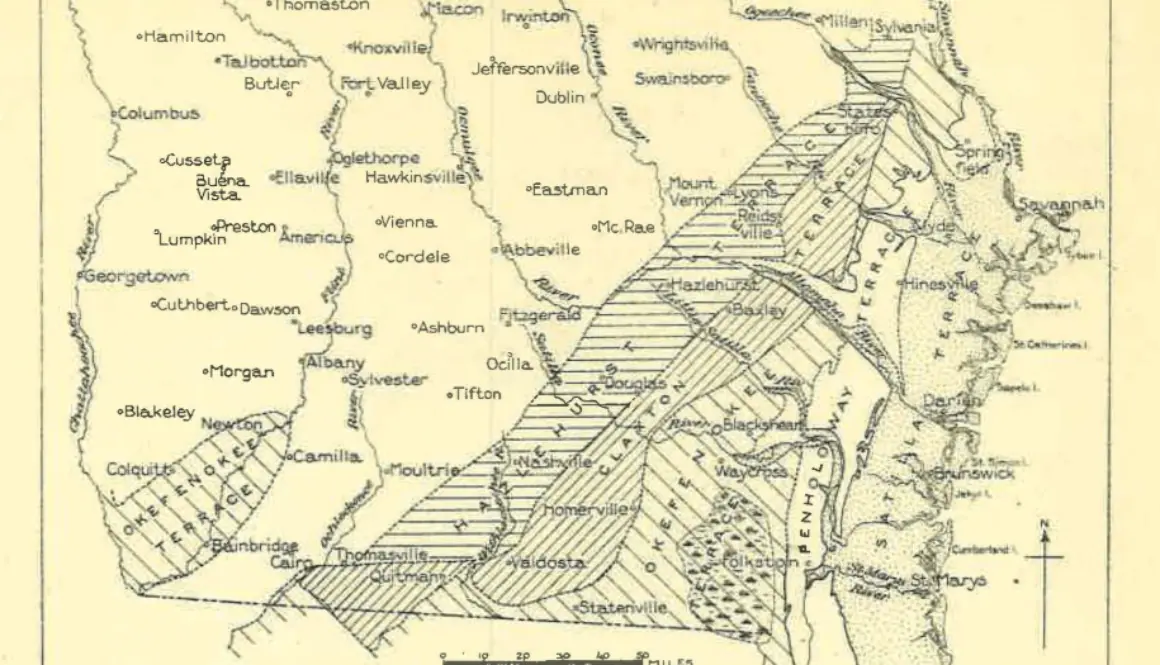
 Have you ever wanted to own beachfront property? Well, if you own land in Thomas County or the surrounding area, congratulations! You are the proud owner of beachfront property!
Or at least you would be if you had that property some 250 million years ago.
That was roughly the last time our area was underwater. Right around the transition from the Pliocene Epoch, a time 5.3 to 2.6 million years ago in which the climate was warmer and more tropical, to the Pleistocene Epoch, a time 2.58 million to 11,000 years ago also known as the “Ice Age,” our area was mostly submerged up to the Hazelhurst Terrace, an area that ran roughly from Cairo up to Sylvania, Georgia along the modern coastline. Slowly, the water began to recede as global temperatures dropped and water cooled into glaciers far north of our region. As this process went on, the receding water revealed islands, one of them located on what is now 319 along the state border. There’s a fun fact you can throw out the next time you pass the border on the way to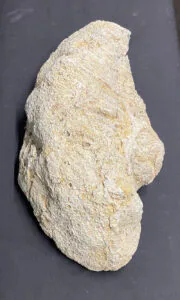 Tallahassee!
After a few more thousand or so years, the coastline receded to an area called the Okefenokee Terrace, revealing the land that would one day be known as Thomas County. It also revealed many of the rivers, lakes, and land formations of this area we’re familiar with today: the Ochloknee River, Lake Iamonia, Lake Lafayette, the basin of the Okefenokee Swamp, and the Cody Scarp, a terrace that is often used to mark the boundary of the Red Hills Region.
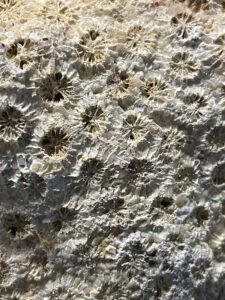
Here at the History Center, we have a memento from Thomas County’s underwater days. It measures to be roughly the length of a loaf of bread but tips the scales at a whopping eighteen pounds. This heaping hunk was found in Metcalfe, and if it isn’t impressive enough in its own right, it won first place in the fossil category at the 1991 Georgia State Fair. This sample of fossilized coral is called Solenastrea hyades or “Knobby Star Coral” for us laypeople. It dates to around the early Pleistocene Epoch, the last time this area was submerged under water.
If you would like to learn more about this specimen or view it in person, reach out to Meme at meme@thomascountyhistory.org.