
The Elizabeth Hopkins Collection Funded by the Georgia Historical Records Advisory Council
In 2024–2025, the Thomasville History Center completed a grant-funded archival processing project for the Elizabeth Hopkins Collection with support from the Georgia Historical Records Advisory Council (GHRAC) and the University of Georgia Libraries.
The project was completed by Kayla Reeves, a consultant archivist and (now) graduate student at the University of Georgia, who processed two previously under-described accessions of the collection. This work brought the entire Hopkins Collection under full intellectual control of the Thomasville History Center and significantly expanded public access.
The Elizabeth "Bessie" Hopkins Collection at the Thomasville History Center
About the Collection
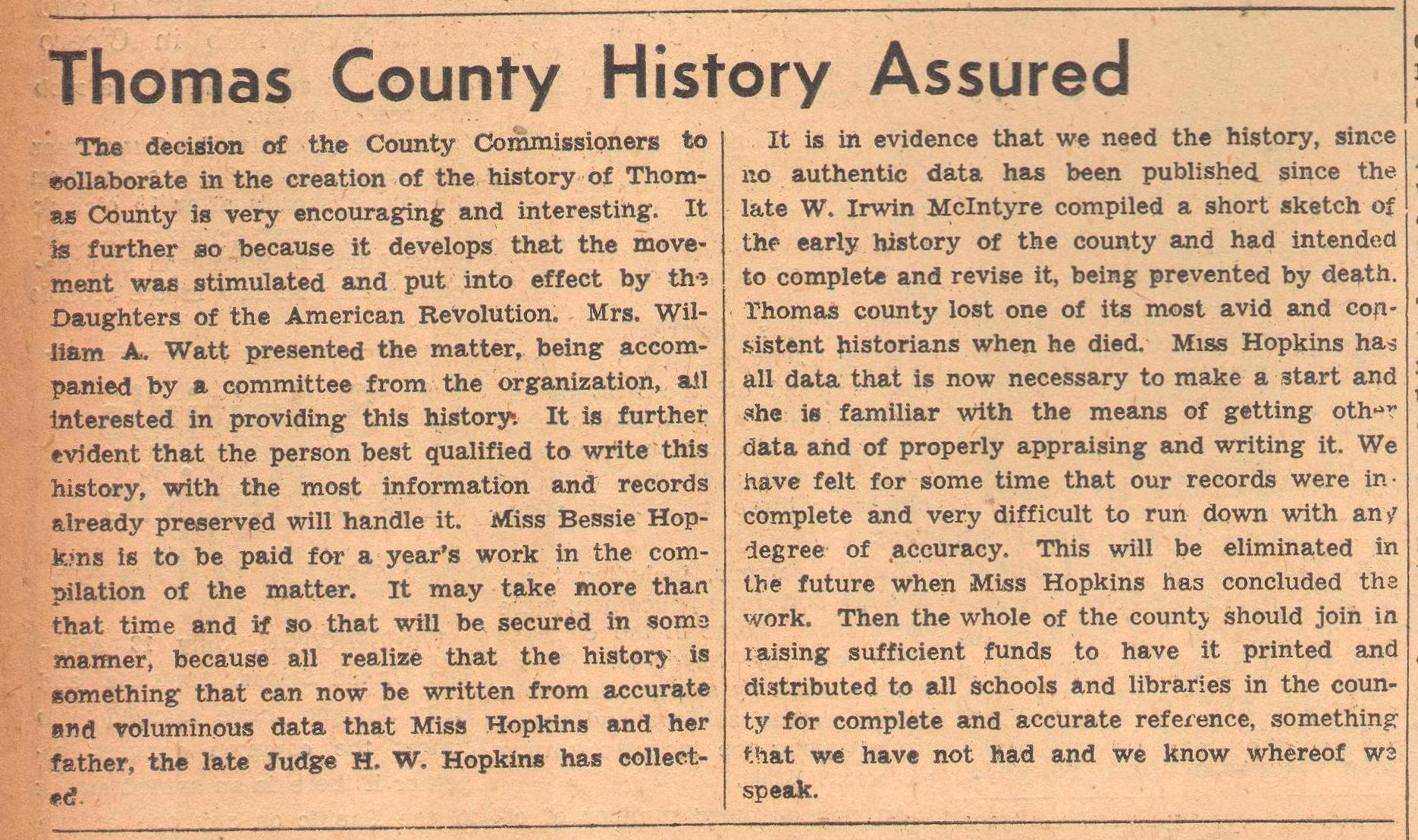
Elizabeth “Bessie” Hopkins (1872-1957) was a graduate of Bryn Mawr College who devoted much of her life to historical research, civic engagement, and philanthropy. Never married and supported by family resources, Hopkins traveled extensively and dedicated significant time to charitable, heritage, and lineage organizations.
She was an active member of the local chapters of the Daughters of the American Revolution, the United Daughters of the Confederacy, and the Colonial Dames of America. The Hopkins Collection includes several boxes of materials documenting her service and leadership within these organizations.
In 1952, with the support of the newly formed Thomas County Historical Society and financial assistance from the Thomas County government, Hopkins began research for a comprehensive history of Thomasville, Georgia. Although she did not complete the manuscript, her efforts resulted in the accumulation of a substantial body of primary source material, including correspondence written by Civil War soldiers to their families.
The Hopkins Collection has since served as a foundational research resource and was used extensively by historian William Rogers in the preparation of his four-volume History of Thomasville, Georgia, published with the support of the Thomasville County Historical Society (now the Thomasville History Center) and Florida State University.
Project Outcomes
As part of this project, Kayla Reeves carefully reviewed and organized thousands of documents and created detailed finding aids—guides that help researchers understand what is in the collection and where to find it. The collection is now organized into clear subject categories such as genealogy, military history, government, education, agriculture, business, race and gender, and more.
The finding aids are now available online in searchable PDF format, allowing students, genealogists, historians, and community members to explore the collection before visiting in person.
This work greatly expands public access to the Hopkins Collection and helps ensure that these important historical records are preserved and shared for generations to come.
Finding Aids
The finding aids below are organized by topic and provide detailed, searchable guides to the materials in this collection.
Click on each title to open a PDF finding aid, which outlines the contents and helps you identify materials of interest prior to an on-site research visit at the Thomasville History Center.
02 – Genealogy and Family Records
05 – Real Estate and Legal Records
For information about scheduling an on-site research visit: click here.
To search the finding aids as incorporated into our online PastPerfect collections database: click here.
Acknowledgments
Archival processing and description were completed by Kayla Reeves, consultant archivist, in 2025.
This project was made possible through funding from the Georgia Historical Records Advisory Council (GHRAC) in partnership with the University of Georgia Libraries, with additional support from the Thomasville History Center.